



Most Popular Use Cases of Java in Different Industries
Java
5 MIN READ
January 4, 2025

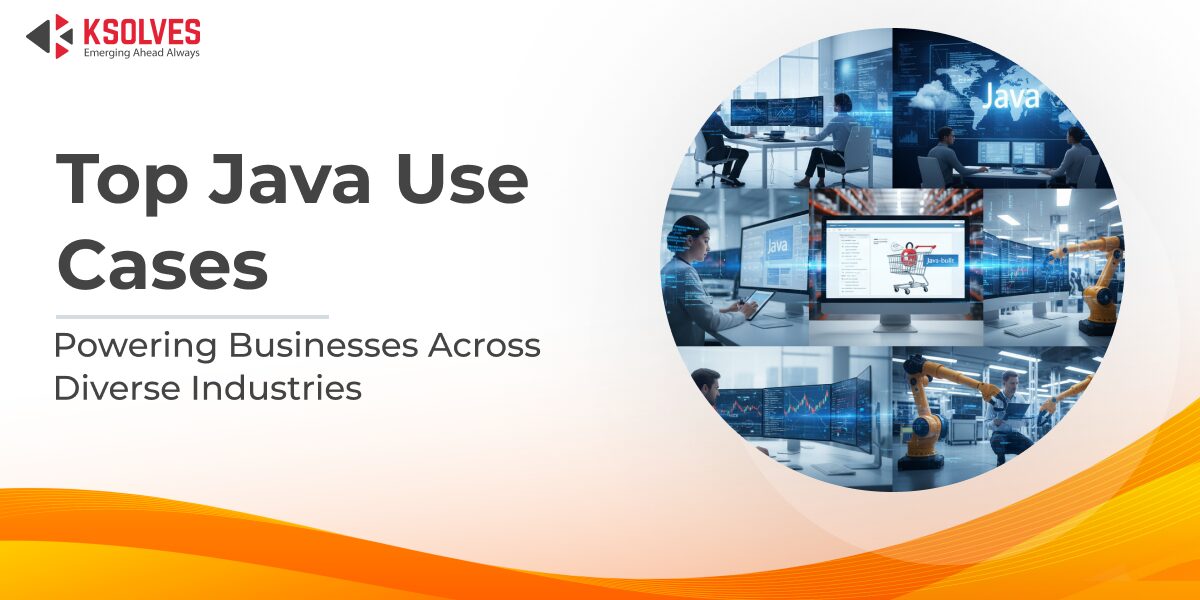
The programming language, Java, has been around for more than two decades and yet remains a dominant force in enterprise software, infrastructure, and industry-specific systems.
What accounts for this staying power? It is a combination of stability, a mature ecosystem, cross-platform portability (“write once, run anywhere”), a large talent base, and vast libraries and frameworks that support everything from web and mobile to embedded and cloud/edge.
As of 2025, Java continues to underpin large-scale mission-critical systems across manufacturing, finance, healthcare, logistics, and more.
In this blog, we explore the use cases of Java across different industries. We will also explore why it remains relevant and how organizations, especially in healthcare, medical tourism, and pharmaceutical supply-chain domains, can leverage this language to build robust systems and integrate processes.
Why Java Still Matters for Industry Applications
Before diving into the industries, it’s useful to highlight the core strengths of Java that make it a preferred choice for large-scale applications:
- Platform independence and portability: Java programs run on the Java Virtual Machine (JVM), enabling code to run on different operating systems with minimal changes.
- Robust ecosystem and libraries: There is an extensive ecosystem of frameworks (e.g., Spring, Jakarta EE), libraries, tools, and a large developer community.
- Enterprise-grade capabilities: Java supports multi-threading, concurrency, transaction management, integration with legacy systems, strong tooling for monitoring and maintenance – all of which are critical in enterprise scenarios.
- Large existing code bases & backward compatibility: Many organizations have decades of systems written in Java. The cost of migrating or rewriting is high, so Java remains a safe bet.
- Suitability for different deployment models: From on-premises to cloud to microservices, from embedded devices to mobile, Java adapts.
In a nutshell, for industries that demand reliability, integration, and long-term maintenance (such as healthcare and supply chains), Java remains a logical choice.
Java Use Cases Across Key Industries
Let’s explore why and how Java is used across diverse industries.
1. Financial Services / Banking / Fintech
Use Cases:
- Core banking systems (deposit/withdrawal processing, account management).
- Online banking platforms and payment gateways.
- Real-time trading platforms, risk/fraud detection systems.
- Regulatory/compliance reporting systems.
Why Java:
- Financial systems demand high reliability, concurrency, transaction integrity, and security. Java’s threading model, mature libraries, and long-standing presence in the banking domain fit well.
- Large institutions often have existing Java infrastructures; new modules integrate more easily in the same ecosystem.
- Performance and support for distributed, multi-node systems.
2. Healthcare / Life Sciences / Pharma
Use Cases:
- Electronic Health Records (EHR) systems, hospital information systems.
- Patient data management, appointment scheduling, and telemedicine platforms.
- Device integration, wearable/embedded monitoring, analytics for life sciences.
- Supply-chain tracking for pharmaceutical manufacturing and distribution.
Why Java:
- Healthcare demands strict security, data integrity and compliance (HIPAA, GDPR etc). Java’s mature ecosystem supports strong encryption libraries, audit/logging capabilities.
- Many healthcare systems are large, integrated, long-lifecycle; Java’s longstanding presence and maintainability make it ideal.
- Integration with legacy systems, devices, and multiple data sources – Java’s interoperability helps.
In medical tourism and pharma supply-chain operations, Java is particularly useful for building modular platforms that integrate logistics (patient travel, hospital scheduling), vendor/supplier data, regulatory compliance, and tracking of shipments/manufacturing.
For example, Java-based ERP or middleware systems can tie together patient-journey workflows and pharma manufacturing/distribution workflows.
3. E-Commerce & Retail
Use Cases:
- Online shopping platforms, order/inventory management.
- Payment processing, loyalty systems, customer-relationship systems.
- High-traffic web back-ends, catalog services, microservices for checkout, recommendation engines.
Why Java:
- E-commerce often faces large-scale traffic (surges during sales), and needs scalability. Java frameworks (Spring Boot, etc) support microservices and high-volume systems.
- Java’s maturity and ease of integration make it easier to build enterprise-grade back-ends.
4. Telecommunications & Network Services
Use Cases:
- Network management and billing systems, subscriber-data management.
- Real-time usage/monitoring systems, device connectivity services.
- Embedded systems for devices and gateways.
Why Java:
- Multi-threading and distributed nature of telecom systems suit Java’s concurrency model.
- Platform independence helps when systems must run on varied hardware/OS.
- Java’s ecosystem supports large-scale enterprise deployment, which telcos require.
In a pharma logistics context, connectivity among devices, monitoring of shipments, and IoT sensors for cold-chain might involve similar real-time data processing and integration. Java again makes sense for the backend infrastructure.
5. Manufacturing / Industrial Automation / Supply Chain
Use Cases:
- Manufacturing Execution Systems (MES), Product Lifecycle Management (PLM).
- Equipment monitoring, IoT sensors, logistics & supply-chain tracking.
- Warehouse management, inventory systems, and real-time dashboards.
Why Java:
- Given that these systems need to integrate with hardware/embedded systems and enterprise back-end, Java’s versatility helps.
- Many manufacturing companies already use Java for their core systems (e.g., supply-chain modules).
For the pharmaceutical supply chain and logistics, covering manufacturing, tracking, and cold-chain monitoring, Java is very suitable. Systems can integrate sensors/IoT, enterprise ERP modules, logistics dashboards, and vendor interfaces. Your company can leverage this to build modular, reusable Java-based components for pharma logistics.
6. Education & e-Learning
Use Cases:
- Learning Management Systems (LMS), Student Information Systems (SIS).
- Virtual classrooms, remote learning platforms, and course-administration back-ends.
Why Java:
- Java supports large-scale web platforms with high concurrency (many students accessing simultaneously).
- Cross-platform capability allows deployments on varied devices.
7. Government / Public Sector
Use Cases:
- Citizen portals, e-governance systems, tax/filing systems, and large-scale national applications.
- Data-management systems for health, logistics, and transport.
Why Java:
- Government systems typically require long-term support, backward compatibility, and high security. Java matches these needs.
- Many legacy systems in the public sector were built in Java, so maintenance/new modules stay in Java.
In the medical-tourism space, interacting with governmental/regulatory systems (visas, cross-border compliance, health registries) may call for Java‐based modules that integrate easily with the large public-sector ecosystem.
8. Emerging Areas: IoT, Big Data, Automotive, Gaming
Use Cases:
- IoT and edge computing: Sensors, devices, in-vehicle systems, etc. Java ME / lightweight JVMs suffice.
- Big data & analytics: Frameworks like Apache Hadoop, Apache Spark, and Apache Kafka are part of or integrate with Java.
- Automotive/vehicle systems: Java used in in-vehicle infotainment, embedded controllers.
- Gaming and cross-platform apps: e.g., Minecraft was built with Java.
Why Java?
- Platform independence allows uniform IoT solutions across varied devices.
- Memory-efficient runtime (Java ME Embedded).
- Built-in security APIs for encrypted communication.
- Mature ecosystem for integration with cloud and edge services (AWS IoT, Azure IoT).
Challenges & Considerations When Choosing Java
While Java remains one of the most trusted and versatile languages in the enterprise ecosystem, it’s not without its trade-offs. Every organization must evaluate its technical and business goals before choosing Java for its specific use case. Here are some key considerations:
1. Memory and Resource Footprint
Java applications, particularly legacy or monolithic ones, can consume more memory and CPU resources compared to lighter alternatives. This can be a challenge in resource-constrained environments like embedded systems, IoT edge devices, or small-scale virtual machines.
Although frameworks such as GraalVM and Quarkus are addressing these concerns, optimization still requires careful planning.
2. Learning Curve and Development Costs
While Java has a massive global talent pool, enterprise-level Java development involves mastering complex frameworks, architectural patterns, and build tools (e.g., Spring Boot, Hibernate, Maven).
This creates a steeper learning curve and may require more experienced, and thus costlier, developers to ensure best practices and maintainable codebases.
3. Not Always the Fastest for Every Use Case
For lightweight applications, quick prototypes, or performance-critical microservices, languages like Go, Rust, or Node.js might offer faster development and deployment cycles. Java’s runtime and startup overhead can be a limiting factor in scenarios where rapid iteration or minimal latency is a priority.
4. Legacy Baggage and System Complexity
Many enterprises still rely on large, monolithic Java applications built years ago. While stable, these systems can slow down innovation and hinder agility. Transitioning them into modern architectures, like microservices or event-driven systems, requires significant refactoring, architectural rethinking, and investment in modernization efforts.
5. Cloud-Native Adaptation Challenges
Although Java is evolving rapidly with containers, Kubernetes, and serverless environments, some newer languages (like Python or Go) are more naturally optimized for cloud-native and low-memory deployments.
Java’s JVM warm-up time and memory footprint still pose challenges for ultra-light or ephemeral workloads unless mitigated with newer runtimes.
6. Device and Embedded Constraints
For deeply embedded or low-power IoT devices, running a full JVM can be impractical. Developers often opt for Java ME Embedded or other lightweight alternatives, or even switch to C/C++, to achieve better performance within hardware limits.
Final Words
Java continues to be one of the most versatile and reliable programming languages across industries, powering everything from healthcare and pharma supply chains to finance, retail, and emerging technologies like IoT and Big Data. Its scalability, cross-platform capabilities, and robust ecosystem make it ideal for building complex, mission-critical systems that require security, maintainability, and long-term support.
As a leading Java Development Company, we boast a team of certified experts with over a decade of experience in delivering industry-specific, custom Java solutions. From enterprise-grade applications to cloud-native platforms, our team helps businesses streamline processes and achieve digital transformation with Java-powered solutions tailored to their unique needs.
Need a custom Java solution for your business? Partner with Ksolves today!
Schedule your free consultation.































AUTHOR
Java
Share with