



Should You Hire a Flutter or React Native Developer in 2026?
ReactJS
5 MIN READ
April 20, 2025

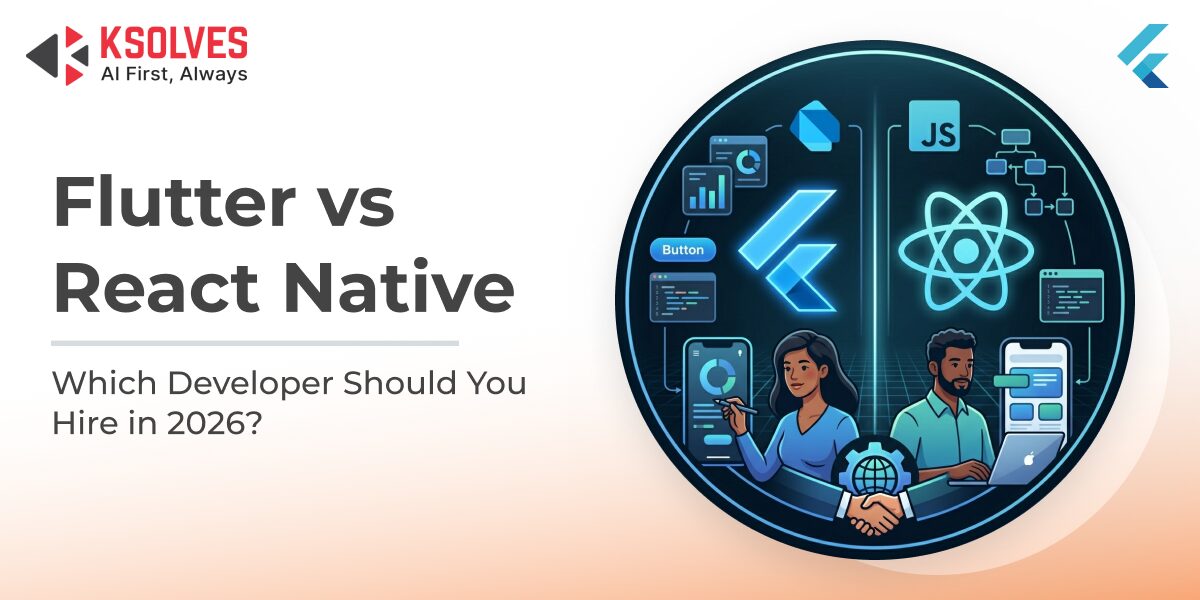
Cross-platform mobile development has moved from an experiment to a standard delivery model. If you are evaluating whether to hire a Flutter developer or a React Native developer for your next project, the decision requires more than a feature checklist. Both frameworks have evolved significantly, and the right choice depends on your team, your timeline, and what your app actually needs to do. While React Native is a warhorse of the industry, Flutter is no longer just a rising star. This blog will aid you in deciding the one that is best suited to your needs before you hire a Flutter or React Native developer.
Flutter and React Native: A Brief Overview
React Native is a popular framework created by Meta (formerly Facebook) that is widely utilized in cross-platform mobile development. Developers leverage React with the various functionalities of a specific platform (Android, iOS, web, etc.). The framework allows developers to create user interfaces with native elements.
Flutter was developed by Google and this framework is utilized by the developers to craft cross-platform apps that are uniformly good on both the newer and older versions of a device’s OS. Users can have a great feel with an extensive suite of available widgets. Flutter significantly diminishes the time required to develop an app in comparison to native development.
Both are open-source.
Flutter vs React Native: Key Differences Compared
Programming Language
React Native relies on JavaScript, the most common language of web development. The React Framework has many features common to React Native and is typically known to JS developers. This makes it easier for React Native developers to master and integrate the tool.
Flutter uses Dart. It is a programming language developed by Google which resembles both JavaScript and Java in syntax. Developers who are a bit experienced with JS, C#, and other object-oriented languages, can learn it easily.
With AI-powered code assistants now widely available, the Dart learning curve has shortened considerably. Developers can get contextual suggestions, auto-complete, and real-time error resolution directly in their IDE, which means onboarding onto Flutter is faster than it was even two years ago. Tools like Gemini Code Assist allow for rapid prototyping, reducing time spent on boilerplate code and letting developers focus on building actual product logic from the start.
Architecture
React Native is a great option for speeding up the development of cross-platform apps. Earlier versions of the framework depended on a JavaScript bridge to handle communication between JavaScript and native modules, which could introduce latency in UI-heavy applications. Since React Native 0.76 (released October 2024), the New Architecture is enabled by default. This replaces the bridge entirely with JSI (JavaScript Interface), TurboModules, and the Fabric renderer, enabling direct and synchronous communication between JavaScript and native code. The performance limitations associated with the old bridge are no longer a default concern for new projects on current versions.
Flutter does not rely on a bridge to connect with platform-specific native modules. It uses UI frameworks such as Cupertino and Material Design and renders everything through its own rendering engine. Since Flutter 3.27 (December 2024), Impeller is the default rendering engine on both iOS and Android API 29+, replacing the older Skia engine. Impeller pre-compiles shaders at build time rather than runtime, which eliminates the frame drops and animation jank that Skia’s just-in-time compilation could cause. The wide range of functionalities in Flutter removes the necessity of other technologies to develop the apps.
AI-assisted profiling tools can help developers on both frameworks identify UI performance bottlenecks earlier in the development cycle, reducing the chance of performance issues reaching production.
Native Components
React Native has many elements to develop an app (like device API access and UI rendering capabilities). For other functions like accessing native modules, React depends on third-party libraries. It is not very convenient as you will like to have all the tools you require in one suite or place.
Flutter has multiple libraries, testing tools, and a range of widgets apart from the standard device API access and basic UI rendering to develop visually appealing interfaces. The framework comes with a set of functionalities that are generally enough to execute all necessary tasks and fulfill the design requirements.
Performance
Flutter has a slight upper hand when it comes to performance. In older versions of React Native, developers encountered UI lag caused by the JavaScript bridge, which handled communication between JavaScript and native modules asynchronously. That specific bottleneck no longer applies to projects running React Native 0.76+ with the New Architecture, which removed the bridge in favour of direct JSI-based communication.
Flutter has a different approach altogether. Flutter apps are compiled with the ARM C/C++ library which renders close to native performance. With Impeller now the default rendering engine, Flutter handles complex animations and transitions with pre-compiled shaders, removing the runtime compilation pauses that were previously common.
AI-assisted code review helps teams on both frameworks catch common performance anti-patterns during development rather than after deployment. That said, this only works well when the developers using these tools have a solid enough understanding of the framework internals to evaluate what AI flags and act on it correctly. AI accelerates the review process; it does not replace the judgment needed to fix the right thing.
Community
The community picture has shifted notably since this comparison was originally written. Flutter has overtaken React Native in most popularity metrics. According to Statista’s 2023 global developer survey, 46% of developers worldwide used Flutter for cross-platform mobile development, compared to 35% for React Native. Stack Overflow’s 2024 Developer Survey shows the two frameworks nearly level among professional developers (Flutter at ~9.4%, React Native at ~9%), confirming both remain widely used at scale. On GitHub, Flutter now has over 170,000 stars compared to React Native’s 121,000, a lead that has been growing consistently.
That said, React Native still holds a practical advantage when it comes to hiring. JavaScript developers outnumber Dart developers significantly, making React Native teams easier and faster to staff. If your project timeline requires assembling a team quickly, that remains a real consideration in 2026.
Flutter’s documentation is structured, well-maintained, and pub.dev covers most common development needs. For teams that can plan their hiring window, the Flutter community is no longer the liability it once was.
AI tools are helping narrow what remains of any gap. Developers working with Flutter can resolve many issues through AI-assisted search and code generation that would previously have required community forums, bringing effective resolution speed closer to parity with the React Native ecosystem.
Testing Support
Testing is the standard process to get fast feedback on the code.
React Native ships with Jest for unit and snapshot testing and officially integrates with React Native Testing Library for component rendering and interaction tests. For end-to-end testing, the ecosystem supports Detox, a grey-box testing framework built specifically for React Native. Built-in TypeScript support adds another layer of reliability by catching type errors before tests even run. React Native 0.76 and above default to the New Architecture (TurboModules and Fabric), which also brings better support for testing UI interactions via Suspense. The testing story here is mature and well-integrated, not dependent on patchwork solutions.
Flutter has a robust set of testing features for unit, widget, and integration tests. With Flutter’s widget testing, you can test UI components and execute them at the same speed as unit tests, all within the framework itself without external dependencies.
The meaningful difference between the two is in structure: Flutter consolidates everything under one testing framework, while React Native’s testing capabilities are spread across Jest, React Native Testing Library, and Detox. Both approaches are production-ready; the React Native setup just requires more deliberate configuration to get fully wired up.
AI tools can reduce that setup time in practice. When starting a new React Native project, AI can scaffold the initial Jest and Detox configurations, generate component test templates from existing code, and flag untested paths during review, cutting the time it takes to reach meaningful coverage from scratch.
Flutter vs. React Native: Conclusion
Both frameworks are production-ready for building cross-platform apps under a restricted timeline. The right choice depends on the points covered above as well as the specific requirements of your project. React Native has a larger existing talent pool and a mature ecosystem if your team is already working in JavaScript. Flutter has pulled ahead in popularity metrics and delivers more consistent UI performance across platforms, particularly with Impeller as the default renderer.
At Ksolves, our developers work with both Flutter and React Native and use AI tools as a standard part of the development workflow, covering code generation, testing, documentation, and performance review. This means your project ships faster and with fewer post-launch issues, regardless of which framework fits your requirements.

































Author
About the Author Editorial Team The Ksolves Editorial Team includes certified Salesforce experts, Big Data engineers, AI/ML specialists, Zoho consultants, and experienced technology writers focused on delivering clear, actionable insights for modern businesses. With hands-on experience across Salesforce, Big Data platforms, AI/ML solutions, application development, software testing, and Zoho ERP/CRM, the team publishes practical guides, real-world use cases, and industry updates that support smarter decisions and faster growth. Every article is created to solve business challenges, guide technology adoption, and keep organizations aligned with evolving digital ecosystems.
Share with