



Generative AI for Salesforce: Practical Use Cases and Best Practices for Implementation
Salesforce
5 MIN READ
February 13, 2026

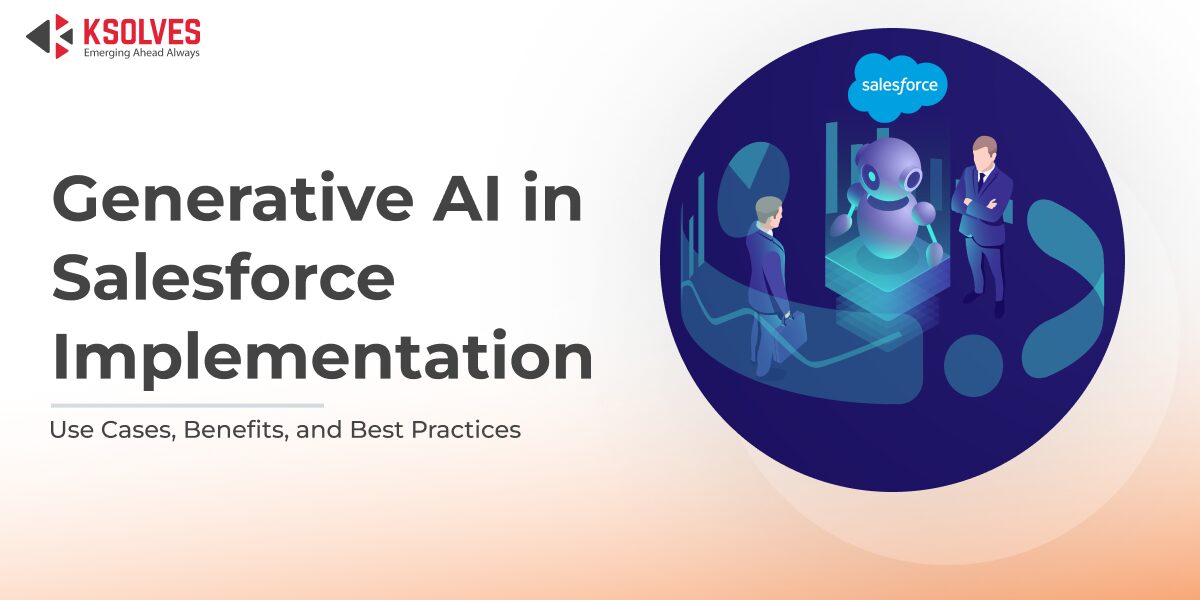
Generative AI is reshaping how modern CRM platforms operate by moving beyond data storage and automation to intelligent, context-aware decision-making. In Salesforce, Generative AI enables businesses to analyze customer intent, generate personalized interactions, and surface insights in real time, helping teams work faster and engage customers more effectively.
However, traditional Salesforce implementations often face limitations. Manual configuration, rigid workflows, and heavy dependence on user input can slow adoption and reduce the platform’s ability to scale with evolving business needs. As a result, many organizations struggle to unlock the full value of their Salesforce investment.
Generative AI changes this approach by adding intelligence across the Salesforce ecosystem, while Agentforce acts as its execution layer. Together, they enable Salesforce to not only recommend actions but also autonomously execute workflows, adapt to user behavior, and continuously optimize processes. This shift transforms Salesforce implementations from static system setups into intelligent, self-improving platforms built for modern business demands.
Understanding Generative AI in Salesforce
What Generative AI Means in a Salesforce Context
In Salesforce, Generative AI goes beyond traditional automation and analytics. It enables the platform to understand context, interpret user intent, and generate meaningful outputs such as responses, summaries, recommendations, and next-best actions. Instead of relying solely on predefined rules, Generative AI learns from data and adapts to changing business scenarios, making Salesforce more intelligent and responsive.
Key Salesforce Generative AI Components
Salesforce delivers Generative AI through a combination of native tools and platforms that work together:
- Einstein AI: Powers predictive insights, recommendations, and AI-driven automation across Salesforce Clouds.
- Prompt Builder: Allows businesses to design and manage prompts that guide how Generative AI generates content and responses within Salesforce workflows.
- Data Cloud: Unifies customer data from multiple sources to provide a trusted, real-time foundation for AI-driven insights and personalization.
Together, these components ensure Generative AI operates on accurate data, follows business context, and delivers relevant outcomes.
AI Assistance vs. AI-Driven Execution
AI assistance focuses on supporting users by suggesting actions, drafting content, or providing insights. While helpful, it still requires manual decision-making and execution.
AI-driven execution takes this a step further. It utilizes Generative AI to reason, make decisions, and act autonomously within defined boundaries. In Salesforce, this is where frameworks like Agentforce come into play, transforming AI from a support tool into an active participant that executes workflows, updates records, and continuously improves processes.
Agentforce: Turning Generative AI into Action
Agentforce is Salesforce’s framework for deploying autonomous AI agents that operate directly within Salesforce workflows. Instead of relying only on predefined rules or manual inputs, Agentforce enables AI agents to understand context, interpret intent, and take actions across Sales, Service, and Data Cloud.
Powered by Generative AI, Agentforce agents can reason through information, decide next-best actions, and execute tasks such as updating records, routing cases, or triggering workflows, without constant human intervention.
In modern Salesforce implementations, Agentforce shifts CRM from AI-assisted to AI-driven execution. It reduces manual effort, accelerates processes, and enables Salesforce to continuously adapt and improve as business needs evolve.
Key Use Cases of Generative AI in Salesforce Implementation
Generative AI enhances Salesforce implementations by adding intelligence, automation, and adaptability across core CRM processes. When combined with Agentforce, it enables AI-driven execution that improves efficiency and user experience.
1. AI-Powered Requirement Analysis
Generative AI helps analyze user inputs, historical data, and existing processes to identify real business needs. Agentforce agents support discovery by capturing requirements, documenting workflows, and translating user intent into actionable Salesforce configurations.
2. Intelligent Workflow Automation
Generative AI enables smarter automation for leads, cases, approvals, and follow-ups. With Agentforce, AI agents can execute workflows across Salesforce Clouds—routing cases, triggering actions, and updating records automatically based on context.
3. Personalized Customer Engagement
Generative AI delivers context-aware responses, recommendations, and next-best actions. Agentforce agents use this intelligence to engage customers in real time, ensuring personalized interactions across sales, service, and support channels.
4. Smarter Data Management and Insights
Generative AI assists in data unification, cleansing, and forecasting by analyzing large data sets. Agentforce works with Salesforce Data Cloud to turn these insights into actions, enabling faster and more informed decision-making.
5. Continuous Post-Go-Live Optimization
Generative AI monitors system performance and user behavior to identify improvement areas. Agentforce enables continuous optimization by learning from outcomes and refining workflows over time without major reconfiguration.
Also Read: Top Agentforce Use Cases Across Sales, Service, and Operations
Benefits of Generative AI in Salesforce Implementation
- Faster Implementation and Reduced Manual Effort: Generative AI accelerates Salesforce implementation by automating analysis, configuration support, and routine tasks, reducing dependency on manual processes.
- Improved Productivity and User Adoption: AI-driven assistance and automation simplify daily workflows, helping users complete tasks faster and encouraging higher adoption across teams.
- Better Decision-Making with AI-Driven Insights: Generative AI analyzes real-time data to surface relevant insights, forecasts, and recommendations that support smarter business decisions.
- Scalable and Future-Ready Salesforce Architecture: AI-enabled Salesforce implementations adapt easily to new users, data, and processes, ensuring long-term scalability and flexibility.
- Enhanced Customer Experience Through Autonomous Agents: With Agentforce, autonomous AI agents deliver timely, personalized responses and execute actions proactively, improving customer satisfaction and consistency.
Best Practices for Implementing Generative AI and Agentforce
Follow these best practices to ensure a smooth, secure, and impactful deployment of Generative AI and Agentforce in your Salesforce environment.
1. Define Clear Use Cases
Start by identifying the business problems you want to solve, rather than focusing solely on AI features. Clearly define objectives, such as reducing case resolution time, improving lead conversion, or enhancing customer engagement. Measurable outcomes help guide AI implementation and demonstrate ROI.
2. Assign Roles and Boundaries
AI agents work best when they have well-defined responsibilities. Assign each Agentforce agent specific tasks, and set boundaries to prevent unintended actions. This ensures the AI operates predictably while complementing human workflows.
3. Prioritize Data Quality
Generative AI is only as effective as the data it uses. Ensure your Salesforce data is clean, unified, and well-governed. Regular audits, deduplication, and data enrichment help maintain accuracy, which is critical for AI-driven insights and automation.
4. Roll Out in Phases
Implement Agentforce gradually across workflows. Start with high-impact, low-risk processes to demonstrate value and build confidence among users. As teams become familiar with AI-driven automation, expand its use to more complex workflows for maximum impact.
5. Ensure Security and Oversight
Integrate AI within Salesforce’s security and compliance frameworks. Maintain human oversight for critical decisions, approvals, or sensitive customer interactions. This builds trust and ensures compliance with internal policies and industry regulations.
6. Work with Experienced Partners
Partnering with certified Salesforce and AI experts accelerates implementation and ensures best practices. Experienced partners can guide architecture design, integration, and governance, helping your organization maximize the value of Generative AI and Agentforce while avoiding common pitfalls.
How Agentforce Shapes the Future of Salesforce Implementations
Salesforce implementations are shifting from configuration-led setups to AI-led architectures. Instead of relying heavily on manual configurations and static workflows, organizations are adopting intelligent systems where AI continuously learns, adapts, and optimizes processes.
With Agentforce, autonomous AI agents act as digital employees, handling tasks such as case resolution, lead qualification, follow-ups, and data updates with minimal human intervention. These agents work alongside teams, improving efficiency while allowing employees to focus on higher-value work.
Over the long term, Agentforce influences CRM strategy by making Salesforce more proactive, scalable, and outcome-driven. Businesses move from managing systems to managing outcomes, with AI playing a central role in decision-making and execution.
Conclusion
Generative AI is redefining Salesforce implementations by adding intelligence, adaptability, and automation across CRM processes. It helps organizations understand intent, derive insights, and improve productivity beyond traditional rule-based systems.
Agentforce serves as a practical enabler of Generative AI, turning insights into real-time actions through autonomous AI agents. It bridges the gap between AI assistance and AI-driven execution, making Salesforce implementations smarter and more future-ready.
To successfully adopt this shift, organizations need the right strategy and expertise. Ksolves, a Salesforce Summit Partner, offers Agentforce consulting services to help businesses design, implement, and scale AI-driven Salesforce solutions responsibly. By combining deep Salesforce expertise with Generative AI capabilities, Ksolves helps organizations build intelligent, scalable Salesforce systems that deliver long-term value.































Author
About the Author Editorial Team The Ksolves Editorial Team includes certified Salesforce experts, Big Data engineers, AI/ML specialists, Zoho consultants, and experienced technology writers focused on delivering clear, actionable insights for modern businesses. With hands-on experience across Salesforce, Big Data platforms, AI/ML solutions, application development, software testing, and Zoho ERP/CRM, the team publishes practical guides, real-world use cases, and industry updates that support smarter decisions and faster growth. Every article is created to solve business challenges, guide technology adoption, and keep organizations aligned with evolving digital ecosystems.
Share with