



AI & Salesforce Sales Cloud for Real Estate Savings
Sales Cloud
5 MIN READ
April 29, 2026

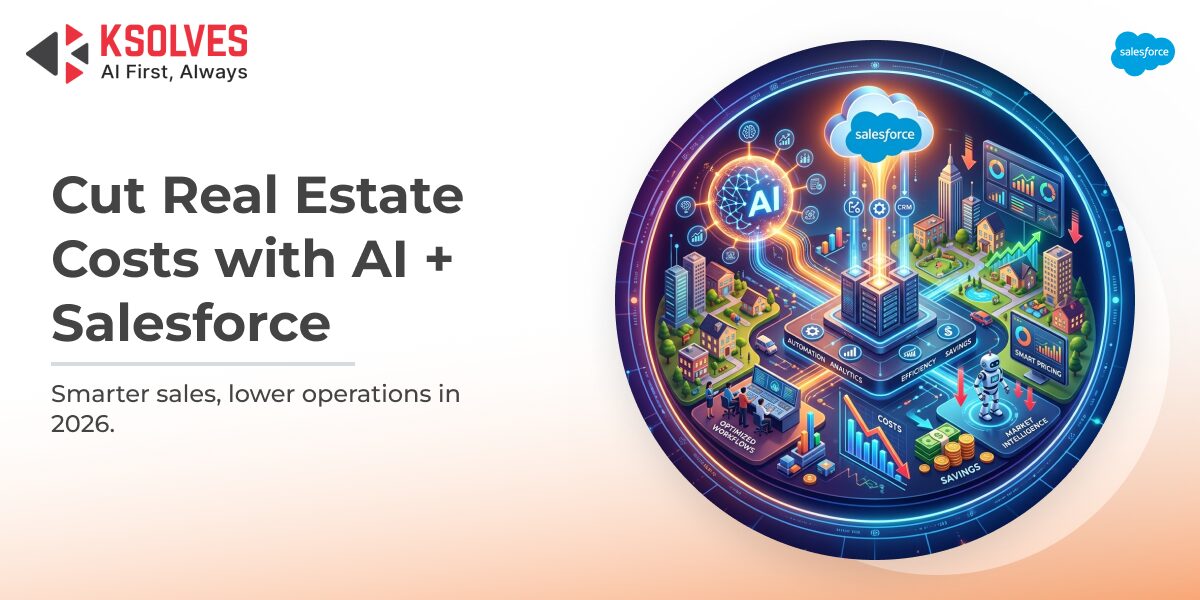
Real estate firms have always operated on thin margins. Between juggling property listings, managing complex client pipelines, and tracking agent commissions, operational overhead builds up quickly before a single deal ever closes.
According to Deloitte’s 2025 Commercial Real Estate Outlook, 76% of real estate organizations are still in the research, pilot, or early-stage implementation phase of AI adoption. That means the majority of firms are still running on largely manual workflows, leaving significant operational costs on the table. With AI-powered CRM platforms now accessible to firms of every size, those who move early stand to gain a measurable competitive advantage.
Salesforce Sales Cloud, deeply integrated with Einstein AI and Agentforce, gives real estate businesses a practical way to automate repetitive work, reduce avoidable costs, and put agent time toward closing deals instead of managing data.
Salesforce reports that companies using Sales Cloud see an average 25% boost in productivity and a 29% increase in sales revenue. When AI capabilities are layered on top, those gains compound further.
This blog breaks down five practical, AI-augmented strategies real estate firms can use right now to lower operational costs with Salesforce Sales Cloud.
Key Takeaways
- AI-powered lead routing reduces manual assignment time and improves response speed to new inquiries.
- Automated client communication protects agent time for high-value conversations, not routine follow-ups.
- Built-in duplicate management and data validation tools prevent costly CRM errors before they occur.
- Real-time, AI-generated reporting replaces manual spreadsheet work and speeds up decision-making.
- Mobile CRM access enables agents to work productively from the field, reducing office overhead.
Why Salesforce Sales Cloud Works So Well for Real Estate
Salesforce Sales Cloud (now known as Agentforce Sales) is a cloud-based CRM built to manage the full sales lifecycle in a single, centralized platform. For real estate firms handling multiple properties, clients, and agents simultaneously, that centralization removes enormous day-to-day friction.
What makes it especially valuable in 2026 is the native integration with Einstein AI and Agentforce. These tools go beyond organizing data. They analyze patterns, predict deal outcomes, and trigger intelligent automation based on real-time signals from your pipeline. Agents receive actionable recommendations on which leads to prioritize, where deals are stalling, and what follow-up action is most likely to move things forward.
The result is a CRM that actively improves operational performance rather than simply recording it.
5 Ways Real Estate Firms Are Saving Money with Salesforce Sales Cloud
From chasing leads to chasing reports, here is where real estate firms are cutting the most operational fat with Salesforce Sales Cloud.
Strategy 1: Automate Lead Capture and Routing Using AI
Manual lead assignment is one of the most common hidden costs in real estate operations. When leads arrive from multiple channels such as web forms, property portals, referrals, and social ads, sorting and assigning them by hand creates delays, inconsistencies, and lost opportunities.
Salesforce Sales Cloud allows you to build auto-assignment rules that instantly match incoming leads to the right agent based on location, property type, buyer budget, or agent availability. With Einstein Lead Scoring added to the workflow, the system can also rank leads by conversion likelihood automatically, so your best agents focus their energy where it matters most.
The operational payoff is faster response times, fewer dropped leads, and a significant reduction in the administrative overhead that comes with manual distribution.
Strategy 2: Replace Repetitive Client Communication with Smart Automation
Keeping buyers, sellers, and tenants consistently informed is critical to closing deals. However, when agents manually draft every follow-up email and track each next step, that effort compounds into hours of lost time every week.
Salesforce Sales Cloud addresses this through pre-built email templates, automated task reminders, and Einstein-powered next-step suggestions that surface the right action at the right moment. Agentforce AI agents can now handle routine client inquiries, send property updates, and confirm appointment details without requiring agent involvement in every exchange.
This approach protects agent time for the conversations that genuinely need a human touch. The downstream effect is a more consistent client experience, fewer missed touchpoints, and lower communication overhead across the entire pipeline.
To see how these workflows can be set up for your team, explore Ksolves Agentforce services.
Strategy 3: Keep Your CRM Clean with Duplicate Detection and Data Validation
In busy real estate offices, multiple agents frequently work the same lead, list the same property under different records, or update client details inconsistently. Over time, this data fragmentation causes real operational damage: missed follow-ups, contradictory contract information, and client disputes that require significant time to resolve.
Salesforce Sales Cloud includes built-in duplicate management and data validation tools that address this at the source. The system flags or merges duplicate records automatically, enforces consistent entry formats, and keeps property details, client profiles, and deal statuses accurate across the entire team.
With a cleaner CRM, decisions come faster, reporting becomes more reliable, and your team avoids the downstream costs that come from working with fragmented or inaccurate data.
Strategy 4: Move from Manual Reporting to Automated, AI-Driven Insights
Building sales reports by hand and tracking pipeline progress in spreadsheets is a significant time drain for brokers and managers. Waiting for weekly or monthly summaries is even more costly because by the time a bottleneck appears in a report, deals may have already stalled.
Salesforce Sales Cloud’s real-time dashboards pull live data directly from your CRM. This gives every stakeholder immediate visibility into pipeline health, agent performance, property deal stages, and revenue forecasts. Einstein Analytics extends this further by surfacing predictive signals: which deals need attention, which agents are underperforming, and where revenue risks are building.
The operational benefit is twofold. Your team spends less time generating reports, and you gain the visibility needed to course-correct before problems become expensive. That combination directly reduces the kind of costly missteps that delay deal closures.
For more on how Sales Cloud improves overall business performance, see our blog on boosting sales performance with Salesforce Sales Cloud.
Strategy 5: Give Agents Mobile Access and Reduce Office Dependency
Real estate is inherently a field-based profession. Agents spend time at showings, traveling between client meetings, and coordinating transactions across multiple locations. When they need to return to the office to update records, access property data, or handle paperwork, that friction accumulates across the team and slows everything down.
Salesforce Sales Cloud’s mobile CRM features give agents full access to leads, listings, deal statuses, and client information directly from their phones. Einstein-powered voice-to-text note capture and AI-generated task recommendations let agents update their pipeline and plan next steps immediately after a showing, rather than hours later at a desk.
For firms managing large agent teams, this flexibility translates into measurable savings: less office overhead, fewer administrative backlogs, and faster deal progression without the delays created by disconnected workflows.
Final Thoughts
Small operational inefficiencies in real estate compound quickly. Manual lead sorting, repetitive client communication, inconsistent CRM data, slow reporting, and limited mobile access each chip away at productivity and margins. Together, they represent a significant and addressable cost.
Salesforce Sales Cloud, with Einstein AI and Agentforce capabilities built in, gives real estate firms a concrete path to resolving all five at once. Firms that have made the shift are seeing faster deal cycles, lower overhead, and more consistent revenue performance.
If you are ready to identify where your workflows could be leaner, now is a good time to audit your current processes and map them against what Sales Cloud and AI automation can handle.
At Ksolves, we specialize in Salesforce Sales Cloud consulting and have helped real estate businesses implement, customize, and optimize their CRM for measurable returns. We also help firms explore how Generative AI and ML services can extend Sales Cloud intelligence beyond its native capabilities.
Ready to see where your savings are? Reach out to us at [email protected] and let us take a look together.
Frequently Asked Questions
Q1. Is Salesforce Sales Cloud a good fit for smaller real estate agencies, or only large brokerages?
Salesforce Sales Cloud is fully scalable and delivers strong value for firms of all sizes. Smaller agencies often benefit the most because they have less administrative capacity to absorb manual work, making automation even more impactful. Ksolves offers implementation support tailored to teams at any stage of growth.
Q2. How does Einstein AI help real estate teams specifically?
Einstein AI analyzes your historical sales data to score leads by conversion likelihood, recommend next-best actions for agents, and surface pipeline risks before they affect deal outcomes. For real estate teams, this means agents can prioritize genuine buyers and move faster on the deals most likely to close.
Q3. How long does a Salesforce Sales Cloud implementation typically take for a real estate firm?
Timelines vary based on workflow complexity and existing data infrastructure. A focused engagement with an experienced partner like Ksolves can bring a core Sales Cloud setup live within 6 to 12 weeks, with phased additions of AI and automation workflows added afterward.
Q4. Can Salesforce Sales Cloud connect with property listing platforms and other tools our team already uses?
Yes. Salesforce has a broad integration ecosystem through AppExchange, and custom connections with property portals, e-signature platforms, and communication tools are common in real estate implementations. Ksolves can assess your current tech stack and build an integration plan that fits your specific needs.

































AUTHOR
Sales Cloud
Shivam Yadav, a Senior Software Engineer at Ksolves, with 4+ years of experience, specializing in Health Cloud and Salesforce development. A 4× Salesforce Certified expert (PD1, PD2, SFCC B2C DEV, Associate), he excels in React Native, Java, Python, and C++.
Share with