



Odoo vs PSA: What IT Leaders Should Know Before Scaling
Odoo
5 MIN READ
March 12, 2026

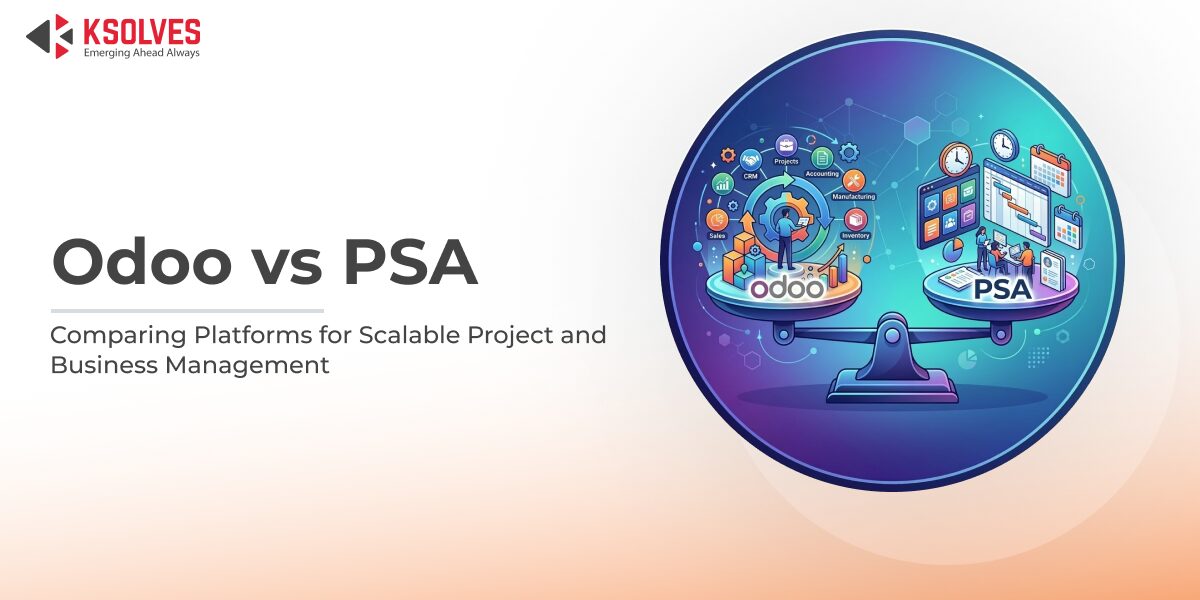
As organizations grow, project execution stops being just a delivery problem; it becomes a systems, governance, and data orchestration challenge. Many IT leaders reach a point where their Professional Services Automation (PSA) tool no longer answers the questions that matter at scale:
- Are project margins accurate in real time?
- Can delivery, finance, and sales trust the same data?
- How much operational risk is hidden in integrations?
This is where the comparison between Odoo ERP and PSA tools becomes relevant, not as competitors in the same category, but as very different architectural approaches to managing service-led businesses.
This article breaks down what IT leaders should realistically evaluate before scaling.
Understanding the Core Purpose of PSA Tools
Professional Services Automation (PSA) platforms are built to support project-centric service delivery. Their primary role is to help delivery teams plan, execute, and track projects while maintaining visibility into utilization and billable work.
At their core, PSA tools focus on:
- Project planning and task management.
- Resource allocation and utilization.
- Time and expense tracking.
- Project-level billing and revenue visibility.
These capabilities are essential for standardizing project execution and bringing operational transparency within the delivery lifecycle.
Where PSA Tools Are Strong
PSA platforms excel when:
- Project delivery is the primary operational concern.
- Financial processes are handled separately by ERP or accounting systems.
- Organizational scale is moderate, with limited cross-entity complexity.
Where PSA Tools Begin to Strain
As organizations scale, PSA tools increasingly depend on:
- Tight integrations with ERP, CRM, HR, and billing systems.
- Data synchronization for financial accuracy.
- Manual reconciliation across systems.
At this stage, the PSA is no longer a standalone solution, but it becomes one node in a complex system landscape.
Also Read – Why Startups Prefer Odoo ERP as Their Product Backbone
Odoo’s Approach: ERP First, Projects as a Native Capability
Odoo is not designed as a PSA tool. It is a modular ERP platform where project management exists as a native capability within a broader, end-to-end operational system.
For service-based organizations, Odoo brings together key functional areas such as:
- Project management
- Accounting and invoicing
- Sales and CRM
- Human resources
- Timesheets
- Helpdesk and support
All of these modules operate on a shared data model, allowing project execution, financial performance, and customer information to remain consistently aligned across the organization.
Why This Matters for IT Leaders
As organizations scale, operational complexity increases across departments, not just within projects. Many scaling challenges stem from data fragmentation and process misalignment, rather than missing functionality.
Odoo addresses this by design, enabling organizations to manage delivery, finance, and customer operations within a single, connected platform instead of relying on multiple integrations to keep systems in sync.
Also Read – Why Odoo is the Ideal ERP for Supermarket Operations
Odoo vs PSA: Understanding Key Differences Between Platforms
1. Odoo vs PSA: Data Architecture and System Design
PSA-Centric Model
In a PSA-led environment, organizations typically operate multiple specialized systems:
- PSA for project and resource management
- ERP for finance and accounting
- CRM for sales and customer data
- HR systems for workforce management
Each system owns its data, making synchronization essential. As scale increases, data latency becomes more visible, reconciliation efforts multiply, and reporting accuracy depends heavily on integration reliability.
Odoo’s Platform-Driven Model
Odoo centralizes these capabilities within a single platform. Sales orders can initiate projects directly, timesheets feed into costing and invoicing in real time, and financial reports reflect operational activity without data duplication.
This reduces integration complexity, lowers the risk of data inconsistency, and simplifies system maintenance for IT teams.
2. Odoo vs PSA: Governance, Controls, and Auditability
Governance in PSA-Centric Setups
While PSA tools support project-level controls, enterprise governance often relies on external ERP workflows, manual approval handoffs, and fragmented audit trails across systems.
Governance with Odoo
Odoo enables role-based access control, configurable approval workflows, and end-to-end traceability, from sales quotation to project delivery and invoicing. This is particularly valuable for organizations operating across multiple entities, regions, or shared service delivery models.
3. Odoo vs PSA: Customization and Scalability
PSA Customization Constraints
Most PSA platforms allow configuration within defined limits and support add-ons for specific use cases. However, deeper workflow changes are often restricted, custom logic can complicate upgrades, and scaling unique business models can become costly over time.
Odoo’s Extensibility
Odoo’s modular architecture allows deeper configuration without modifying core logic. Custom modules can be built around business processes while maintaining scalability and upgrade stability, giving IT teams greater control over long-term system evolution.
As an Odoo Gold Partner and Odoo Best Partner India 2025, Ksolves specializes in delivering Odoo customization services that align the platform with real-world business processes. With deep functional and technical expertise, Ksolves helps organizations extend Odoo responsibly, building scalable custom modules, optimizing workflows, and ensuring long-term stability as businesses grow.
4. Odoo vs PSA: Total Cost of Ownership (TCO) at Scale
Hidden Costs in PSA-Centric Architectures
Beyond licensing, PSA-led environments often incur costs related to integration development and maintenance, data reconciliation, duplicate reporting efforts, and vendor lock-in.
Odoo’s Cost Profile
Although Odoo requires thoughtful implementation and solution design, it can reduce long-term costs by consolidating systems, simplifying reporting, and minimizing operational inefficiencies. This results in a more predictable cost structure as the organization scales.
5. Odoo vs PSA: Reporting, Analytics, and Decision-Making
PSA-Centric Reporting
PSA tools typically provide strong project-level reports, such as utilization, project progress, and billable hours. However, when leadership requires insights that span delivery, finance, and sales, reporting often depends on data pulled from multiple systems. This can lead to:
- Duplicate metrics across tools.
- Delays in consolidated reporting.
- Dependence on BI layers or manual data preparation.
Odoo’s Unified Reporting Model
Odoo reporting is built on a centralized data structure. Operational and financial data are inherently connected, allowing IT and business leaders to generate cross-functional insights, such as project profitability, customer lifetime value, or revenue forecasts, without reconciling multiple data sources. This supports faster and more consistent decision-making at scale.
6. Odoo vs PSA: Scalability Across Business Models
PSA Tools and Service-Centric Growth
Most PSA platforms are optimized for traditional professional services models: time-and-materials or fixed-bid projects. As organizations introduce new revenue models (managed services, subscriptions, hybrid delivery), PSA tools often require:
- Additional tools or extensions
- Custom billing logic
- Increased manual intervention
Odoo’s Flexibility Across Models
Odoo supports multiple business models within the same platform, including project-based services, recurring contracts, and support-driven delivery. This flexibility allows organizations to scale or diversify offerings without re-architecting their core systems.
7. Odoo vs PSA: Deployment, Control, and IT Ownership
PSA Deployment Model
Most PSA tools are SaaS-only, with limited control over:
- Infrastructure
- Data residency
- Custom deployment strategies
For some IT teams, this simplifies operations; for others, it introduces constraints around compliance, performance tuning, or regional requirements.
Odoo Deployment Options
Odoo can be deployed on-premise, in a private cloud, or via managed hosting. This gives IT leaders greater control over:
- Data governance
- Security policies
- Integration architecture
This flexibility is often highlighted in enterprise IT discussions where infrastructure strategy is a key consideration.
8. Odoo vs PSA: Ecosystem and Long-Term System Strategy
PSA as a Specialized Tool
PSA platforms are designed to do one job well – optimize service delivery. As a result, organizations often build broader ecosystems around them, adding tools for finance, HR, procurement, and analytics.
Odoo as a Business Platform
Odoo is positioned as a broad business platform rather than a single-purpose tool. Its ecosystem supports operational expansion into areas like inventory, procurement, field service, and customer support, without introducing separate systems. This aligns well with long-term digital transformation strategies discussed across ERP-focused industry blogs.
Odoo vs PSA: A Head-to-Head Comparison
| Dimension | PSA Tools | Odoo ERP |
| Purpose | Project-focused service delivery. | ERP-first platform with projects as a native capability. |
| Architecture | Integration-driven (PSA + ERP + CRM + HR). | Platform-driven with shared data across modules. |
| Financial Visibility | Project-level; relies on external ERP for enterprise view. | Real-time financial impact of projects within the same system. |
| Data & Reporting | Data spread across systems; cross-functional reporting requires integration. | Centralized data; unified reporting for delivery, finance, and operations. |
| Governance | Project-level controls; enterprise governance is fragmented. | End-to-end traceability and configurable approval workflows. |
| Customization & Scalability | Limited deeper changes; scaling requires integrations. | Deep configuration and custom modules; scales across entities and business models. |
| Deployment & Control | Mostly SaaS; limited IT control. | Flexible deployment (cloud, on-premise, private hosting). |
| Cost Profile | Lower initial cost; higher long-term integration/maintenance. | Higher implementation effort; lower operational overhead long-term. |
| Best Fit | Delivery-focused teams with limited complexity. | Organizations seeking end-to-end operational control. |
Odoo vs PSA: Which is the Right Choice?
When a PSA Tool Is Still the Right Choice
PSA platforms continue to be a strong fit in environments where service delivery is the primary operational focus and organizational complexity remains manageable.
They are typically well-suited when:
- Project execution is the core business priority.
- Financial processes are relatively straightforward and managed separately.
- Growth is incremental rather than transformational.
- An ERP transformation is not an immediate or strategic priority.
In these scenarios, PSA tools deliver focused operational value, helping teams improve delivery efficiency without introducing the overhead of a broader enterprise platform.
When Odoo Becomes the Strategic Choice
Odoo becomes increasingly relevant as organizations move beyond project execution and begin aligning delivery closely with financial and operational outcomes.
It is often the better fit when:
- Project performance directly impacts revenue, margins, and cash flow.
- Leadership requires real-time visibility into project profitability.
- Operations span multiple entities, regions, or delivery models.
- IT teams need a unified platform rather than a collection of specialized tools.
At this stage, the conversation shifts from “How do we manage projects effectively?” to “How do we run the business end-to-end, with control, visibility, and scale?”
Final Words
Choosing between a PSA tool and Odoo is not about feature comparison, but it’s about strategic intent. PSA platforms excel at optimizing project delivery within defined boundaries, while Odoo supports a broader, platform-driven approach to running and scaling the business.
For IT leaders, the right choice depends on where the organization is headed. If the goal is to improve delivery efficiency without altering the existing system landscape, a PSA tool may be sufficient. But if growth demands tighter alignment between projects, finance, operations, and governance, a unified ERP platform like Odoo provides the foundation to scale with clarity and control.
Ultimately, the decision should reflect not just today’s operational needs, but the architecture required for the next phase of growth.































AUTHOR
Odoo
Neha Negi, Presales and Business Associate Head at Ksolves is a results-driven ERP consultant with over 8 years of expertise in designing and implementing tailored ERP solutions. She has a proven track record of leading successful projects from concept to completion, driving organizational efficiency and success.
Share with