



How We Estimate Cost and Scale From Big Data RFPs
RFP
5 MIN READ
March 12, 2026

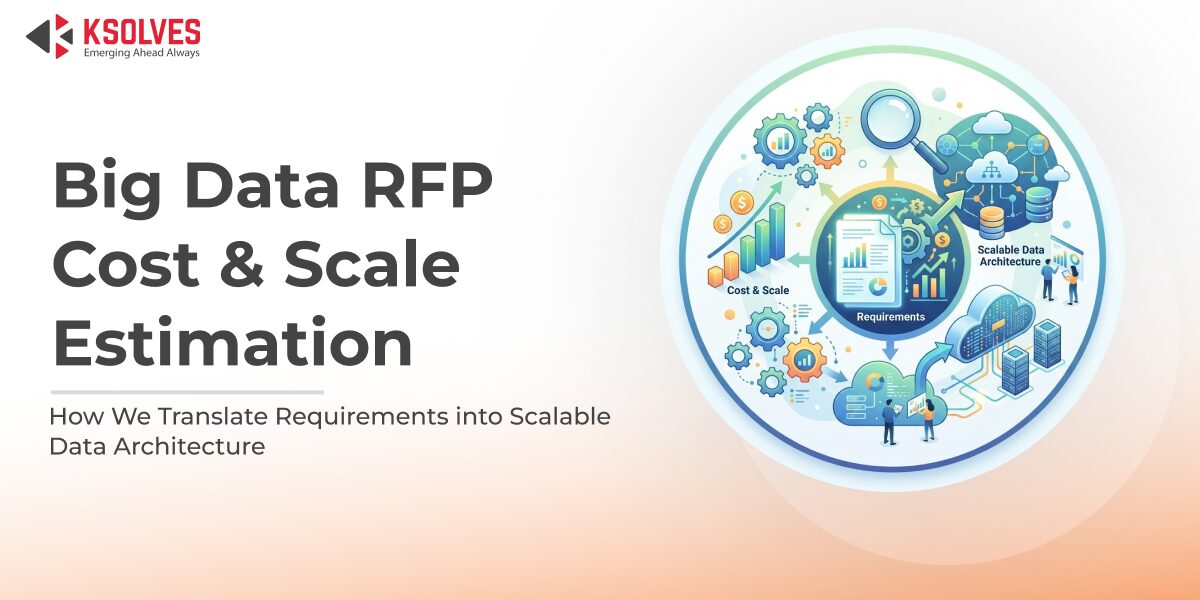
Submitting a Big Data RFP is only the beginning. What happens next, how a vendor reads your requirements, interprets your scale, and translates everything into a cost estimate, determines whether your project launches on solid ground or struggles from day one.
At Ksolves, we take estimation seriously. With over 12 years of experience delivering enterprise data solutions across healthcare, BFSI, manufacturing, retail, and logistics, we have built an estimation process that is transparent, technically grounded, and reliable. We do not produce ballpark numbers and call them estimates. Every figure we present to a client is backed by a clear methodology, documented assumptions, and honest risk assessment.
Here is exactly how we estimate cost and scale from Big Data RFPs.
How We Turn a Big Data RFP Into an Accurate Estimate
Reading the RFP
Most vendors skim an RFP, fill in a template, and send it back. That is not how Ksolves works. When an RFP arrives, our solution architects, data engineers, and project strategists read it together. We look for what is stated, what is implied, and what is missing entirely.
Big Data RFPs are rarely straightforward. A request for a “data pipeline” often means real-time ingestion, multi-year historical data, a business-friendly reporting layer, and full HIPAA compliance. Each of those is a separate workstream with its own cost.
Before we write a single line of our proposal, we map the RFP across the business goal, technical requirements, data landscape, infrastructure context, and timeline. If anything is unclear, we ask. A short clarification call saves weeks of misaligned work.
As a seasoned big data consulting company with 12+ years of enterprise delivery experience, Ksolves brings the technical depth that separates a meaningful estimate from a generic one.
Assessing Scale Across Three Dimensions
Cost estimation in Big Data is inseparable from scale estimation. You cannot price what you have not measured. At Ksolves, we assess scale across three dimensions before committing to any number.
-
Volume: How Much Data Are We Dealing With?
We look at current data size, growth projections, and any historical data that needs to be migrated or reprocessed. A client might start with 500GB today, but if they’re growing at 40% year-over-year, the architecture we design today needs to handle tomorrow’s load without breaking. We build that growth trajectory into our estimates from day one.
-
Velocity: How Fast Is Data Moving?
A nightly batch job and a real-time streaming pipeline are not the same thing. We dig into how frequently data is arriving, what peak ingestion windows look like, and how much latency the business can tolerate. These decisions directly shape the tools we recommend, whether that’s Apache Kafka, Spark Streaming, AWS Kinesis, or something else entirely, and they directly affect the cost.
-
Variety: What Types of Data Are Involved?
Structured data from a CRM, unstructured text from customer support tickets, semi-structured JSON from IoT sensors, each type requires different handling. When a project involves multiple data varieties, complexity multiplies. We account for this explicitly rather than averaging it out or ignoring it.
Understanding all three dimensions is what allows Ksolves to size infrastructure correctly and avoid the two most common mistakes in Big Data projects: over-engineering, which wastes money, and under-engineering, which breaks in production.
Our Cost Estimation Framework: Five Layers, Full Transparency
We never present a lump-sum figure without breaking it down. Every cost estimate from Ksolves is structured in clear layers so clients understand exactly where their investment is going.
-
Infrastructure and Cloud Costs
We model compute, storage, and networking costs based on expected usage patterns from our scale assessment, not theoretical maximums. Where possible, we identify architecture optimizations that reduce infrastructure spend without compromising performance.
-
Engineering and Development Effort
We break development down to the task level, covering data ingestion, pipeline architecture, transformation logic, API integrations, and the reporting layer. Each task is estimated in hours using benchmarks from comparable past projects. There is no padding and no guessing.
-
Data Governance and Compliance
Encryption, role-based access control, data lineage tracking, audit logging, and privacy compliance, such as GDPR or HIPAA, are engineering requirements, not optional additions. We include these costs in every relevant estimate rather than surfacing them later as unexpected change requests.
-
Quality Assurance and Testing
Our QA phase covers functional testing, integration testing, load testing, and data quality validation. This phase is scoped and costed as a dedicated workstream, not absorbed into development hours. Data quality issues caught during testing are far less expensive than those discovered after go-live.
-
Post-Launch Support and Enablement
Our estimates include monitoring setup, production support during the stabilization period, documentation, and knowledge transfer to your internal team. Clients always know what post-delivery support looks like and what it will cost.
Tiered Estimates for Evolving Requirements
Not every RFP arrives with a fully defined scope, and that is completely normal. When that is the case, we present tiered proposals: a core scope that delivers foundational capability, a standard scope that adds the next layer of functionality, and a full-feature scope that covers the complete vision. Each tier is independently priced with a clear explanation of trade-offs, giving clients the information they need to make decisions that align with their budget and priorities.
What Makes Ksolves Estimates Reliable
Our estimation process is built on three core commitments.
- Documented Assumptions: If our estimate depends on a particular data volume, ingestion frequency, or compliance requirement, that assumption is stated explicitly in the proposal. If any assumption changes, we explain the cost impact before the project moves forward.
- A Clear Risk Register: Every proposal we produce identifies factors that could affect scope or cost, along with their likelihood and our mitigation approach. Clients are never surprised by risks that were visible from the start.
- Team Transparency: The team profiles in our proposals represent the actual people who will do the work. Costs are calculated based on their specific roles and experience, not blended rate assumptions. There are no anonymous resources. Our team is our strongest credential.
This is the standard we hold ourselves to across every Big Data RFP we respond to. An estimate that does not hold through delivery is not an estimate. It is a liability.
Submit Your Big Data RFP to Ksolves
If you are preparing a Big Data RFP or have one ready to share, our team is ready to respond with the technical depth and pricing transparency your project deserves. Reach our team directly at [email protected]
































AUTHOR
RFP
Anil Kushwaha, Technology Head at Ksolves, is an expert in Big Data. With over 11 years at Ksolves, he has been pivotal in driving innovative, high-volume data solutions with technologies like Nifi, Cassandra, Spark, Hadoop, etc. Passionate about advancing tech, he ensures smooth data warehousing for client success through tailored, cutting-edge strategies.
Share with