



Why AI Projects Fail Before Deployment And How to Fix It
RFP
5 MIN READ
March 27, 2026

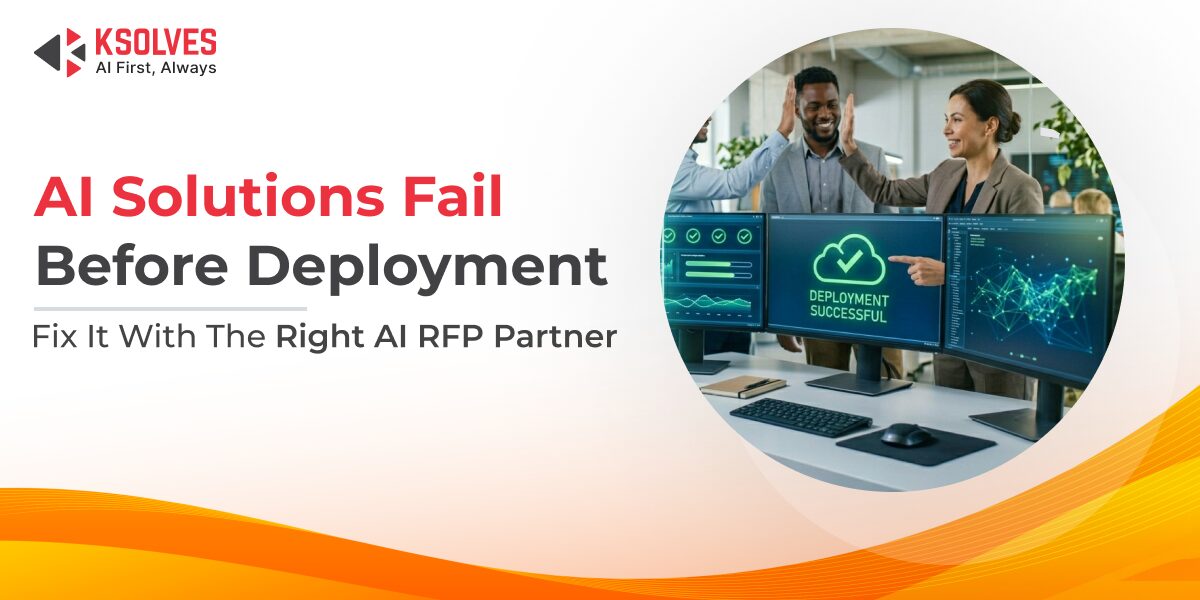
Imagine your organization has invested months of planning, a sizeable budget, and the enthusiasm of an entire leadership team into an AI initiative. The demos were impressive. The vendor was confident. The vision was clear. And then, somewhere between the pilot and production, the whole thing quietly falls apart. No dramatic crash. No single point of failure. Just a slow, expensive fade into irrelevance.
This is not a rare story. It is, in fact, the most common one in enterprise AI today.
The uncomfortable truth is that most AI projects do not fail because the technology does not work. They fail because the strategy around the technology was never solid to begin with. And for organizations pouring resources into digital transformation, that distinction matters enormously. Organizations serious about bridging that gap typically turn to structured AI/ML services rather than attempting to build the strategy and the technology simultaneously.
In this blog, we will pull back the curtain on why so many AI initiatives stall before deployment, covering the five root causes that derail even well-funded projects, why choosing the right AI partner through a structured RFP for AI process is one of the most consequential decisions your organization will make, what it truly means for AI solutions to be deployment-ready, and a practical four-step framework that IT decision makers and digital transformation leaders can apply right now.
The Scale of the Problem: AI Failure Is More Common Than You Think
The gap between AI ambition and AI delivery is wider than most organizations care to admit publicly. According to a report, 88% of organizations now use AI in at least one business function, yet nearly two-thirds are still stuck in the experimentation or piloting phase, with only about one-third having genuinely scaled AI across the enterprise.
These are not scrappy startups experimenting without resources. Many are Fortune 500 companies, government agencies, and ERP-heavy enterprises with substantial IT budgets and experienced teams. The failure rates point to a systemic, strategic problem, not a technology one. What fails is not the algorithm. What fails is everything surrounding it: the planning, the people, and the process.
The 5 Root Causes of AI Project Failure
Most AI implementation failures share the same handful of root causes. Recognizing them early is the difference between a successful rollout and an expensive lesson your organization did not need to learn the hard way.
- Vague or Shifting Business Objectives
AI projects that begin without a clearly defined business problem almost always fail to deliver value. Teams invest months building models without knowing what success looks like or who the end users are. Before evaluating any AI solutions, leaders must define the specific outcome they are solving for, whether that is reducing invoice processing time by 40%, cutting customer churn by a defined percentage, or improving demand forecasting accuracy within an ERP environment. Clarity at the start is not optional but a foundation for everything else.
- Poor Data Quality and Governance
No AI model outperforms the data it is trained on. A well-established framework for data governance in machine learning addresses these issues before model training begins, not after costly failures surface in production. This is especially common in organizations running large ERP platforms where data pipelines were never designed with AI readiness in mind. Building AI on bad data not only produces poor results but also produces confidently wrong results, which can be far more damaging than no AI at all.
- Misaligned Stakeholder Expectations
Technical teams and business leaders often operate with fundamentally different mental models of what AI can do and how long it takes to do it. Data scientists speak in probability and model performance metrics. Executives speak in ROI and deployment timelines. Without a shared language and clearly documented milestones, frustration compounds steadily. Projects get cancelled not because they were technically failing, but because stakeholders had lost confidence in the AI strategy long before the work was ever completed.
- Choosing the Wrong AI Partner
This is where many well-intentioned AI initiatives quietly unravel. When organizations issue an RFP for AI services without a rigorous evaluation framework, they frequently end up with vendors who look impressive on paper but lack the depth to deliver in production environments. The wrong AI partner can not only drain your budget but also set back your organization’s AI readiness by months or even years. Vendor selection in AI is not a procurement formality. It is one of the highest-leverage decisions in your entire AI strategy.
- Lack of Change Management and User Adoption Planning
You can build the most accurate predictive model in the world, but if the people who are supposed to use it do not understand it, do not trust it, or cannot fit it into their daily workflows, the project has failed. AI deployment is a human challenge as much as a technical one. Organizations that invest in change management, training, and structured feedback loops from the start dramatically increase their odds of achieving meaningful adoption.
Why the RFP for AI Process Is Your Most Underused Strategic Asset
When enterprises decide to pursue AI, they typically focus on the technology itself. What they underinvest in is the process of selecting who will build and deliver it. A well-structured RFP for AI is not a bureaucratic exercise. It is the mechanism through which your organization defines its requirements, tests vendor capability, and protects itself from costly mismatches before a single line of code is written.
For a vendor-side view of what makes an AI RFP effective, Ksolves has published a detailed breakdown of exactly what evaluation criteria our technical teams look for before scoping any engagement.
- A precise use case description with measurable success criteria
- Data availability, format, and governance requirements
- Integration specifications for ERP, CRM, or other enterprise platforms
- Scalability, performance benchmarks, and model monitoring expectations
- Compliance, privacy, security, and regulatory requirements
- Vendor track record with deployments in your specific industry
- Post-deployment support, model maintenance, and retraining obligations
The challenge most IT decision makers face is that responding to an RFP for AI requires highly specialized expertise that most internal teams cannot provide on short notice. This is precisely where a dedicated AI RFP partner becomes critical. Ksolves, for instance, offers enterprise AI RFP execution services designed to help organizations move from requirements to deployment-ready AI solutions with strategic thinking, technical depth, and full compliance documentation built in. With over 12 years of experience, 100+ AI developers and consultants, and a 90% client retention rate across 30+ countries, Ksolves brings the kind of structured delivery that most organizations simply cannot replicate on their own.
This applies equally to broader technology engagements – organizations exploring RFP for IT services across cloud, data, or ERP platforms face similar selection risks and benefit from the same structured evaluation approach.
When IT decision makers engage the right AI partner through a structured RFP process, they accomplish something no amount of internal deliberation can replicate: surfacing the real capabilities, risks, and trade-offs of every vendor before committing organizational resources. That informed alignment is worth more than any feature checklist.
Building AI Solutions That Are Actually Deployment-Ready
Here is a distinction that does not get enough attention: a proof of concept is not an AI deployment. Many organizations celebrate the completion of a pilot without stopping to ask the harder question: can this work reliably, at scale, in production with real users and real consequences? This is precisely where MLOps consulting becomes essential – providing the automated pipelines, model versioning, and monitoring infrastructure that keep AI solutions production-reliable beyond launch day.
For digital transformation leaders, the checklist for true deployment readiness should include model versioning and rollback capabilities, automated monitoring for model drift, clear escalation protocols when AI confidence falls below defined thresholds, and a governance layer that ensures accountability at every level. The organizations that treat AI readiness as an ongoing operational responsibility rather than a one-time launch moment are the ones that sustain genuine AI value over the long term.
A Practical Framework for AI Leaders: Define, Evaluate, Pilot, Scale
If you are an IT decision maker or digital transformation leader looking for a structured place to start, this four-step framework is designed to reduce risk and meaningfully improve your odds of a successful AI deployment:
- Define: Articulate the business problem with precision. What decision or process will AI improve? Who owns the outcome? What does success look like in measurable, time-bound terms?
- Evaluate: Issue a rigorous RFP for AI services and assess respondents on more than their demos. Look for documented deployments in your industry, clear integration capability with your existing ERP environment, and transparent model governance practices. Consider working with an experienced AI RFP partner like Ksolves to ensure your evaluation criteria are comprehensive and your shortlisting process is defensible.
- Pilot: Run a structured pilot with real data, real users, and defined success metrics. Treat it as a genuine learning exercise, not a rubber stamp for a decision already made. Involve end users from the beginning to surface adoption friction early.
- Scale: Once the pilot validates the AI solution, build a scaling roadmap that includes governance, training, monitoring, and active feedback channels. Scaling is not simply running the pilot on more data. It requires a fully operational infrastructure built to support it.
Conclusion
The most common reason AI projects fail before deployment is not a shortage of talent or technology. It is a shortage of structured thinking applied at the right moments. Organizations that rush to select AI solutions before clearly defining their problem, honestly assessing their data, and genuinely aligning their stakeholders are setting themselves up for expensive and avoidable disappointments.
For IT decision makers and digital transformation leaders, the path forward is straightforward even when it is not easy: treat AI readiness as a prerequisite, not an afterthought. Use the RFP for AI process to hold vendors accountable before a single commitment is made. And internalize the fact that successful AI implementation is not a launch event. It is a sustained, deliberate operational commitment.
The organizations winning with AI are not the ones who moved the fastest. They are the ones who moved with the most intention.































Author
About the Author Editorial Team The Ksolves Editorial Team includes certified Salesforce experts, Big Data engineers, AI/ML specialists, Zoho consultants, and experienced technology writers focused on delivering clear, actionable insights for modern businesses. With hands-on experience across Salesforce, Big Data platforms, AI/ML solutions, application development, software testing, and Zoho ERP/CRM, the team publishes practical guides, real-world use cases, and industry updates that support smarter decisions and faster growth. Every article is created to solve business challenges, guide technology adoption, and keep organizations aligned with evolving digital ecosystems.
Share with