



Apache NiFi vs GCP Dataproc: Which One Actually Fits Your Stack?
Big Data
5 MIN READ
March 22, 2026

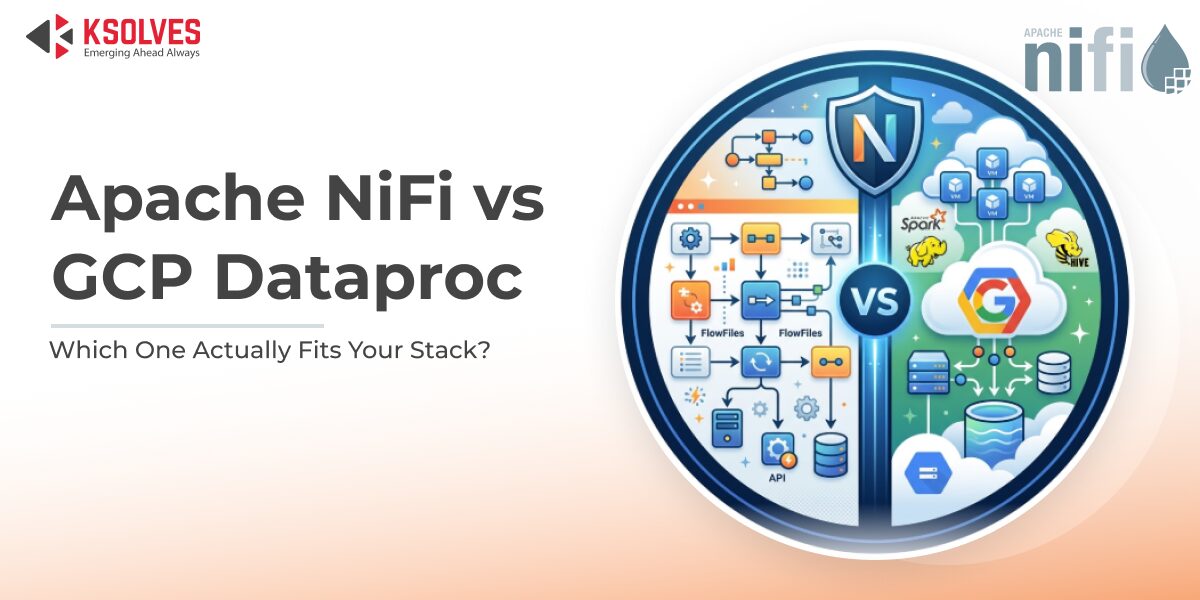
Selecting the right data pipeline tool is one of the most consequential architectural decisions an engineering team will make. Apache NiFi and Google Cloud Dataproc are both widely adopted in enterprise environments, yet they address fundamentally different challenges within the data engineering stack.
Apache NiFi is an open-source data ingestion and routing platform built for reliable, auditable data movement across heterogeneous systems. GCP Dataproc is a fully managed cloud service for executing Apache Spark and Hadoop workloads at scale. Understanding the distinction between these two platforms is essential before committing to either one.
This article provides a structured, keyword-informed comparison covering architecture, ETL suitability, real-world use cases, pricing, and a clear decision framework for data engineering teams in 2026.
What Is Apache NiFi?
Apache NiFi is an open-source dataflow automation platform originally developed by the National Security Agency and donated to the Apache Software Foundation. It is purpose-built for automated, reliable, and auditable data movement across diverse source and destination systems.
How Apache NiFi Works
NiFi operates through a visual drag-and-drop user interface where engineers connect processors to build data flows without writing extensive code. Data travels as FlowFiles, which carry both content and descriptive metadata attributes, through a directed network of processors. Each processor handles a specific task such as fetching from a REST API, transforming a file format, applying conditional routing, or writing to a target system such as a data lake or data warehouse.
The platform includes over 300 built-in processors supporting REST APIs, JDBC databases, Apache Kafka, SFTP, HDFS, cloud storage, and MQTT for IoT device connectivity. Custom processors can be developed in Java for specialised requirements.
Key Strengths of Apache NiFi
NiFi delivers three capabilities that are difficult to replicate with other tools. First, it handles real-time data ingestion from multiple concurrent sources with built-in scheduling, retry logic, error routing, and connection pooling managed natively. Second, its built-in data provenance system records the complete journey of every FlowFile, including origin, every transformation applied, and final destination, providing the data integrity and traceability required for GDPR, HIPAA, and SOX compliance. Third, its backpressure and flow control mechanism pauses upstream processors automatically when downstream systems are overloaded, ensuring pipeline stability without manual intervention.
NiFi 2.x Clustering Update
NiFi 2.x replaced ZooKeeper-based clustering with an embedded Raft consensus mechanism, significantly simplifying high-availability deployments. Any documentation referencing ZooKeeper as a NiFi clustering requirement describes the superseded NiFi 1.x architecture.
Limitations of Apache NiFi
NiFi is a routing and ingestion engine, not a distributed compute engine. Large-scale data transformations require integration with Apache Spark or Apache Flink. Very large pipeline canvases can become operationally complex, and horizontal scaling requires more engineering discipline than a fully managed cloud service.
For a detailed look at how NiFi solves production-scale dataflow challenges, the Ksolves guide on 10 Common Data Flow Challenges Solved by Apache NiFi covers the most frequently encountered scenarios in enterprise deployments.
What Is GCP Dataproc?
Google Cloud Dataproc is a fully managed service for running Apache Spark, Hadoop, Hive, Pig, and Flink workloads on Google Cloud infrastructure. It provides the power of the open-source big data ecosystem without the operational burden of cluster provisioning, configuration, and maintenance.
How GCP Dataproc Works
Dataproc provisions a cluster in approximately 90 seconds, executes the submitted job, and the cluster can be terminated immediately upon completion. Teams pay only for active compute time rather than sustaining persistent infrastructure between job runs.
Dataproc Serverless, now widely adopted across enterprise GCP environments, removes cluster management entirely. Engineers submit Spark workloads and Google Cloud handles resource allocation, autoscaling, and teardown automatically, with billing calculated per workload.
Key Strengths of GCP Dataproc
Dataproc excels at distributed batch processing at the petabyte scale. It provides deep, native integration with BigQuery, Cloud Storage, Pub/Sub, Vertex AI, and Cloud Composer for Apache Airflow-based orchestration. Autoscaling adjusts worker node capacity based on real-time job demand, and preemptible VMs reduce worker compute costs by 60 to 80 percent for fault-tolerant workloads.
Limitations of GCP Dataproc
Dataproc requires writing Spark, Hive, or Hadoop code and provides no visual pipeline builder. The service is tightly coupled to GCP, creating vendor dependency. For managed streaming with exactly-once processing guarantees inside GCP, Google Dataflow is the appropriate service. Dataproc is batch-first, and its Spark Streaming capability operates on micro-batch intervals rather than true event-level real-time processing.
Real-World Use Cases: Which Tool Is the Right Fit?
Use Case 1: Enterprise Data Ingestion from Multiple Sources
An organisation must ingest data reliably from 40 upstream systems, including relational databases, REST APIs, flat file feeds, and IoT sensors, delivering all records into a central data lake with full error handling and an audit trail.
Apache NiFi is the correct choice. Its processor library covers virtually every source type, and its backpressure mechanism and provenance tracking ensure reliability and data integrity by design. Dataproc provides no native capability for managing heterogeneous source connectivity at this level.
For a practical walkthrough of this architecture, the Ksolves article on real-time data ingestion and batch processing with Apache NiFi demonstrates the pattern with concrete implementation examples.
Use Case 2: Large-Scale Nightly Batch Transformation
Ten terabytes of application logs arrive in Cloud Storage nightly and must be parsed, aggregated, joined against reference datasets, and loaded into BigQuery before morning analytics dashboards refresh.
GCP Dataproc is the correct choice. A well-configured Spark job on a Dataproc cluster processes this volume in minutes. NiFi is a routing engine and is not designed for distributed record-level compute at this scale.
Use Case 3: Real-Time IoT Data Streaming
Sensor data arrives at 100,000 events per second and requires sub-second routing, metadata enrichment, and delivery to downstream consumers.
Apache NiFi is the appropriate ingestion and routing layer, typically combined with Apache Kafka for high-throughput message buffering. The Ksolves guide on how Spark, NiFi, and Kafka redefine big data workflows explains this combined architecture in detail. Dataproc Spark Streaming operates on micro-batch intervals and is not suited for sub-second event routing.
Use Case 4: GCP-Native Machine Learning Feature Pipelines
A team building on BigQuery ML and Vertex AI requires Spark-based feature engineering pipelines that read from BigQuery, apply transformations, and write engineered features back for model training.
GCP Dataproc is the clear choice. Native BigQuery integration requires no additional configuration, and Cloud Composer provides Apache Airflow-based orchestration within the same GCP IAM boundary. Introducing NiFi into a fully GCP-native stack would add operational complexity without proportional benefit.
Pricing Comparison
- Apache NiFi Pricing
NiFi is free and open source. Operational costs include compute instances, storage, and the engineering effort required for cluster management and version upgrades. The commercial Cloudera DataFlow distribution starts at approximately $5,000 to $10,000 per year for smaller deployments.
- GCP Dataproc Pricing
Dataproc is billed per vCPU-hour and per GB-hour across master and worker nodes. A standard three-node cluster runs approximately $0.50 to $1.00 per hour depending on machine type and region. Dataproc Serverless is billed per workload, making it cost-efficient for intermittent batch jobs. The most significant cost risk with standard Dataproc is failing to terminate clusters after job completion, as idle clusters accumulate charges continuously. Preemptible VMs reduce worker node costs by 60 to 80 percent for fault-tolerant workloads.
How to Choose Between Apache NiFi and GCP Dataproc
Before finalising this decision, reviewing NiFi in the context of other commonly evaluated tools provides a useful additional perspective. The Ksolves comparison of Apache NiFi vs Azure Data Factory covers a frequently considered alternative, and the Apache NiFi vs Apache Airflow guide clarifies the boundary between data ingestion and workflow orchestration.
Choose Apache NiFi when the primary challenge is connecting and ingesting from diverse data sources, enforcing data governance and compliance requirements, maintaining data integrity across pipeline stages, or operating across hybrid or multi-cloud environments.
Choose GCP Dataproc when the primary challenge is large-scale batch transformation using Spark or Hadoop and the team is already operating within the GCP ecosystem.
Use both tools together in a mature enterprise data platform. NiFi manages the ingestion and routing layer, Cloud Storage serves as the centralised landing zone, Dataproc handles distributed transformation, and BigQuery serves the analytics and reporting layer.
Ksolves Apache NiFi Services: Enterprise-Grade Implementation and Support
For organisations that have determined Apache NiFi is the right fit for their data architecture, the next step is deciding whether to implement it internally or engage specialists with deep platform expertise.
Ksolves has over a decade of Apache NiFi experience delivering enterprise data solutions across logistics, healthcare, fintech, retail, and telecommunications. Our Big Data team provides comprehensive NiFi services, including pipeline design and development, NiFi 1.x to 2.x upgrades, high-availability cluster configuration, real-time streaming architectures with Apache Kafka and Apache Spark, and ongoing managed support. For organisations combining NiFi with GCP, we design and implement the full integration layer connecting NiFi pipelines with Dataproc, BigQuery, and Cloud Storage.
Our Apache NiFi support services provide access to certified engineers for proactive monitoring, incident response, and continuous performance optimisation. Contact our experts to arrange a complimentary architecture review and discuss your requirements.































Author
About the Author Editorial Team The Ksolves Editorial Team includes certified Salesforce experts, Big Data engineers, AI/ML specialists, Zoho consultants, and experienced technology writers focused on delivering clear, actionable insights for modern businesses. With hands-on experience across Salesforce, Big Data platforms, AI/ML solutions, application development, software testing, and Zoho ERP/CRM, the team publishes practical guides, real-world use cases, and industry updates that support smarter decisions and faster growth. Every article is created to solve business challenges, guide technology adoption, and keep organizations aligned with evolving digital ecosystems.
Share with