



Apache Kafka Stream Processing: Real-World Use Cases in 2026
Apache Kafka
5 MIN READ
May 5, 2026

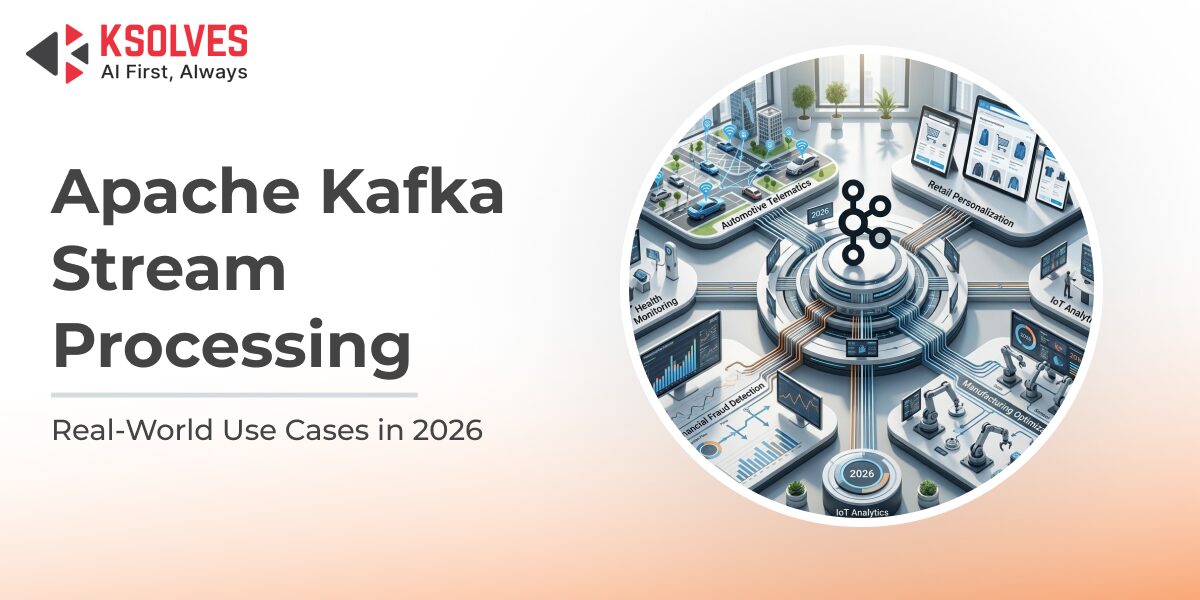
In 2026, data streaming has moved from an infrastructure experiment to a strategic necessity. Enterprises across finance, retail, healthcare, and manufacturing are building entire operating models around the ability to act on data the moment it is generated. Batch processing, once the default, is now the fallback. Apache Kafka has become the platform that makes real-time streaming reliable enough to stake a business on.
More than 80% of Fortune 100 companies run Kafka in production, a figure consistent with what Ksolves sees across its own Apache Kafka development engagements. Kafka handles millions of events per second with latencies as low as 2ms, scales horizontally to thousands of brokers and trillions of messages per day, and maintains data durability through replication across brokers and availability zones. Kafka 4.x has also completed the transition from ZooKeeper to KRaft (Kafka Raft Metadata mode), removing an entire layer of operational complexity that historically made large-scale deployments harder to manage.
The following sections walk through the ten most common Apache Kafka stream processing use cases, with concrete examples of how each plays out in real production environments.
- Log Aggregation Across Distributed Systems
Kafka consolidates log data from servers, applications, and devices into a centralized repository. Logs are written to Kafka topics, which are partitioned and replicated for fault tolerance. Downstream consumers, such as log analysis tools or alerting systems, process those logs in real time as they arrive.
The practical benefit is straightforward. Instead of SSH-ing into individual servers to debug an incident, operations teams get a single stream they can query and monitor continuously. Critical events like server failures or security incidents trigger automated alerts before they escalate.
- Metrics Collection and Performance Monitoring
Web applications, microservices, and infrastructure components emit metrics constantly: response times, error rates, memory usage, and throughput. Kafka ingests all of this in real time and routes it to monitoring dashboards or anomaly detection systems.
A web application team, for example, can use Kafka to collect response time and error rate data, analyze it in a streaming window, and surface degradation before users start filing support tickets. The same pipeline that feeds the monitoring dashboard can also trigger automated scaling decisions.
- Event-Driven Architecture for Microservices
In a microservices architecture, services need to communicate without becoming tightly coupled to one another. Kafka solves this cleanly. Each microservice publishes events to a Kafka topic. Other services subscribe to the topics they care about. Neither side knows nor cares about the other’s internals.
This loose coupling is the key architectural benefit. Teams can deploy, update, or scale individual services independently. The overall system keeps working even when individual components are being changed, because Kafka’s durable log retains events until every subscriber has consumed them.
- Fraud Detection in Real Time
Fraud detection systems need to evaluate transactions against behavioral baselines within milliseconds. Kafka supports this by collecting transaction data, customer behavior signals, and identity verification events into a single real-time pipeline.
Financial institutions and e-commerce platforms use this approach to detect patterns that indicate fraud, including stolen credit card use, forged account numbers, and duplicate transactions. The detection logic runs in a stream processing layer, such as Kafka Streams or Apache Flink, consuming events from Kafka topics and flagging suspicious activity before the transaction completes rather than catching it during an overnight batch review.
- Financial Transaction Processing and Settlement
The financial industry depends on Kafka for three distinct workloads. First, trade processing: trading platforms publish trade events to a Kafka topic and settlement systems subscribe to receive and finalize each trade in real time. Second, risk management: real-time data from customer transactions, market feeds, and credit systems flows into Kafka for continuous risk assessment. Third, market analysis: stock prices, trading volumes, and news events are aggregated in Kafka and analyzed to identify trends or anomalies. Each of these workloads shares the same core requirement: act on data within seconds of it being generated, not minutes.
- IoT Data Processing and Device Management
Internet of Things deployments generate enormous volumes of telemetry data from sensors and connected devices. Kafka handles this at scale without data loss, even when devices transmit simultaneously across thousands of endpoints.
Three IoT applications stand out in practice:
- Predictive maintenance: Devices transmit performance and usage data continuously. Kafka routes this to models that flag components likely to fail before they actually do, reducing unplanned downtime.
- Traffic management: Traffic sensors feed real-time flow and congestion data into Kafka. Downstream systems adjust signal timing and routing recommendations dynamically.
- Energy optimization: Smart meters and building systems send consumption data through Kafka pipelines, where it is analyzed to reduce waste and improve load balancing.
- User Activity Tracking and Personalization
Web and mobile applications publish user events (page views, clicks, searches, and purchases) to Kafka topics. This stream feeds real-time analytics systems that generate personalized recommendations, targeted content, and behavioral insights.
The value of doing this in real time rather than in nightly batch jobs is significant. A recommendation that surfaces two hours after a user searched for a product is far less useful than one that appears within seconds. Kafka enables the latter. The same stream also feeds fraud and abuse detection, flagging unusual activity patterns as they emerge.
- Customer 360: Unified Customer Intelligence
Building a complete picture of each customer requires combining data from multiple channels: in-store behavior, online activity, purchase history, support interactions, and loyalty program data. Kafka makes this possible in real time.
Organizations use Kafka-powered Customer 360 pipelines to correlate in-store and online behavior, analyze clickstream data to understand the full customer journey, match user identities across platforms, and develop more effective loyalty programs based on actual behavioral data rather than demographic assumptions.
- Cybersecurity Monitoring and Threat Detection
Security operations centers need to process massive volumes of log and event data to identify threats before they cause damage. Kafka serves as the backbone of real-time security monitoring pipelines.
Common cybersecurity applications include monitoring audit logs for suspicious activity, identifying firewall denial events, detecting DDoS attack patterns, and analyzing SSH attack signatures. The ability to process these signals in real time, rather than reviewing them in daily log files, is the difference between catching an intrusion early and discovering it after the damage is done.
How Ksolves AI-First Approach Delivers Smarter Kafka Solutions
Kafka implementations fail not at the code level but at the architecture level: wrong partition counts, unplanned schema changes, misconfigured consumer groups, and ignored KRaft migration requirements in Kafka 4.x deployments. Ksolves brings over a decade of Big Data experience to every engagement. Our Apache Kafka development team uses AI-assisted tools during the design phase to model throughput, simulate partitioning strategies, and surface bottlenecks before a line of production code is written. This reduces rework, shortens delivery cycles, and lowers overall project cost. For ongoing Kafka support, contact us.
Conclusion
Apache Kafka has earned its position as the standard platform for stream processing by solving a genuinely hard problem: making real-time data reliable at scale. The ten use cases covered here, spanning log aggregation, fraud detection, IoT, cybersecurity, and Customer 360, represent the most common ways organizations are putting Kafka to work in 2026. Each use case is powerful on its own, but the real return comes when Kafka is implemented correctly from the start with a thoughtful architecture that accounts for growth, fault tolerance, and maintainability. If your organization is evaluating Kafka or looking to improve an existing deployment, Ksolves is ready to help. Contact the team at [email protected] to start the conversation.
Frequently Asked Questions
What is Apache Kafka stream processing?
Apache Kafka stream processing is the practice of consuming, transforming, and analyzing event streams in real time as they flow through Kafka topics, rather than processing data in scheduled batch jobs. It uses libraries such as Kafka Streams or external engines like Apache Flink to apply filtering, aggregation, and enrichment logic on millions of events per second with millisecond latency.
What are the most common Apache Kafka use cases in 2026?
The most common Apache Kafka use cases in 2026 are log aggregation, metrics and performance monitoring, event-driven microservices, real-time fraud detection, financial transaction processing, IoT telemetry pipelines, user activity tracking, Customer 360 intelligence, and cybersecurity threat detection. More than 80% of Fortune 100 companies now run Kafka in production for at least one of these workloads.
What changed with Kafka 4.x and the KRaft transition?
Kafka 4.x completed the move from ZooKeeper to KRaft (Kafka Raft Metadata mode), so cluster metadata is now managed inside Kafka itself using a Raft consensus protocol. This removes the need to run and maintain a separate ZooKeeper ensemble, simplifies operations, speeds up leader elections, and eliminates an entire class of failure modes that affected large-scale deployments.
Is Kafka Streams or Apache Flink better for real-time stream processing?
Kafka Streams is best when the entire pipeline lives inside Kafka and you want a lightweight, JVM-embedded library with minimal operational overhead. Apache Flink is better when you need stateful complex event processing, exactly-once semantics across heterogeneous sources, advanced windowing, or integration with non-Kafka systems at scale. Many production architectures use both — Kafka Streams for in-Kafka transformations and Flink for cross-system stream analytics.
How does Apache Kafka help with fraud detection?
Apache Kafka helps with fraud detection by streaming transaction data, customer behavior signals, and identity events into a unified pipeline that fraud-scoring models consume in real time. Detection logic running in Kafka Streams or Apache Flink can flag suspicious activity within milliseconds, allowing fraud to be blocked before the transaction completes rather than discovered during overnight batch review.
When should a business move beyond basic Kafka support to Kafka consulting?
A business should move beyond basic Kafka support to Kafka consulting when it faces recurring scaling problems, growing outages, governance issues, complex security requirements, or planned migrations such as ZooKeeper-to-KRaft. Support solves immediate incidents reactively, while consulting designs the architecture, partitioning strategy, and security posture that prevent those incidents from recurring.
Who provides Apache Kafka stream processing implementation services?
Ksolves provides end-to-end Apache Kafka stream processing implementation services, including cluster architecture, KRaft migration, partitioning strategy design, Kafka Connect and Kafka Streams development, and 24×7 production support. Ksolves’ AI-first Big Data team uses AI-assisted modeling during the design phase to simulate throughput and surface bottlenecks before any production code is written, which shortens delivery cycles and reduces overall project cost.
Still have questions?
Contact our team — we’re happy to help.
 Atul Khanduri
You add 50 servers to your Apache HBase cluster expecting it to run faster. Instead, everything slows down. You open […]
 Atul Khanduri
For an enterprise, “real-time” has a specific, measurable bar: dashboards that update within seconds of an event happening, and queries […]






























Author
About the Author Editorial Team The Ksolves Editorial Team includes certified Salesforce experts, Big Data engineers, AI/ML specialists, Zoho consultants, and experienced technology writers focused on delivering clear, actionable insights for modern businesses. With hands-on experience across Salesforce, Big Data platforms, AI/ML solutions, application development, software testing, and Zoho ERP/CRM, the team publishes practical guides, real-world use cases, and industry updates that support smarter decisions and faster growth. Every article is created to solve business challenges, guide technology adoption, and keep organizations aligned with evolving digital ecosystems.
Share with