



Cost Benefits of OpenShift for Enterprises: How Ksolves’ AI-Led Approach Maximizes ROI and Reduces Spend
OpenShift
5 MIN READ
June 22, 2026

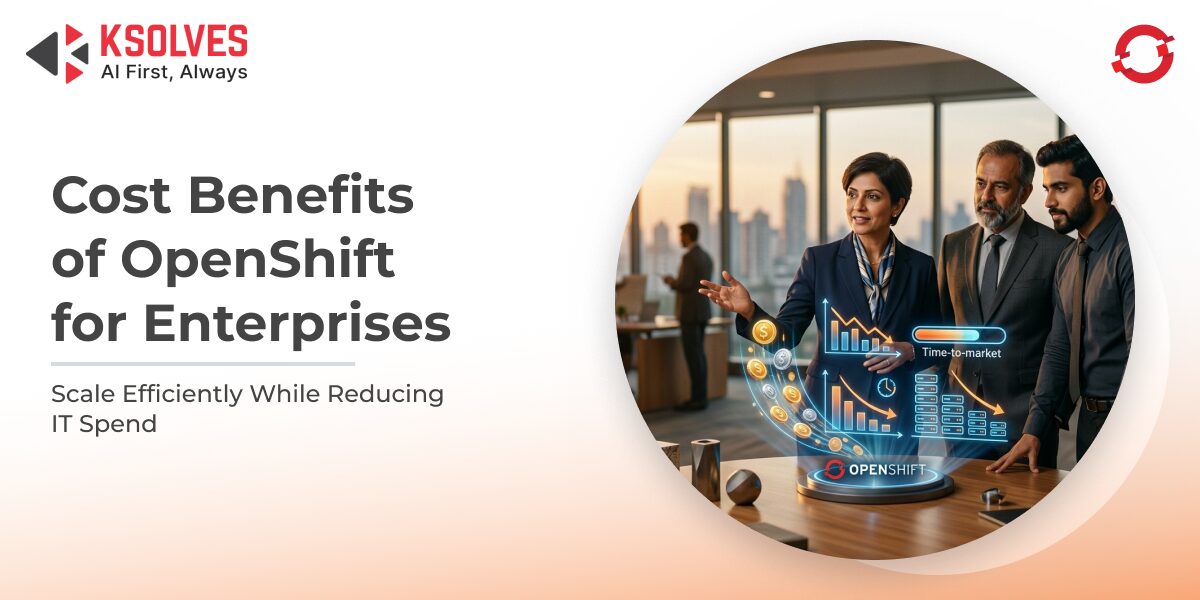
Enterprise IT is no longer just about scaling infrastructure; it’s about scaling intelligently without letting costs spiral out of control. Many organizations that embraced cloud and Kubernetes expected cost efficiency, yet often encounter the opposite: unpredictable cloud bills, fragmented toolchains, and growing operational overhead.
The real challenge is the lack of a unified, optimized approach to managing scale. Without standardization and built-in controls, even modern platforms can become expensive to operate.
Red Hat OpenShift changes this equation by combining Kubernetes with enterprise-ready automation, governance, and integrated tooling. It helps organizations bring cost discipline to complex, distributed environments while still enabling rapid growth.
This blog explores how OpenShift helps enterprises reduce spend without compromising scale, and where the real cost advantages come from. Also, we will explore how Ksolves, an AI-first OpenShift consulting company, helps maximize the cost benefits of OpenShift.
Understanding Enterprise Cost Challenges in Modern IT
Before evaluating OpenShift, it’s critical to understand where and why enterprise IT costs escalate. In most cases, rising spend is not driven by a single factor, but by compounding inefficiencies across infrastructure, tooling, and operations.
Key Cost Drivers
- Cloud sprawl and poor resource allocation lead to underutilized or idle infrastructure.
- Tool fragmentation increases licensing costs and integration complexity.
- Heavy reliance on manual operations and DevOps intervention.
- Unplanned downtime impacts revenue, productivity, and customer experience.
Hidden Costs That Often Go Unnoticed
- Overprovisioned compute and storage are inflating cloud bills.
- Inefficient CI/CD pipelines are slowing releases and increasing rework.
- Security and compliance gaps require additional tools and remediation efforts.
- Skill shortages driving higher hiring, onboarding, and training expenses.
Over time, these visible and hidden costs compound, making it difficult to control budgets or scale efficiently. Without a standardized and integrated platform, enterprises often end up increasing their total cost of ownership (TCO) while trying to grow.
What is OpenShift and Why Does it Matter for Cost Optimization
Red Hat OpenShift is an enterprise-grade Kubernetes platform that goes beyond orchestration by delivering a fully integrated, production-ready ecosystem. It combines Kubernetes with built-in automation, security, and developer tooling, eliminating much of the complexity typically associated with managing containerized environments at scale.
Unlike DIY Kubernetes setups, where teams must assemble and maintain multiple tools, OpenShift offers a unified platform experience:
- Pre-integrated DevOps capabilities to streamline build, deploy, and release cycles.
- Built-in security and compliance controls embedded across the application lifecycle.
- Automated deployment, scaling, and lifecycle management.
- Consistent operations across on-premises, hybrid, and multi-cloud environments.
This level of integration reduces tool sprawl, manual effort, and operational risk – all of which are major cost drivers. As a result, OpenShift enables enterprises to achieve greater cost efficiency, predictable operations, and faster time-to-value from their infrastructure investments.
Also Read: Understanding OpenShift Architecture: A Beginner’s Guide
The Real Cost Benefits of OpenShift for Enterprises
OpenShift delivers cost advantages not through a single feature, but through a combination of efficiency, automation, and platform standardization. These benefits directly impact both capital and operational expenditure, while supporting enterprise-scale growth.
1. Optimized Resource Utilization
OpenShift maximizes infrastructure efficiency by leveraging containerization and intelligent workload orchestration.
- Higher workload density compared to traditional virtual machines.
- Dynamic auto-scaling based on real-time demand.
- Smarter scheduling to reduce unused or idle resources.
Impact: More efficient infrastructure usage leads to significantly lower compute and storage costs across environments.
2. Reduced Operational Overhead
Running Kubernetes independently often introduces complexity and requires specialized expertise. OpenShift simplifies operations through built-in automation and standardization.
- Automated deployment, scaling, patching, and lifecycle management.
- Consistent environments across development, testing, and production.
- Reduced reliance on large, highly specialized DevOps teams.
Impact: Lower operational burden translates into reduced staffing costs and improved team efficiency.
3. Faster Time-to-Market Lowers Development Costs
In enterprise environments, delays in delivery directly increase costs. OpenShift accelerates development with a streamlined and developer-friendly ecosystem.
- Integrated CI/CD pipelines for faster build and release cycles.
- Self-service capabilities that reduce dependency on operations teams.
- Faster testing, iteration, and deployment workflows.
Impact: Accelerated delivery reduces development overhead and enables quicker realization of business value.
4. Built-in Security Minimizes Risk-Related Costs
Security is a major cost center when handled reactively. OpenShift embeds security and compliance into the platform by design.
- Role-Based Access Control (RBAC) and policy enforcement.
- Automated patching and vulnerability management.
- Integrated compliance frameworks across workloads.
Impact: Reduced need for additional security tools and lower exposure to costly breaches, penalties, and remediation efforts.
5. Multi-Cloud Flexibility Prevents Vendor Lock-In
OpenShift enables true workload portability across hybrid and multi-cloud environments, giving enterprises greater control over costs.
- Seamless movement of applications across cloud providers and on-premises.
- Flexibility to choose the most cost-effective infrastructure for each workload.
- Reduced dependency on a single vendor’s pricing model.
Impact: Improved cost governance and long-term financial flexibility in cloud strategy.
6. Improved Reliability and Reduced Downtime
System failures and downtime can result in significant financial and reputational loss. OpenShift enhances resilience through automated recovery and high availability.
- Self-healing containers that restart failed workloads.
- Built-in high availability architecture.
- Automated failover and disaster recovery capabilities.
Impact: Increased uptime reduces revenue loss, operational disruption, and support costs.
Also Read: 10 Common Challenges in OpenShift Adoption and How to Overcome Them with Ksolves’ AI-Led Strategy
OpenShift vs Traditional Infrastructure and DIY Kubernetes
| Aspect | Traditional Infrastructure | DIY Kubernetes | OpenShift Advantage |
| Cost Structure | High capital expenditure on hardware and setup | Lower initial cost but rising long-term expenses | Predictable cost model with better financial planning |
| Scalability | Limited scalability; requires manual expansion | Scalable but requires significant configuration | Built-in, automated scaling across environments |
| Operational Complexity | High maintenance and manual management effort | Complex to set up and manage with multiple components | Simplified operations through automation and standardization |
| Tooling & Integration | Fragmented tools with limited integration | Requires multiple third-party tools and integrations | Unified platform with pre-integrated DevOps and security tools |
| Resource Efficiency | Low utilization due to static provisioning | Better than traditional but depends on expertise | Optimized resource utilization with intelligent scheduling |
| Skill Requirements | Moderate but infrastructure-heavy | High demand for specialized Kubernetes expertise | Reduced skill dependency due to platform abstraction |
| Maintenance & Updates | Manual upgrades and patching | Ongoing maintenance across multiple tools | Automated updates, patching, and lifecycle management |
| Total Cost of Ownership (TCO) | High due to infrastructure and maintenance costs | Hidden costs increase over time | Lower TCO through consolidation, efficiency, and automation |
How Ksolves Maximizes Cost Benefits with AI-Enabled OpenShift Consulting Services
While OpenShift provides a strong foundation for cost efficiency, real savings depend on how effectively the platform is designed, implemented, and continuously optimized. This is where Ksolves, a leading OpenShift consulting company, brings a differentiated, AI-enabled approach, helping enterprises move from potential savings to measurable cost outcomes.
1. AI-Driven Cost Visibility and Optimization
Ksolves integrates AI into OpenShift environments to provide real-time insights into resource consumption and cost patterns.
- Intelligent analysis of workload usage and cost anomalies.
- Identification of overprovisioned or underutilized resources.
- Continuous recommendations for right-sizing and optimization.
Outcome: Improved cost transparency and ongoing reduction in cloud and infrastructure spend.
2. Smart Architecture Design for Cost Efficiency
A poorly designed architecture can quickly inflate costs. Ksolves ensures that OpenShift environments are built for both performance and efficiency from day one.
- Workload placement strategies based on cost and performance needs.
- Optimized cluster sizing and resource allocation.
- Hybrid and multi-cloud architecture tailored for cost control.
Outcome: A cost-efficient foundation that prevents unnecessary spending as systems scale.
3. Automation-Led Operations to Reduce Overhead
Ksolves leverages automation and AI to minimize manual intervention across the OpenShift lifecycle.
- Automated deployment, scaling, and monitoring workflows.
- Self-healing and performance optimization mechanisms.
- Reduced dependency on large DevOps teams.
Outcome: Lower operational costs and higher team productivity.
4. AI-Augmented DevOps for Faster, Cost-Efficient Delivery
Ksolves enhances OpenShift’s DevOps capabilities with AI to accelerate development cycles while controlling costs.
- Intelligent CI/CD pipeline optimization.
- Faster issue detection and resolution.
- Reduced rework and deployment delays.
Outcome: Faster time-to-market with lower development and operational expenses.
5. Built-In Governance and Cost Control Mechanisms
Ksolves implements strong governance frameworks to ensure cost discipline at scale.
- Policy-driven resource allocation and usage limits.
- Continuous monitoring and cost tracking dashboards.
- Compliance and security aligned with enterprise standards.
Outcome: Sustained cost control with reduced risk of overspending or policy violations.
6. Continuous Optimization for Long-Term ROI
Cost optimization is not a one-time effort. Ksolves ensures continuous improvement through AI-led monitoring and refinement.
- Ongoing performance and cost audits.
- Adaptive optimization strategies based on usage trends.
- Proactive identification of inefficiencies.
Outcome: Long-term cost savings and maximized return on OpenShift investment.
The Ksolves Advantage
By combining deep OpenShift expertise with AI-driven methodologies, Ksolves helps enterprises:
- Reduce total cost of ownership (TCO).
- Eliminate inefficiencies across infrastructure and operations.
- Scale confidently without cost overruns.
- Turn OpenShift into a strategic, cost-optimized platform for growth.
In essence, Ksolves doesn’t just implement OpenShift; it ensures that every layer of the platform is aligned with cost efficiency, performance, and business outcomes.
Final Words
OpenShift enables enterprises to reduce costs while scaling efficiently, but its true value depends on how well it is implemented and optimized. With the right strategy and governance, it becomes a long-term cost optimization engine, not just a platform.
Ksolves enhances this value through its AI-enabled OpenShift consulting services, helping organizations achieve measurable savings, operational efficiency, and scalable growth.
Ready to reduce OpenShift costs without limiting scale? Partner with Ksolves!































AUTHOR
OpenShift
Share with