



Agricultural Intelligence: Optimizing Crop Management with Computer Vision
AI
5 MIN READ
May 9, 2026

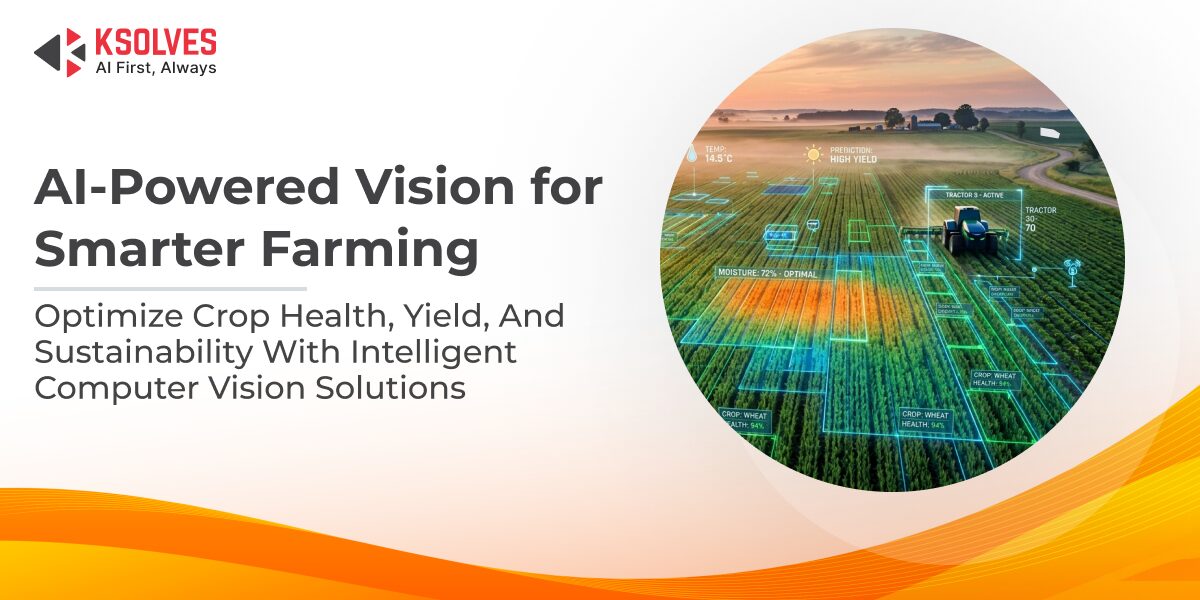
Agriculture has always been the backbone of human civilization. But in the modern era, the sector faces growing challenges, climate uncertainty, pest outbreaks, soil degradation, and the rising demand for sustainable food production. This is where Computer Vision steps in, transforming traditional farming into smart agriculture powered by real-time data and AI-driven insights.
Computer Vision, a field of Artificial Intelligence that enables machines to interpret and process visual data, is revolutionizing how farmers monitor, manage, and optimize crops. From disease detection to yield estimation, AI-powered vision systems are helping farmers make faster, more informed decisions, leading to higher productivity and resource efficiency. In this blog, we’ll explore how Computer Vision technologies are reshaping modern agriculture through intelligent automation and data analytics.
Understanding Computer Vision in Agriculture
Computer Vision enables machines to analyze visual data more quickly and consistently than manual inspection, particularly for repetitive, large-scale monitoring tasks. In agriculture, it involves capturing and analyzing images of plants, soil, and crops using drones, IoT sensors, and camera-equipped machinery. These images are processed through AI algorithms and deep learning models to identify patterns, classify plant health, detect anomalies, and predict outcomes.
As per the study, over the past few years, deep-learning methods have been shown to outperform previous state-of-the-art machine-learning techniques in computer vision, and these advances have enabled large-scale visual analysis, such as real-time crop and plant-disease monitoring.
Hence, unlike traditional manual inspections that are time-consuming and error-prone, Computer Vision enables automated, 24×7 monitoring across extensive farmlands. This not only improves crop management precision but also helps farmers minimize wastage and make data-backed interventions.
Key Applications of Computer Vision in Crop Management
1. Early Disease and Pest Detection
Crop diseases and pest infestations can spread rapidly if not detected early. Computer Vision models trained on large datasets can identify visual symptoms of diseases such as leaf discoloration, spots, or fungal infections at an early stage. By deploying cameras or drones, farmers can continuously scan crops and receive alerts on affected areas. This enables targeted pesticide application, saving time, money, and the environment.
2. Weed Detection and Management
Weeds compete with crops for nutrients and water. With AI-based image segmentation, computer vision systems can distinguish between crops and weeds, enabling precision spraying only where needed, reducing herbicide use, and supporting sustainable agriculture.
However, accuracy depends on image resolution, crop growth stage, and field conditions, and models perform best when trained on region-specific crop-weed datasets.
3. Yield Estimation and Harvest Forecasting
Computer Vision models analyze plant growth patterns and fruit density to estimate expected yields with high accuracy. Techniques like object detection for fruit counting and NDVI analysis from satellite imagery enable yield predictions, though accuracy varies by crop type and imaging resolution.
By leveraging drone or satellite images, farmers and agri-businesses can plan harvest logistics, market strategies, and resource allocation in advance, improving supply chain efficiency and reducing post-harvest losses.
4. Soil and Nutrient Analysis
Using hyperspectral imaging and deep learning, Computer Vision tools can assess soil texture, color, and nutrient levels. This helps determine optimal fertilization schedules and identify regions suffering from nutrient deficiencies or moisture imbalance. Automating this analysis leads to better soil health management and supports long-term sustainability.
5. Crop Monitoring via Drones
Drones equipped with Computer Vision cameras provide aerial imaging to monitor crop growth, irrigation coverage, and field conditions. With machine learning algorithms, farmers can spot areas under stress or affected by water scarcity, enabling faster corrective action. This aerial intelligence forms the foundation of precision farming, where every action is driven by data rather than assumption.
Advantages of Using Computer Vision in Agriculture
Integrating Computer Vision in agriculture offers benefits beyond automation as it fosters data-driven decision-making that enhances both productivity and sustainability. From predictive maintenance in manufacturing to smart irrigation in agriculture, Ksolves’ AI services are purpose-built to turn raw operational data into reliable, real-world outcomes across every industry vertical.
Some key advantages include:
- Real-time monitoring: Continuous visual data enables timely action against threats.
- Higher yield and quality: AI-based insights improve crop performance and minimize losses.
- Reduced resource usage: Precision targeting minimizes fertilizer, pesticide, and water waste.
- Sustainability: Promotes eco-friendly farming by optimizing input use.
- Labor efficiency: Reduces manual inspection efforts, especially across large fields.
With increasing digital transformation in agriculture, Computer Vision systems have become an integral part of smart farming ecosystems, integrating seamlessly with IoT devices and cloud analytics platforms.
Future of Agricultural Intelligence with Computer Vision
The future of farming lies in AI-powered agricultural intelligence. As deep learning models become more sophisticated, Computer Vision will move beyond basic detection to predictive analytics and automated decision-making. For instance, upcoming technologies are enabling autonomous tractors, robotic harvesters, and AI-driven irrigation systems, all guided by real-time visual data. Combined with satellite imaging and weather analytics, Computer Vision is set to create fully connected, intelligent farms capable of self-optimization.
Moreover, as global food demand rises, Computer Vision solutions will play a critical role in ensuring food security, reducing waste, and improving the overall efficiency of agricultural supply chains.
Partner with Ksolves for Advanced Computer Vision Solutions
At Ksolves, we empower agritech organizations and enterprises to build next-generation solutions using our Computer Vision services. Our expertise spans image processing, AI model development, and custom agricultural intelligence platforms that transform visual data into actionable insights.
Whether you’re developing a drone-based crop monitoring system, an AI pest detection model, or a smart irrigation solution, Ksolves helps accelerate your innovation with robust, scalable Computer Vision architectures.
Conclusion
Computer Vision is redefining how farmers grow, monitor, and manage crops. By turning visual data into intelligence, it bridges the gap between traditional farming practices and modern agritech innovation. From early disease detection to yield prediction, the integration of Computer Vision in agriculture represents a vital step toward data-driven, sustainable farming.
With trusted partners like Ksolves, agricultural organizations can leverage AI not just to optimize crop management but to shape the future of intelligent, resilient, and sustainable food production.
Frequently Asked Questions
What is computer vision in agriculture and how does it work?
Computer vision in agriculture is the application of AI-powered image processing to analyze visual data from crops, soil, and fields captured by drones, IoT cameras, and satellite sensors. Deep learning models process these images to classify plant health, detect diseases, identify weeds, and estimate yields — all automatically and at scale. Unlike manual field inspections, computer vision systems operate continuously and with consistent accuracy across large farmlands.
How can AI-powered disease detection help farmers reduce crop losses?
AI-powered disease detection uses computer vision models trained on large labeled datasets to identify early visual symptoms of fungal infections, pest damage, and leaf discoloration before they spread. By deploying drones or fixed cameras for continuous field scanning, farmers receive automated alerts and can apply targeted interventions — saving time, reducing pesticide costs, and preventing widespread crop damage. Early detection can significantly improve yield quality and reduce post-harvest losses.
What role do drones play in precision farming with computer vision?
Drones equipped with computer vision cameras provide high-resolution aerial imaging that enables farmers to monitor crop growth, assess irrigation coverage, and identify field stress zones in real time. Machine learning algorithms process this aerial data to generate actionable field maps, helping farmers make targeted decisions on water application, fertilization, and pest control. This aerial intelligence transforms reactive farming into a proactive, data-driven operation.
Can computer vision accurately estimate crop yields before harvest?
Yes — computer vision models use object detection techniques such as fruit counting and NDVI analysis from satellite or drone imagery to estimate expected yields with high accuracy, though precision varies by crop type and imaging resolution. These yield forecasts enable agribusinesses to plan logistics, negotiate market contracts in advance, and allocate resources more efficiently, reducing both waste and supply chain disruptions.
How does hyperspectral imaging support soil and nutrient analysis in smart farming?
Hyperspectral imaging captures data across hundreds of wavelength bands invisible to the human eye, enabling AI models to assess soil texture, moisture levels, organic content, and nutrient deficiencies across large fields. When combined with deep learning, this technology can identify specific regions suffering from nitrogen, phosphorus, or potassium imbalances — allowing farmers to optimize fertilization schedules and improve long-term soil health without excessive chemical use.
What are the key challenges in implementing computer vision for crop management?
The main challenges include the need for large, high-quality labeled datasets to train reliable models, variability in image quality due to lighting changes and weather conditions, and the computational infrastructure required for real-time analysis at field scale. Working with an experienced AI partner like Ksolves helps enterprises address these challenges through robust data strategies, production-grade model architectures, and continuous model governance.
How can Ksolves help agritech companies build computer vision solutions?
Ksolves provides end-to-end Computer Vision services for agritech enterprises, spanning custom model development, image processing pipelines, drone analytics integration, and scalable agricultural intelligence platforms. Whether you need a pest detection prototype or a full-scale precision farming platform, Ksolves brings the engineering depth and domain expertise to accelerate your build. Contact our team to scope your project.
Have a crop intelligence project in mind? Contact our team to discuss your requirements.


































Author
About the Author Editorial Team The Ksolves Editorial Team includes certified Salesforce experts, Big Data engineers, AI/ML specialists, Zoho consultants, and experienced technology writers focused on delivering clear, actionable insights for modern businesses. With hands-on experience across Salesforce, Big Data platforms, AI/ML solutions, application development, software testing, and Zoho ERP/CRM, the team publishes practical guides, real-world use cases, and industry updates that support smarter decisions and faster growth. Every article is created to solve business challenges, guide technology adoption, and keep organizations aligned with evolving digital ecosystems.
Share with