



Golang and Apache Airflow: A Powerful Combination for Workflow Automation
Airflow
5 MIN READ
March 31, 2026

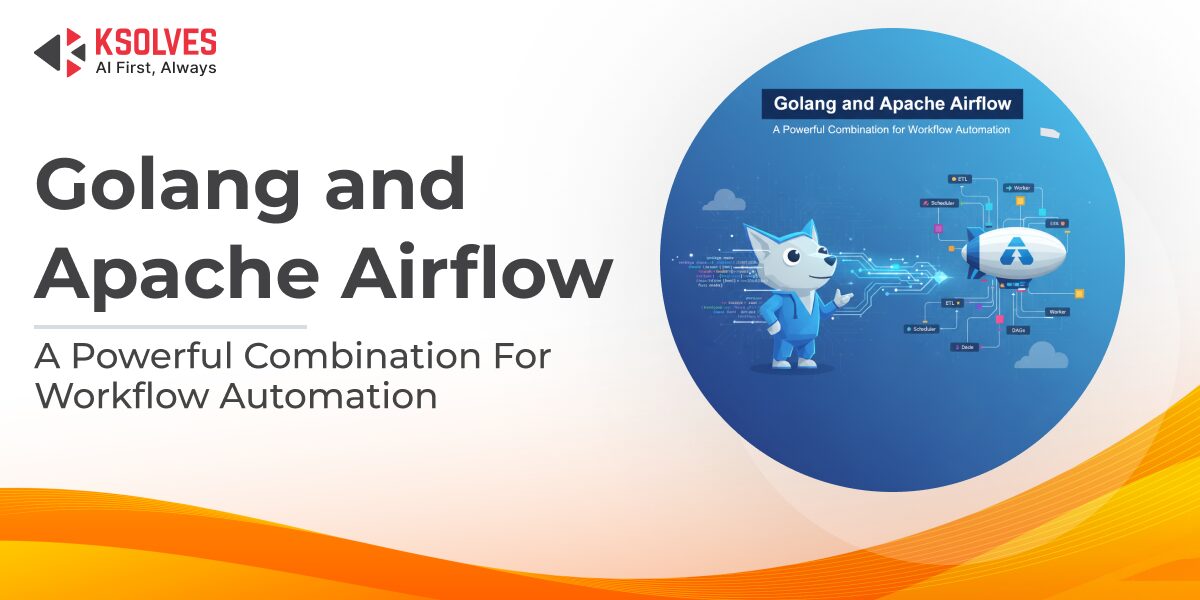
Modern data pipelines form the backbone of today’s data-driven organizations, powering everything from analytics and reporting to machine learning and operational automation. Managing these workflows efficiently is a growing challenge, especially as data volumes expand and tasks become increasingly complex. Apache Airflow has emerged as a trusted solution for orchestrating such workflows, enabling teams to schedule jobs, manage dependencies, and monitor pipelines, all while keeping processes maintainable and transparent through code.
However, Python—the primary language used in Airflow, can sometimes struggle with heavy computational workloads or highly concurrent tasks, creating performance bottlenecks. This is where Golang (Go) comes in. Known for its speed, efficient concurrency, and lightweight deployment, Go can handle compute-intensive tasks seamlessly, complementing Airflow’s orchestration capabilities.
In this blog, we will explore how Golang complements Apache Airflow for workflow automation and where this combination can optimize modern data engineering pipelines for both performance and scalability.
Why Airflow Remains a Go‑To for Orchestration
Before discussing Go, it helps to understand why Airflow is so popular for workflow automation:
- DAG-based scheduling: Workflows are defined as Directed Acyclic Graphs (DAGs), making it easy to manage dependencies, sequence tasks, and schedule jobs reliably.
- Rich ecosystem: Airflow offers numerous operators, connectors, and integrations, connecting pipelines to databases, cloud services, analytics engines, and more.
- Monitoring & visibility: Its intuitive UI lets teams track task status, logs, retries, and failures, providing full pipeline observability.
- Workflows as code: Defining pipelines in code ensures reproducibility, version control, and easier collaboration.
For ETL, batch processing, and scheduled data pipelines, Airflow remains a reliable and widely adopted orchestration backbone. Organizations that need ongoing pipeline reliability can leverage Airflow support services to keep DAGs optimized, executors tuned, and upgrades seamless.
Where Airflow (Python‑Only) Can Be Limiting
However, pure Python-based task execution in Airflow has limitations:
- Python can struggle with CPU-heavy or highly concurrent tasks.
- Low-latency and high-performance workloads may be bottlenecked by Python’s interpreted nature and the GIL.
- Teams already using Go for backend or microservices face added complexity if they rely only on Python.
- Supports the case for a polyglot approach: Airflow for orchestration, Go for compute-intensive execution.
Why Golang Is a Strong Complement to Airflow
Here’s how Go brings value when paired with Airflow:
-
Performance & Concurrency
Golang is compiled, statically typed, and designed with concurrency in mind. Its goroutines and channel-based concurrency model make it ideal for parallel processing, high-throughput I/O tasks, or CPU‑intensive operations, scenarios where Python may lag.
For tasks like data transformations, large file processing, heavy computation, or concurrent API calls, a Go-based implementation can significantly reduce runtime or resource consumption compared to Python.
-
Polyglot & Microservices‑Friendly Architecture
With the arrival of Apache Airflow 3.0, there is explicit support for multi-language task execution. The community has introduced a Go Task SDK that allows defining tasks in Go rather than Python.
This makes it possible to maintain orchestration logic in Airflow (DAGs, scheduling, dependencies) while letting teams implement task logic in Go, aligning well with microservices or polyglot architectures.
-
Efficient Deployment & Containerization
Go binaries are standalone; they don’t require heavy runtime dependencies. This simplicity makes containerization straightforward. You can easily build a minimal Docker image for Go tasks and run them via container-based executors, such as Kubernetes, or using Airflow’s operators. This reduces deployment complexity and improves portability across environments.
-
Maintainability & Alignment with Existing Systems
If your backend services or data tools are already written in Go, using Go for data‑processing tasks keeps your stack consistent. It reduces cognitive overhead for developers, avoids context switching across languages, and allows reuse of existing libraries and modules.
How to Integrate Go with Airflow – Practical Approaches
Depending on your project’s maturity and risk tolerance, here are practical ways to integrate Go tasks into Airflow pipelines:
| Approach | Description |
| Compile Go binary + BashOperator / Docker / KubernetesPodOperator | Build your Go task as a binary or container and run it from a Python-defined DAG. Simple and works without relying on the SDK. |
| Go Task SDK (Airflow 3.x) | Define tasks directly in Go using Airflow’s experimental Go SDK, enabling multi-language workflows without extra wrappers. |
| Hybrid Architecture | Use Airflow for orchestration while delegating compute-heavy or concurrent tasks to Go microservices via APIs, message queues, or containers. |
Each method has trade-offs. The SDK is clean but experimental, container execution is mature but adds deployment steps, and hybrid setups offer flexibility but increase system complexity.
When (and When Not) to Combine Go + Airflow
When it Makes Sense
- You have to compute‑intensive data processing tasks (large files, CPU‑heavy transformations, concurrent processing).
- Your team already uses Go or wants a polyglot architecture.
- You need efficient, container-friendly deployment (Docker, Kubernetes).
- You want to separate orchestration from execution — maintain stable, reliable DAG scheduling while enabling high-performance task execution.
When to Think Twice
- Rely heavily on Python libraries (Pandas, NumPy, ML frameworks), rewriting in Go may be impractical.
- Tasks are simple, lightweight, or infrequent. Go, and containerization may add unnecessary overhead.
- Prioritize stability and maturity. Go SDK for Airflow is still experimental and may have limitations
Wrapping Up
For many engineering teams, combining Airflow with Go offers the perfect balance: Airflow handles orchestration, scheduling, and monitoring, while Golang takes care of compute-intensive, high-performance tasks. This hybrid approach provides flexibility, using Python where the ecosystem matters and Go where performance and concurrency are critical.
For complex, large-scale, mission-critical pipelines especially in microservices-heavy or containerized environments, this synergy delivers both stability and efficiency. Organizations looking to leverage Golang software development services can benefit from expert teams like Ksolves, which provide end-to-end Golang solutions tailored for modern workflow automation and data engineering needs.
Combining Airflow and Go is not just a technical choice; it’s a strategic step toward faster, more reliable, and scalable data pipelines.
Frequently Asked Questions
What is the benefit of combining Golang with Apache Airflow for workflow automation?
Can Airflow execute tasks written in Golang natively?
When should I use Go instead of Python for Airflow tasks?
How does Golang improve containerized Airflow deployments on Kubernetes?
Is the Go Task SDK for Apache Airflow stable enough for production use?
Which companies provide Golang and Airflow integration services?
What is the effort involved in migrating Python Airflow tasks to Golang?
Have more questions? Contact our team




























AUTHOR
Airflow
Anil Kushwaha, Technology Head at Ksolves, is an expert in Big Data. With over 11 years at Ksolves, he has been pivotal in driving innovative, high-volume data solutions with technologies like Nifi, Cassandra, Spark, Hadoop, etc. Passionate about advancing tech, he ensures smooth data warehousing for client success through tailored, cutting-edge strategies.
Share with