Agentic AI in Commerce: Revolutionizing Retail and E-Commerce
Executive Summary
Agentic AI is transforming retail and e-commerce by shifting commerce from user-driven interactions to autonomous, intent-led experiences. This guide explores the rise of agentic commerce in 2025, its technical foundations, and real-world applications such as hyperpersonalization, dynamic pricing, subscription automation, agent-to-agent protocols, and autonomous payments. It also examines security, governance, and implementation strategies, helping businesses understand how to adopt agentic AI responsibly and prepare for large-scale commercialization as agentic systems become mainstream beyond 2026.
1. Introduction to Agentic Commerce
The year 2025 has proven to be the inflection point for agentic AI in commerce. What began as experimental prototypes has now become a mainstream force reshaping retail and e-commerce. McKinsey’s landmark October 2025 report, “The Agentic Commerce Opportunity: How AI Agents Are Ushering in a New Era for Consumers and Merchants,” describes this shift as one of the most significant transformations in retail since the rise of mobile shopping. The report projects that by 2030, agentic commerce could generate up to $1 trillion in the U.S.
This agentic AI guide for commerce provides a comprehensive, technical exploration of how AI-powered commerce is evolving. We cover definitions, technical foundations, key applications (hyperpersonalization, agent-to-agent protocols, dynamic pricing, subscription automation, negotiation, and complex task orchestration), business model evolution, trust and risk considerations and real-world implementations, and strategic recommendations for 2026 and beyond.
2. What is Agentic AI? Technical Foundations
To begin this agentic AI guide, let us define agentic AI more precisely. Agentic AI is not a separate category of AI, but an architectural pattern built on generative models such as large language models. In this pattern, generative AI systems are orchestrated with memory, tools, planning, and reasoning capabilities, enabling them to autonomously pursue goals by breaking complex objectives into actionable steps rather than only responding to prompts.
In retail and e-commerce, agentic AI evolves from basic chatbots to sophisticated entities. For example, an agent might remember your past purchases, analyze reviews, and reorder items like paper towels without prompting. This autonomy stems from advances in machine learning, enabling AI to handle multi-step processes. Key components include long-term memory for preferences, access to APIs for real-time data, and advanced reasoning to evaluate options based on price, quality, and logistics.
Agentic AI is distinguished from earlier generations of AI by its ability to act as an independent entity with agency. Technically, modern agentic systems are built on:
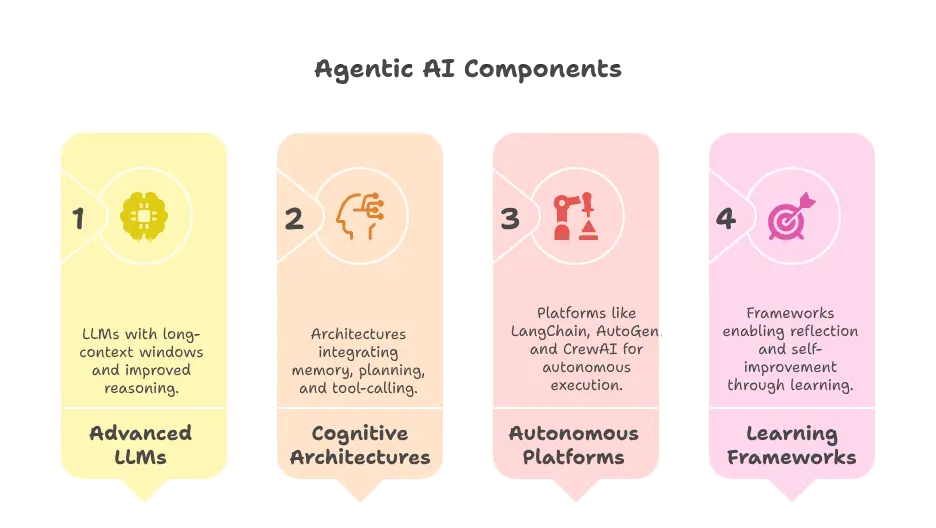
Also Read: What is the Difference Between Generative AI and Agentic AI?
Agentic Commerce Explained
Agentic commerce is the application of agentic AI to buying and selling activities. Rather than consumers navigating marketplaces manually, AI agents manage commerce workflows end-to-end.
Examples include:
- A personal AI agent that monitors prices and purchases when conditions are met
- A merchant agent that dynamically updates prices based on demand and competition
- Subscription agents that manage replenishment and usage-based billing
- This shift reduces friction, accelerates decisions, and enables scalable personalization.
In commerce contexts, agentic systems typically operate via a ReAct-style loop (Reason + Act), Planner-executor, DAG-based workflows, and more:
- Observe user intent
- Plan multi-step actions
- Call external tools (APIs, web search, payment gateways)
- Reflect on outcomes
- Iterate until goal completion
This architecture allows agents to handle complex, open-ended tasks such as “plan and book a 3-day family trip to Paris under $4,000, including flights, hotel, and activities.”
3. The Rise of Agentic Commerce in 2025
The ascent of AI-powered commerce through agentic systems is reshaping retail and e-commerce. Historically, e-commerce relied on user-driven searches and static recommendations. Now, agentic AI introduces proactive engagement, where agents anticipate needs based on data like browsing history or calendar events.
2025 witnessed an explosion of agentic commerce infrastructure:
- January: OpenAI launches Operator within ChatGPT
- March: Anthropic releases Claude Projects with persistent memory
- May: Google unveils Gemini Agents and Agent Mode
- July: Stripe + OpenAI introduce Agentic Commerce Protocol (ACP)
- September: Google launches Agent Payments Protocol (AP2)
- October: Visa, Mastercard, and PayPal announce agent-verified payment mandates
- November: Amazon rolls out Rufus 2.0 with full agentic capabilities
- December: Walmart integrates agentic shopping across its mobile app and website
4. Hyperpersonalized Shopping Experiences
Hyperpersonalization represents the most visible consumer-facing application of agentic AI. Agents move beyond static recommendations to proactive and context-aware curation.
Technical components include:
- Persistent memory stores (vector databases like Pinecone, Weaviate)
- Real-time context synthesis from location, calendar, past purchases, social signals, and external data (weather, events)
- Multi-modal reasoning (analyzing images, videos, text reviews)
Furthermore, here computer vision enhances multi-modal reasoning by allowing agents to understand visual context from product images, videos, and in-store feeds. This enables more accurate product matching, condition assessment, and visually informed personalization across digital and physical retail journeys.
5. Agent-to-Agent Protocols and Multi-Agent Systems
The future of commerce lies in agent-to-agent (A2A) interactions. Several protocols emerged in 2025 to enable secure, standardized communication:
|
Protocol |
Launch Date | Key Features |
Primary Use Case |
| Model Context Protocol (MCP) | Q2 2025 | Persistent context sharing | Cross-model personalization |
| Agent-to-Agent (A2A) | Q3 2025 | JSON-RPC over HTTP | Negotiation & coordination |
| Agent Payments Protocol (AP2) | Sep 2025 | Cryptographic mandates | Secure autonomous payments |
| Agentic Commerce Protocol (ACP) | Jul 2025 | In-chat discovery & checkout | Chat-based shopping |
These protocols allow:
- Consumer agents to negotiate with merchant agents
- Supply-chain agents to coordinate inventory
- Relocation agents to orchestrate multi-vendor services
5.1 Why Agent-to-Agent Communication Matters
As agentic commerce scales, AI agents must interact with:
- Other consumer agents
- Merchant agents
- Platform agents
- Payment agents
This requires standardized communication frameworks.
5.2 Key Agent Protocols
Model Context Protocol (MCP)
- Standardizes how agents access tools and services
- Enables plug-and-play integration across platforms
Agent-to-Agent (A2A) Protocols
- Allow agents to negotiate, delegate, and collaborate
- Support multi-agent workflows (pricing, fulfillment, logistics)
5.3 Agentic Commerce Protocols (ACP)
ACP defines:
- How agents represent user intent
- How merchants authenticate agent requests
- How transactions are executed securely
These protocols are essential for establishing trust, ensuring scalability, and enabling cross-platform commerce.
6. Dynamic Pricing and Autonomous Negotiation
6.1 What Makes Pricing “Agentic.”
Traditional dynamic pricing uses static rules. Agentic pricing:
- Continuously analyzes market conditions
- Adapts in real time
- Optimizes for defined objectives
Agentic systems evaluate:
- Demand signals
- Competitor pricing
- Inventory levels
- Customer willingness to pay
6.2 Personalized Pricing Strategies
Agentic AI enables:
- Individualized offers
- Loyalty-based discounts
- Context-aware bundles
For example, an agent might negotiate a bundled price for frequently purchased items or apply discounts at the moment of highest conversion probability. NLP also supports autonomous negotiation by enabling agents to interpret offers, constraints, and counter-proposals expressed in natural language across agent-to-agent interactions.
6.3 Risks and Ethical Considerations
Retailers must address:
- Price transparency
- Perceived fairness
- Regulatory compliance
Dynamic pricing must be governed by clear policies to maintain consumer trust. Agentic systems enable real-time and intent-aware dynamic pricing and negotiation. Agents can:
- Forecast demand using external signals
- Bundle products across merchants
- Negotiate discounts in real time
- Assess resale values during life events
7. Subscription Automation and Predictive Replenishment
7.1 The Evolution of Subscriptions
Traditional subscriptions operate on fixed schedules and quantities, often leading to overstocking or shortages.
Agentic subscriptions introduce intelligence into this model. They are:
- Usage-aware
- Predictive
- Adaptive
Instead of relying on static rules, AI-driven agents continuously monitor consumption patterns, contextual signals, and behavioral data to trigger replenishment decisions dynamically.
This shifts subscriptions from “set-and-forget” to “sense-and-respond.”
7.2 Intelligent Replenishment
Agentic systems enable real-time, data-driven replenishment across multiple scenarios:
- Household essentials are reordered based on actual usage patterns rather than fixed intervals
- Consumables adjusted dynamically for seasonal or lifestyle changes
- Subscription quantities are optimized automatically based on consumption trends
Concrete Implementation Example:
A smart inventory system integrated with IoT-enabled devices can track real-time consumption of products like water filters or printer ink. When usage crosses a predictive threshold, an AI agent evaluates factors such as delivery timelines, historical consumption variability, and upcoming demand spikes before placing an order automatically.
In an eCommerce setup, this can be implemented by combining:
- Usage tracking (via app activity or connected devices)
- AI models for demand prediction
- Automated order workflows within ERP systems like Odoo
This approach reduces manual intervention while improving fulfillment accuracy.
7.3 Business Benefits
For merchants:
- More stable and predictable recurring revenue
- Improved demand forecasting with real consumption data
- Reduced churn due to better customer experience
For customers:
- Greater convenience with minimal effort
- Reduced risk of stockouts
- No need to manually manage subscriptions
7.4 Challenges and Considerations
While agentic subscriptions unlock efficiency, they also introduce new risks that must be managed carefully.
- Unwanted autonomous purchases: Incorrect predictions or sudden changes in usage can trigger unnecessary orders
- Loss of user control: Fully automated systems may reduce transparency, leading to trust issues
- Data dependency: Poor data quality directly impacts prediction accuracy
- Edge-case failures: Events like travel, lifestyle changes, or one-time bulk usage can distort patterns
Mitigation strategies include:
- User-defined spending or quantity caps
- Approval checkpoints for high-value orders
- Clear visibility into agent decisions and upcoming orders
- Easy override and cancellation mechanisms
8. Additional Applications of Agentic AI in Commerce
8.1 Inventory and Supply Chain Optimization
Agents can:
- Forecast demand
- Automate procurement
- Balance inventory across locations
These capabilities are driven by predictive analytics models that help minimize stockouts, overstocking, and supply chain inefficiencies while improving efficiency and reducing operational costs.
8.2 Marketing and Advertising Automation
Agentic systems:
- Generate campaigns dynamically
- Optimize creative in real time
- Adjust targeting based on performance signals
This closes the gap between consumer intent and advertising execution.
8.3 Autonomous Checkout and Payments
Agentic payment systems:
- Verify user intent
- Tokenize payment credentials
- Execute transactions securely
This enables frictionless, agent-driven purchasing without traditional checkout flows.
8.4 Real-World Implementations of Agentic Commerce
Beyond theoretical models, agentic AI is already being deployed across retail and e-commerce ecosystems.
Retail Example: Autonomous Personal Shopping
Large marketplaces now deploy personal shopping agents that:
- Track user preferences across sessions
- Compare prices across merchants
- Trigger purchases when predefined conditions are met
These agents operate continuously, reducing cognitive load for consumers while increasing conversion consistency for platforms.
E-Commerce Example: Agentic Price Negotiation
Merchant agents negotiate pricing in real time with consumer agents based on:
- Loyalty status
- Inventory pressure
- Competitive benchmarks
This enables dynamic, one-to-one negotiation at scale without human intervention.
Supply Chain Example: Multi-Agent Inventory Coordination
Retailers deploy interconnected agents across warehouses, suppliers, and logistics partners. These agents:
- Rebalance inventory across regions
- Anticipate disruptions
- Trigger procurement autonomously
The result is faster fulfillment, fewer stockouts, and improved resilience.
These implementations demonstrate that agentic commerce is not experimental. It is already operational at scale.
9. Security, Trust, and Governance
9.1 Intent Verification
Critical safeguards include:
- Explicit user permissions
- Cryptographic authorization
- Transaction boundaries
Agents must act only within approved mandates.
9.2 Data Privacy
Agentic commerce relies on deep personalization. Strong data governance and transparency are essential to maintain trust and regulatory compliance.
9.3 Regulatory and Legal Considerations
As agents gain autonomy, regulators may impose:
- AI accountability standards
- Pricing transparency rules
- Consent and audit requirements
Organizations must prepare governance frameworks early.
Also Read: What is Agentic AI in Cybersecurity?
10. Implementation Considerations for Businesses
10.1 Where to Start
Organizations should:
- Identify high-friction workflows
- Introduce agentic capabilities incrementally
- Pilot with defined use cases (subscriptions, pricing, personalization)
10.2 Technology Readiness
Key requirements:
- API-first infrastructure
- Secure identity and payment systems
- Agent-compatible platforms
10.3 Organizational Readiness
Agentic commerce impacts:
- UX design
- Brand control
- Customer relationships
Teams must adapt from managing interfaces to managing intent-based experiences.
Also Read: Agentic AI: Guide to Its Use Cases, Architecture, and Future
11. Conclusion
Agentic AI is fundamentally changing retail and e-commerce. By enabling autonomous, intent-driven experiences, it delivers unprecedented convenience for consumers and unlocks new growth opportunities for merchants. With the infrastructure now in place and adoption accelerating rapidly, 2026 will be the year agentic commerce moves from early adoption to mainstream dominance.
The future of commerce is agentic. Ready to lead this transformation? Explore Ksolves Agentic AI consulting services today and future-proof your business with cutting-edge autonomous solutions. Contact our experts today!
11.1 Preparing for the Post-2026 Agentic Commerce Landscape
As agentic systems mature beyond 2026, commerce will increasingly shift toward agent-first ecosystems.
In this future:
- Consumers deploy personal commerce agents as default interfaces
- Brands compete for agent trust, not just consumer attention
- Discovery, negotiation, and payment occur autonomously
- Commerce becomes continuous, contextual, and invisible
Enterprises that begin building agent-compatible infrastructure today will be positioned to lead this transition rather than react to it. Hence, Agentic commerce is not a feature upgrade. It is a structural shift in how markets operate.