



Top 10 ETL Tools of 2026: Benefits & Key Features
Big Data
5 MIN READ
March 19, 2026

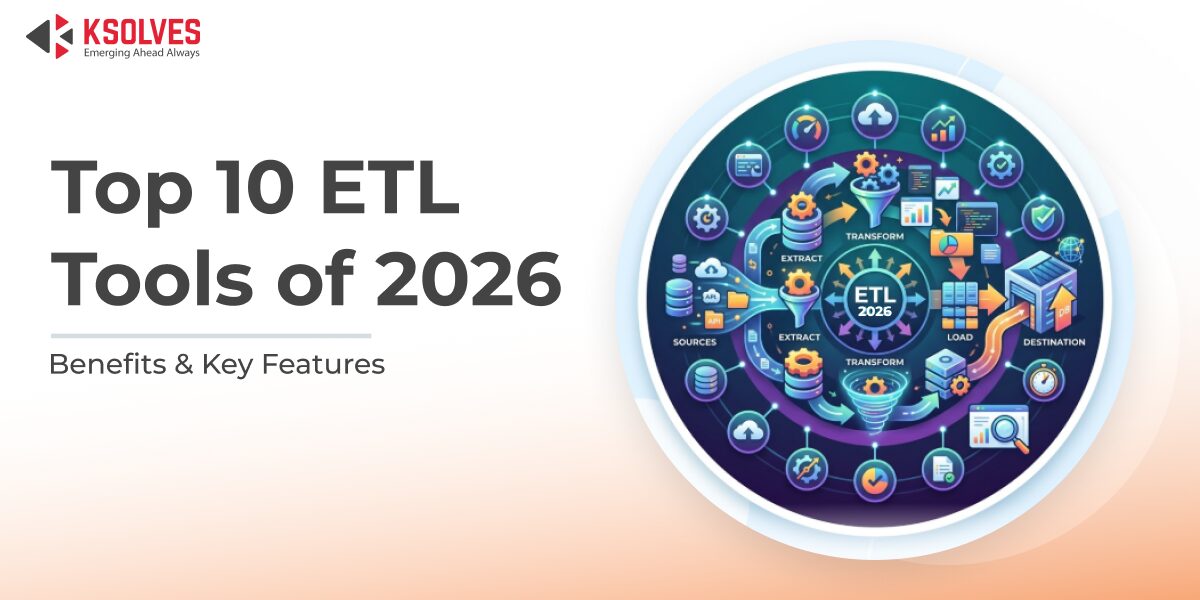
As we move deeper into the era of data-driven decision-making, ETL (Extract, Transform, Load) has evolved beyond batch data movement. It’s now about real-time streaming, cloud scalability, governance, security, and integration with AI/ML. Whether you’re a startup looking to build your first pipeline or an enterprise managing terabytes of data daily, choosing the right ETL tool can directly impact performance, agility, and business outcomes. This blog highlights the Top 10 ETL tools of 2026, based on functionality, innovation, scalability, and user adoption, giving you a clear picture of which platform fits your evolving data strategy.
Top 10 ETL Tools in 2026
Hevo Data
Category: No‑Code SaaS ETL/ELT
Overview:
Hevo Data offers a fully-managed, no-code ETL/ELT platform that automates real-time data ingestion from 150+ SaaS and database sources into modern warehouses like Snowflake, Redshift, and BigQuery. It supports change data capture (CDC) for low-latency syncs, automatic schema detection, and built-in transformation capabilities, all delivered without infrastructure management or coding.
Key Features:
- Wide connector coverage and real-time sync capabilities.
- Auto-schema mapping and transformations via an intuitive UI.
- Error monitoring, retry logic, and control dashboards.
Benefits:
- Fast deployment and onboarding, ideal for analytics-first teams.
- Reliable and self-healing data pipelines, with alerting on failures.
- Transparent pricing and minimal maintenance effort required.
Apache NiFi
Category: Open‑source, Flow-Based ETL
Overview:
Apache NiFi is a visual, real-time data flow automation platform ideal for processing and routing data across systems with precision. Originally developed under the NSA and now an Apache project, NiFi version 2.x (released November 2024) introduces modern capabilities such as native Kubernetes support, stateless execution, a redesigned UI, and Git-based flow versioning, all enhancing its flexibility and developer accessibility
Key Features:
- Over 300 built-in processors for ingestion (HTTP, Kafka, databases), transformation, and routing.
- Peer-to-peer clustering with automatic load balancing and no single point of failure.
- Python processor support, stateless flows, and Git integration for CI/CD.
- Security: TLS encryption, LDAP/SAML authentication, RBAC, and detailed audit logging.
Benefits:
- Enables streaming, real-time routing, and enterprise-grade data provenance.
- Scales fault-tolerantly across clusters, suitable for edge-to-cloud architectures.
- Highly extensible for Python developers and suitable for regulatory environments.
Want to know more about Apache NiFi Benefits? Then read our blog Apache NiFi Transforming Businesses: Examples You Need to Know
Fivetran
Category: Managed ELT
Overview:
Fivetran is a cloud-native, no-code ELT platform trusted by thousands of organizations for automated data ingestion. As of 2026, it offers 600+ prebuilt connectors, real-time CDC support, built-in transformations, and optional hybrid on-prem deployment, facilitating quick setup and low maintenance while ensuring schema drift is handled automatically.
Key Features:
- Extensive connector library (600+), auto schema drift handling, and incremental syncs.
- Native SQL transformations and dbt integration for modeling and pipeline control.
- Enterprise-grade compliance: SOC 2, HIPAA, GDPR; supports column blocking, encryption at rest/in transit, and private link connectivity.
Benefits:
- Quick to set up: usually under 5 minutes for source-to-warehouse pipeline creation.
- Highly reliable and zero-maintenance: you don’t manage infrastructure or monitoring.
- Ideal for analytics teams: minimizes engineering burden and supports BI/ML workflows.
Airbyte
Category: Open‑Source ELT
Overview:
Airbyte is an extensible data integration platform offering over 600 connectors and a custom connector builder. Available in cloud-managed and self-hosted versions, it supports incremental sync, CDC via Debezium, and tight dbt or Airflow orchestration integration.
Key Features:
- 600+ connectors and a low-code Connector Development Kit
- Cloud and self-hosted deployment options
- Integration with orchestration tools like dbt, Airflow, and Dagster
Benefits:
- Cost-effective and flexible for engineering-driven teams
- No vendor lock-in and extensive community support
- Ideal for custom or less-common data sources
DataChannel / Weld
Category: AI-powered ETL + Reverse ETL
Overview:
Combines traditional ETL with reverse ETL and metric automation in one platform. Users can generate pipelines using natural language and sync modeled data back into CRMs, Slack, and BI tools, creating a unified experience for business and technical teams. Beneficial for business users and data teams alike, it includes AI assistants to build pipelines and explore data through natural language.
Key Features:
- Conversational pipeline builder
- Unified ETL and reverse ETL flows
- AI-generated KPI definitions and metric layers
Benefits:
- Enables business users to build pipelines without code
- Keeps metrics consistent across BI and operational systems
- Simplifies data activation and insights sharing
Talend Data Fabric
Category: Hybrid Enterprise ETL
Overview:
Talend’s comprehensive platform integrates ETL, data quality, governance, and master data management. It includes a drag-and-drop UI, AI-powered cataloging, and extensive connector support. It empowers enterprises to meet compliance and accuracy requirements through visual job design and Spark-based execution
Key Features:
- Advanced data profiling and cleansing
- Metadata management and traceable lineage
- Spark integration for large-scale processing
Benefits:
- Ensures high data quality and regulatory compliance
- Supports complex transformation pipelines
- Ideal for heavily regulated industries
Informatica PowerCenter
Category: Enterprise-Grade ETL Suite
Overview:
PowerCenter is a benchmark for large-scale, regulated environments where processing billions of records reliably is essential. It offers advanced mapping, metadata lineage, and robust failure recovery mechanisms over years of enterprise-grade deployments.
Key Features:
- High-throughput data processing
- Detailed lineage and metadata tracking
- Enterprise security and governance
Benefits:
- Reliable in mission-critical, high-volume settings
- Supports complex logic and regulatory auditability
Read our blog to know why migrate from Informatica PowerCenter to Apache NiFi – Migrate from Informatica PowerCenter to Apache NiFi
Matillion
Category: Cloud-Native ELT
Overview:
Matillion is tailored for cloud-first teams using Redshift, BigQuery, Snowflake, and Databricks. It supports pushdown transformations and leverages the power of the underlying warehouse, reducing infrastructure costs and improving performance.
Key Features:
- Visual pipeline designer + script editor
- Pushdown transformation processing
- Git-integrated version control
Benefits:
- Fast development and efficient use of warehouse computing
- Versioned and reproducible pipeline workflows
- Tailored for analytics-intensive cloud environments
Azure Data Factory (ADF)
ADF is Microsoft’s fully managed ETL orchestration tool with over 90 connectors, visual pipelines, parameterized triggers, and deep Synapse/Data Lake integration. It supports both code and GUI workflows and offers enterprise-level monitoring and governance options. Seamlessly integrates with Azure Synapse Analytics, Power BI, and Hybrid data stores.
Key Features:
- 90+ connectors, hybrid VNET support
- Parameterized pipeline orchestration and triggers
- Integration with Synapse, Data Lake, and Power BI
Benefits:
- End‑to‑end Azure-native data workflows
- Strong security and scalability
- Suitable for multi-cloud or hybrid environments
AWS Glue
Category: Serverless ETL
Overview:
AWS Glue is a serverless ETL service built on Apache Spark. It auto-discovers schema using Glue Crawlers, auto-generates PySpark or Scala code, and integrates tightly with S3, Redshift, Lake Formation, and Athena capabilities, scaling compute automatically.
Key Features:
- Automated schema discovery and cataloging
- Visual job editor (Glue Studio) and code-based authoring
- Serverless Spark execution with job scheduling
Benefits:
- No infrastructure to manage
- Seamless AWS service integration
- Scalability and cost-efficiency through a pay-as-you-go model
Planning to migrate from your legacy system to Open-Source ETL Tools? Ksolves Experts are here to assist you.
If you are considering migrating from proprietary platforms to open-source ETL tools like Apache NiFi, Airbyte, or Talend Open Studio, then Ksolves experts are here to help you. With years of hands-on experience in open-source data engineering, our experts help you plan, execute, and optimize ETL migrations with zero disruption. From architecture assessment to pipeline redesign and post-migration support, we ensure your move to open-source is seamless, secure, and scalable.
Conclusion: Choosing the Right ETL Tool
In 2026, choosing the right ETL tool is crucial for scalable, real-time, and reliable data workflows. Whether you prefer open-source flexibility or managed platforms, aligning the tool with your goals ensures long-term success. For seamless open-source migration, trust Ksolves experts to guide your transition with precision and zero downtime.
No matter where you are on your data journey, the tools outlined above offer robust pathways to build, automate, and scale your pipelines with clarity, speed, and confidence.



































AUTHOR
Big Data
Anil Kushwaha, Technology Head at Ksolves, is an expert in Big Data. With over 11 years at Ksolves, he has been pivotal in driving innovative, high-volume data solutions with technologies like Nifi, Cassandra, Spark, Hadoop, etc. Passionate about advancing tech, he ensures smooth data warehousing for client success through tailored, cutting-edge strategies.
Share with