



Apache NiFi 1.x End of Support: The Hidden Risks You Can’t Ignore
Big Data
5 MIN READ
March 25, 2026

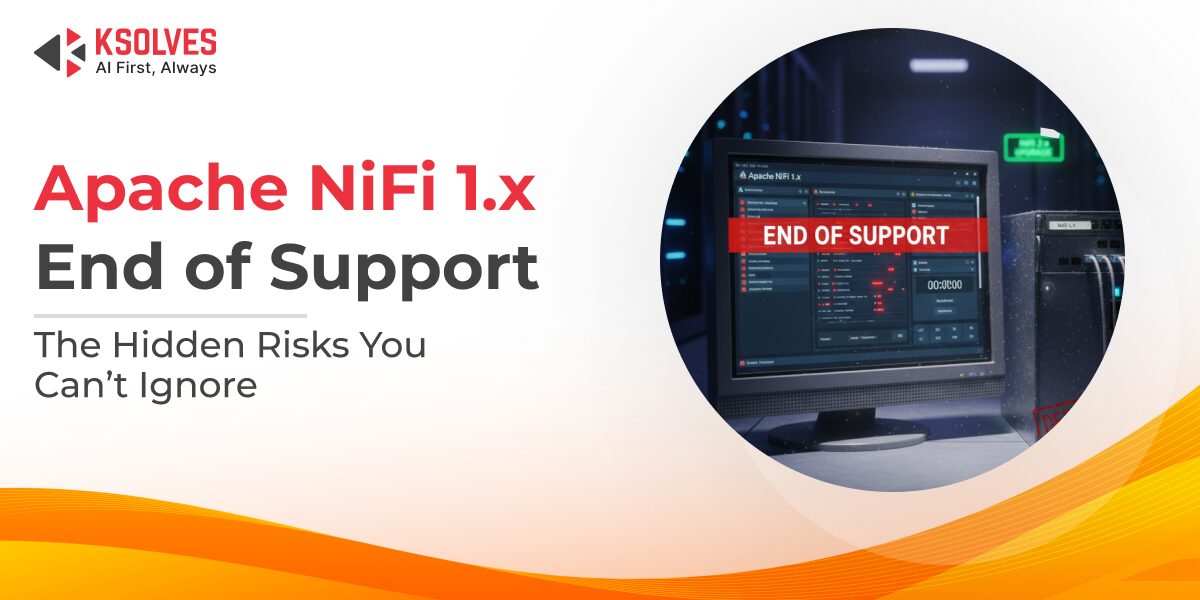
In February 2026, Apache published a high-severity advisory for CVE-2026-25903, a vulnerability affecting Apache NiFi versions 1.1.0 through 2.7.2 that allows lower-privileged users to bypass authorization controls on restricted components. The recommended fix is to upgrade to NiFi 2.x. For teams running NiFi 1.x, that advisory carried a harder message than most: their platform does not have a supported upgrade path. Apache NiFi 1.28.1 is the final release in the 1.x series, and the official end of support date passed on December 8, 2024.
That date is now more than a year behind us. Every security fix, every new capability, and every architectural improvement from the Apache NiFi project now lands exclusively on the 2.x line. The 1.x branch is frozen on a dependency stack built around Jetty 9.4, Spring Framework 5.3, and AngularJS 1.8, each of which has already exceeded its supported life and cannot be upgraded within the 1.x architecture. This blog explains exactly what that means for your business, what NiFi 2.0 delivers in return, and how to plan a migration that protects the data pipelines your teams depend on without disrupting what is already working.
What End of Support Means in Practice for NiFi 1.x
The Apache NiFi download page is explicit: NiFi 1.28 is the last minor release of the version 1 series. The project management committee may consider critical bug fixes for essential framework features on an exceptional basis, but dependency upgrades are ruled out entirely. The reason is architectural. Jetty 9.4, Spring Framework 5.3, and AngularJS 1.8 form the foundation of NiFi 1.x, and none of them can be updated within that codebase. Jetty 9.4 reached the end of community support in May 2022. AngularJS 1.8 reached end of life in December 2021.
This creates a compounding exposure for every organization still running NiFi 1.x in production. When a CVE is published against those underlying libraries, NiFi 1.x users have no remediation path. Security scanners flag these outdated dependencies in every assessment. For organizations responsible for compliance-sensitive data operations under HIPAA, GDPR, or SOC2, an unfixable vulnerability in a production system is not a risk to defer. It is an open audit finding with no close date, and it gets harder to explain with every quarter that passes.
What Apache NiFi 2.0 Actually Changes
Apache NiFi 2.0 was not built as a continuation of 1.x. The community used the major release to address years of accumulated technical debt and replace architectural decisions that had become constraints. The minimum Java requirement was raised to Java 17 at the 2.0.0 GA release, a meaningful jump from the Java 11 ceiling that NiFi 1.x was locked to. The platform also moved to Spring 6, Jetty 12, and Angular 18, bringing the security hardening and performance improvements those versions carry in ways the 1.x architecture was structurally unable to absorb.
The changes go well beyond the dependency stack. ZooKeeper, a persistent source of cluster complexity in NiFi 1.x, has been removed entirely. NiFi 2.0 runs natively on Kubernetes, aligning with the container-based infrastructure most organizations have already standardized on. Flows now integrate with Git-based registries, making DevOps-native data flow management a practical reality rather than a workaround. NiFi 2.0 also introduced a Python API for custom processor development, giving data science and engineering teams the ability to build processors without requiring Java expertise. Stateless flow execution brings transactional, rollback-capable processing to high-stakes pipelines. Full Apache Kafka 3 support keeps NiFi aligned with modern event-driven and big data streaming architectures that 1.x struggled to accommodate cleanly.
The Breaking Changes You Must Plan for Before Migrating
Moving from NiFi 1.x to NiFi 2.0 involves deliberate migration work on several fronts. The official Apache NiFi migration guidance confirms that upgrading to NiFi 1.27.0 is required before moving to 2.0.0. This intermediate step is not optional and must be factored into project timelines from the start.
Beyond that prerequisite, NiFi 2.0 removed several foundational features from 1.x that require explicit handling. XML-based flow templates are gone. All flow definitions must be converted to versioned JSON flow format before migration can proceed. The internal flow configuration file has also moved from flow.xml.gz to flow.json.gz. The Variable Registry has been removed in favor of Parameter Contexts, which means any flow relying on variables needs hands-on reconfiguration.
Processors used across enterprise data pipeline workflows, particularly in the Kafka, Hive, and Jolt families, have been reorganized and relocated across NARs. Conducting a thorough processor inventory before migration prevents discovering broken pipelines under pressure. NiFi Registry, the versioning system from NiFi 1.x, was deprecated by community vote in February 2026 and is planned for removal in NiFi 3.0. Git-based Flow Registry Clients are the supported replacement. Custom Java processors must also be recompiled and validated against the NiFi 2.0 SDK, as any processor referencing removed 1.x APIs will not function on the new platform.
Why the Risk Grows Every Month You Stay on NiFi 1.x
Organizations that have not started their migration usually have understandable reasons: production flows are stable, the team has deep familiarity with the platform, and a major upgrade carries genuine disruption risk. Those are real considerations. The problem is that the risk profile of running NiFi 1.x changed permanently when end of support passed in December 2024. A platform with no dependency patch path does not remain stable. It accumulates exposure with every new CVE published against its underlying libraries and every quarter the broader ecosystem advances without it.
The practical impact is already visible. CVE-2026-25903 requires NiFi 2.8.0 to resolve. That version does not exist for NiFi 1.x users. The integration gap also widens steadily. Modern Kafka versions, cloud storage APIs, and updated connectors evolve in ways NiFi 1.x cannot cleanly accommodate, gradually pushing teams into maintaining fragile workarounds instead of building capability. As the Apache NiFi community directs its documentation, tooling, and support toward the 2.x line, the knowledge base available to 1.x users quietly shrinks.
How to Approach the NiFi 1.x to 2.0 Migration
Migrations that complete cleanly share a consistent starting point: a thorough audit of the existing environment before any code is moved. That means inventorying every active flow, custom processor, controller service, parameter configuration, and external integration dependency. The goal is not just documentation. It is understanding the full scope of breaking changes before commitments are made on timelines or resources.
From there, a parallel deployment is the most reliable path. Running NiFi 2.0 alongside production allows flows to be ported and validated without any pressure on live systems. Remember that the official migration guidance requires upgrading to NiFi 1.27.0 first. Flows using XML templates, flow.xml.gz configuration, or Variable Registry entries need explicit migration steps. Custom Java processors require refactoring and SDK testing against the 2.0 API. Cluster deployments must plan for the ZooKeeper removal and validate high-availability behavior in staging before any production cutover. Setting up Git-based flow version control early gives teams visibility across every change and a clean rollback option at each stage of the migration.
How Ksolves Supports Your Apache NiFi 2.0 Upgrade
Ksolves is a certified Apache NiFi upgrade and consulting partner with over a decade of hands-on enterprise experience building and migrating NiFi-powered data platforms. Our team of 350+ NiFi specialists has delivered migrations across industries and deployment scales, from compact single-node environments to large multi-cluster setups running hundreds of production flows. Our methodology is built around three consistent outcomes: zero data loss, minimal downtime, and a production environment that is more maintainable after the upgrade than before.
Every Ksolves engagement begins with a pre-upgrade audit that maps your environment, identifies breaking changes, confirms the 1.27.0 intermediate upgrade path, and builds a migration plan aligned to your operational schedule. Our team owns the full execution from staging setup through production cutover. Clients who have worked with us on NiFi 2.0 upgrade projects consistently complete faster and with fewer surprises than teams attempting the same migration without a structured framework. After go-live, Ksolves provides ongoing NiFi managed support services and round-the-clock monitoring to ensure your upgraded environment performs reliably as your data volumes and pipeline complexity grow.
Conclusion
Apache NiFi 1.x reached the end of support on December 8, 2024. The dependency stack cannot be patched. Every security advisory now requires a 2.x release to resolve. The community has directed its full energy toward the 2.x line. None of that changes without a migration. The organizations that act now will complete this work on a timeline they control, with the resources to do it properly. Those who continue to wait will face the same migration later under considerably worse conditions.
NiFi 2.0 is a meaningfully stronger platform across every dimension: a patched and modern security stack built on Java 17 as the minimum runtime, Kubernetes-native architecture, Git-integrated flow management, and an expanding Python processor model. The upgrade path is clearly defined by the Apache NiFi community. Reach out to Ksolves today and build a migration plan that fits your environment, your schedule, and everything you have already invested in building.
Frequently Asked Questions
Frequently Asked Questions
What does Apache NiFi 1.x end of support mean for my organization?
Apache NiFi 1.x end of support means the Apache Software Foundation will no longer release security patches, bug fixes, or updates for the 1.x branch. Any vulnerabilities discovered after the EOL date will remain unpatched, leaving your data pipelines exposed to known exploits. Organizations running NiFi 1.x in regulated industries — such as healthcare, finance, or government — face compliance risks in addition to security exposure.
Is it safe to keep running Apache NiFi 1.x after its end-of-life date?
Running NiFi 1.x after end-of-life is risky. Without official security patches, your cluster becomes an increasingly attractive target as new CVEs are published against the 1.x codebase. If you must delay your upgrade, working with a managed NiFi support provider who can apply custom patches and harden your environment is strongly advised as a short-term bridge.
How do I migrate from Apache NiFi 1.x to 2.x without downtime?
A zero-downtime NiFi 1.x to 2.x migration requires a phased approach: start with a full environment audit to identify deprecated processors and incompatible templates, then build a staging cluster mirroring production, migrate and test flows incrementally, and roll out node by node. Ksolves provides a structured 5-phase NiFi upgrade service that covers pre-upgrade audits, flow conversion, staging validation, and production deployment — with no disruption to live pipelines.
What are the biggest differences between Apache NiFi 1.x and NiFi 2.0?
NiFi 2.0 introduces several breaking architectural changes compared to 1.x: ZooKeeper is removed in favour of a Kubernetes-native runtime, XML-based flow templates are replaced by versioned JSON flows via NiFi Registry, and the Variable Registry is replaced by Parameter Contexts. Additionally, NiFi 2.0 adds Python-based processor development, upgraded framework libraries (Java 21, Spring 6, Angular 18), and native Kafka 3.x support — making it a significant generational leap rather than an incremental update.
When did Apache NiFi 1.x officially reach end of support?
The Apache Software Foundation declared Apache NiFi 1.x end-of-life following the stable release of the 2.x branch. Once NiFi 2.0 was generally available, the 1.x line transitioned to unsupported status, meaning no new security advisories or patch releases would be issued for it. Organizations should check the official Apache NiFi release notes and PMC announcements for the specific date applicable to their deployed sub-version.
Who can help with an Apache NiFi 1.x to 2.0 upgrade for enterprise environments?
Ksolves is a specialized Apache NiFi development and upgrade company with a dedicated NiFi 1.x to 2.0 upgrade service. Their certified NiFi engineers handle complex multi-node cluster upgrades, custom processor migrations, ZooKeeper removal, and flow conversion — with a proven track record of 25% faster processing and 30% lower memory consumption in production after upgrade. They offer 24×7 post-upgrade support and a free pre-upgrade assessment.
How long does a NiFi 1.x to 2.x migration typically take?
Migration timelines vary based on the size of your NiFi environment, number of custom processors, and cluster complexity. A single-node deployment with standard flows may be completed in days, while a large enterprise multi-node cluster with custom integrations can take several weeks. Engaging a professional NiFi upgrade partner significantly reduces timelines — Ksolves typically delivers enterprise migrations with a custom roadmap within 24 hours of initial assessment.
Still have questions? Contact our team – we’re happy to help.































AUTHOR
Big Data
Anil Kushwaha, Technology Head at Ksolves, is an expert in Big Data. With over 11 years at Ksolves, he has been pivotal in driving innovative, high-volume data solutions with technologies like Nifi, Cassandra, Spark, Hadoop, etc. Passionate about advancing tech, he ensures smooth data warehousing for client success through tailored, cutting-edge strategies.
Share with