



How Computer Vision Helps Businesses Improve Efficiency and Decisions
AI
5 MIN READ
May 24, 2026

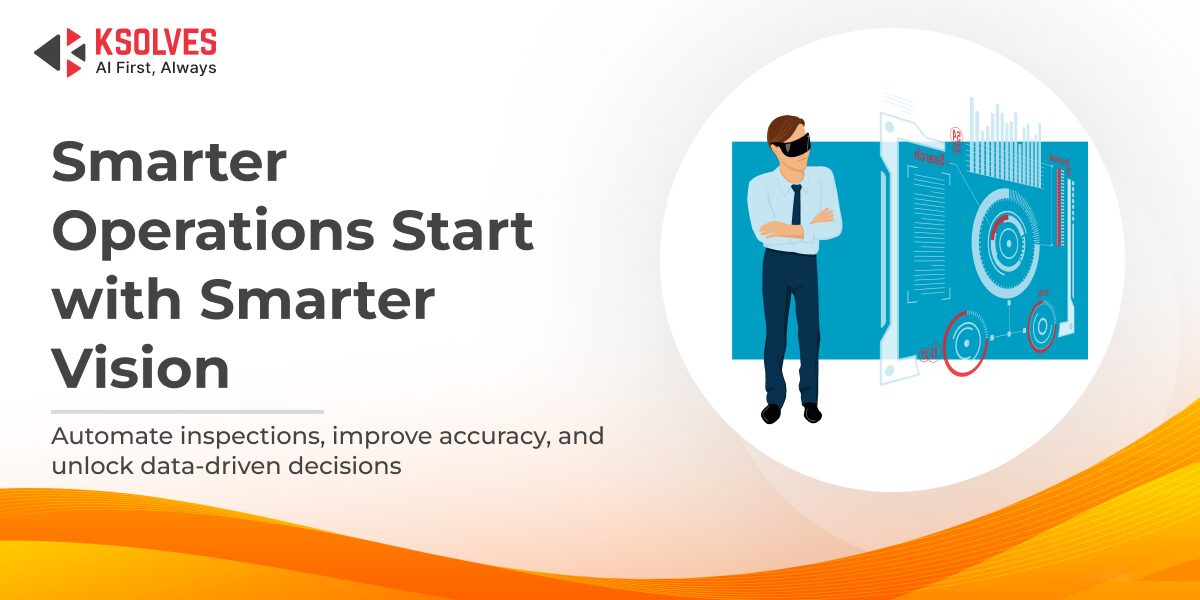
Businesses today generate more visual data than ever before through cameras, mobile devices, sensors, and surveillance systems. Yet for many organizations, this data remains largely untapped because it is difficult to analyze at scale. Computer vision addresses this gap by enabling machines to interpret images and videos and convert visual information into actionable insights.
This blog will explain how computer vision works, the business challenges it solves, and the practical ways organizations use it to improve efficiency, accuracy, and decision-making across industries.
From automating quality inspections to enhancing customer experiences and strengthening safety monitoring, computer vision is no longer limited to research labs. It has become a practical business technology that helps companies reduce manual effort, respond in real time, and unlock new value from visual data.
What Is Computer Vision and How Does It Work?
Computer vision is an AI technology that allows machines to analyze and interpret images and videos using data-driven models inspired by human visual perception. It uses deep learning models trained on large volumes of visual data to recognize objects, patterns, and anomalies.
A typical computer vision workflow starts with image or video capture from sources such as cameras, drones, or mobile devices. The data is then preprocessed to improve quality and consistency. Deep learning models, such as convolutional neural networks, extract visual features and identify patterns. Finally, the system generates predictions or alerts that trigger business actions.
For example, in a retail store, camera feeds can be processed to detect customer movement, identify product interactions, and generate insights that help optimize store layout and product placement.
Key Business Challenges Computer Vision Solves
Many business processes still rely on manual visual inspection, which is time-consuming, inconsistent, and expensive. Human inspection is prone to fatigue and error, especially in high-volume or high-speed environments. Businesses also struggle with limited real-time visibility, making it difficult to detect issues early.
Another challenge is the overwhelming amount of unstructured visual data. Images and videos contain valuable insights, but without automation, they remain underutilized. Computer vision addresses these challenges by automating visual tasks, improving accuracy, and delivering real-time insights.
In manufacturing, for instance, manual defect inspection often leads to late detection and higher rejection rates. Computer vision systems can continuously monitor production lines and flag defects as soon as they appear.
Top Ways Computer Vision Helps Businesses
-
Improves Operational Efficiency
Computer vision automates repetitive and labor-intensive visual tasks, reducing dependency on manual processes. By processing visual data in real time, businesses can accelerate workflows and minimize bottlenecks.
In manufacturing, automated visual inspection systems detect defects such as cracks, misalignments, or surface irregularities directly on the production line. This reduces inspection time and allows teams to focus on higher-value activities.
-
Enhances Customer Experience
By understanding visual cues, computer vision enables more personalized and seamless customer interactions. Businesses can analyze customer behavior to deliver faster and more relevant experiences.
Retailers use computer vision to enable smart checkout systems where customers can pick up products and leave without waiting in long queues. Visual analytics also helps retailers understand how customers interact with products, improving merchandising strategies.
-
Strengthens Quality Control and Compliance
Consistency is critical in regulated industries such as pharmaceuticals, food processing, and manufacturing. Computer vision ensures continuous quality checks and compliance monitoring without interruptions.
For example, in pharmaceutical packaging, vision systems verify labels, seals, and expiry dates in real time. This reduces the risk of recalls, regulatory penalties, and brand damage.
-
Enables Data-Driven Decision-Making
Visual data is a rich but often underused source of business intelligence. Computer vision transforms images and videos into structured insights that support better decision-making.
In retail environments, heatmaps generated from CCTV footage reveal customer movement patterns. These insights help businesses optimize store layouts, improve product placement, and increase conversion rates.
-
Improves Safety and Risk Management
Computer vision plays a key role in workplace safety by identifying risky situations before they lead to incidents. It enables proactive monitoring without intrusive supervision.
Construction and industrial sites use vision-based systems to detect whether workers are wearing required protective equipment. Alerts can be triggered instantly when safety violations occur, reducing accidents and downtime.
How to Get Started with Computer Vision in Your Business
The first step is identifying business processes that rely heavily on visual inspection or monitoring. These are often the areas where computer vision delivers the fastest return on investment. Next, assess the availability and quality of image or video data.
Businesses should start with a pilot use case to validate feasibility and impact. Once successful, solutions can be scaled with custom models, cloud infrastructure, and integration into existing systems such as ERP or quality management platforms.
For example, a manufacturer might begin with automated defect detection for a single production line before expanding across multiple facilities.
Why Choose Ksolves for Computer Vision Development
Ksolves helps businesses design, build, and scale intelligent computer vision development solutions tailored to their operational needs. With deep expertise in AI and enterprise systems, Ksolves delivers end-to-end solutions from model development to deployment and integration.
Case Study Snapshot
A manufacturing client faced challenges with manual quality inspection, resulting in delayed defect detection and increased production waste. Ksolves implemented a computer vision-based automated inspection system using deep learning models to identify surface defects in real time.
The solution significantly reduced inspection time, improved defect detection accuracy, and lowered rejection rates. By integrating the system with existing production workflows, the client achieved faster decision-making and better quality control. Read the full case here.
If you are looking for reliable Computer vision development services that turn visual data into measurable business value, Ksolves helps you implement scalable and production-ready solutions aligned with your goals.
Conclusion
Computer vision is no longer an experimental technology. It is a practical and proven capability that helps businesses automate operations, enhance customer experiences, and make better decisions using visual data. From quality control and safety to customer analytics and compliance, the applications are wide-ranging and impactful. Organizations that invest in computer vision today position themselves to operate smarter, faster, and more efficiently in an increasingly data-driven future.

































Author
About the Author Editorial Team The Ksolves Editorial Team includes certified Salesforce experts, Big Data engineers, AI/ML specialists, Zoho consultants, and experienced technology writers focused on delivering clear, actionable insights for modern businesses. With hands-on experience across Salesforce, Big Data platforms, AI/ML solutions, application development, software testing, and Zoho ERP/CRM, the team publishes practical guides, real-world use cases, and industry updates that support smarter decisions and faster growth. Every article is created to solve business challenges, guide technology adoption, and keep organizations aligned with evolving digital ecosystems.
Share with