



Is Odoo the Right ERP for Fashion and Apparel Retail Businesses?
Odoo
5 MIN READ
March 16, 2026

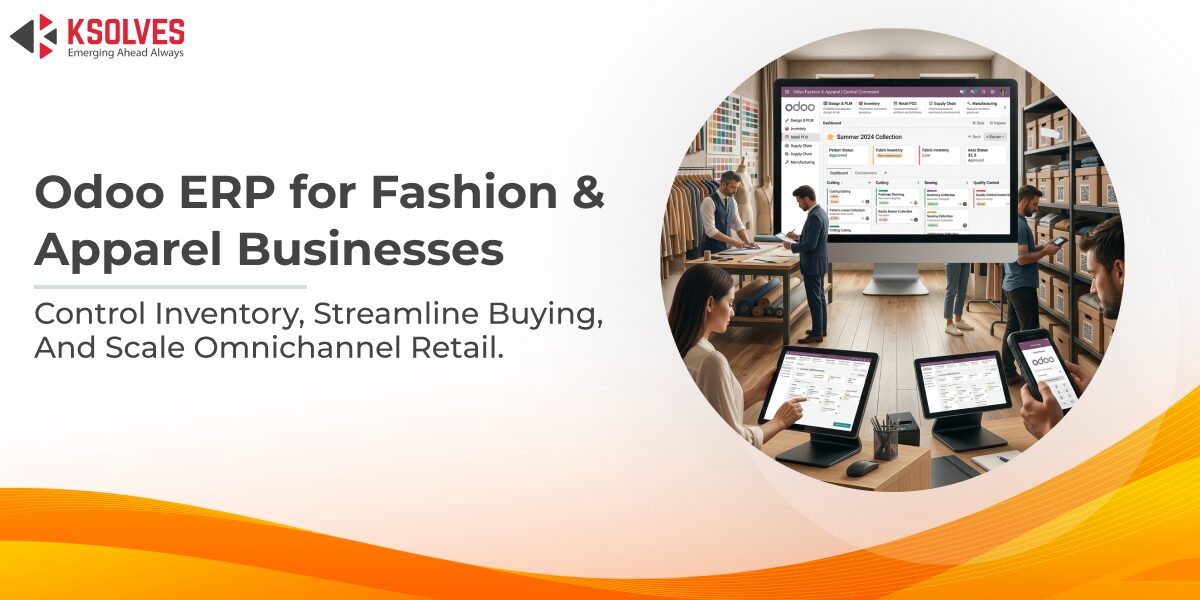
Running a fashion or apparel business today means making high-stakes decisions at speed. Seasonal collections must be planned months in advance, supplier lead times are tightening, customer expectations across both physical and digital channels are rising, and product complexity, measured in sizes, colors, fabrics, and finishes, creates inventory management challenges that general-purpose software simply cannot handle well.
For ERP decision-makers, IT leaders, and digital transformation heads, selecting the right fashion ERP or apparel ERP software is not a technology project; rather, it is a business continuity decision. This is because an incorrect platform creates operational drag that compounds over time. The right one becomes a competitive advantage built into daily operations.
This blog takes a decision-maker’s lens to one of the most commonly asked questions in apparel technology today: Is Odoo good for the fashion industry, and does it have what it takes to serve as a true ERP system for fashion and apparel retail businesses at scale?
The Financial Cost of Getting Inventory Wrong in Fashion
Before evaluating any ERP platform, it helps to understand exactly what poor operational systems cost the industry. According to a study, the fashion industry produced between 2.5 billion and 5 billion excess items in 2023, worth between $70 billion and $140 billion in sales. The same report found that inaccurate stock purchasing across sizes is estimated to result in profit loss of up to 20 percent on average.
These figures represent a systemic failure of data, not of demand. Fashion brands are not losing revenue because customers have stopped buying. They are losing it because the systems connecting buying decisions, production plans, and inventory positions are disconnected, delayed, or inaccurate. An ERP for fashion and apparel retail businesses that integrates these systems in real time is not a cost; it is an investment. It is a margin recovery mechanism. This is the lens through which decision-makers should evaluate any apparel ERP system, including Odoo.
For a foundational overview of how ERP software addresses apparel and textile manufacturing operations, see our earlier deep dive: The Ultimate Solution for Apparel and Textile Industry: ERP Software.
Three Operational Challenges That a Generic ERP Cannot Solve for Fashion
Most ERP platforms are built to handle standard product catalogs, linear production workflows, and stable demand patterns. Fashion operates in none of those conditions. Before determining whether Odoo ERP is suitable for your apparel business, it is important to understand the specific operational challenges that separate fashion from other verticals.
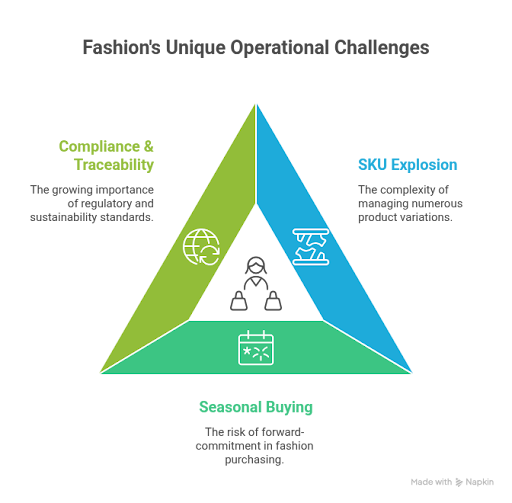
- SKU explosion and the variant management problem. A single style in a clothing business can generate 60 or more individual SKUs once size, color, inseam, and fit variations are accounted for. Multiplied across hundreds of active styles in a season, this creates an inventory management environment of extraordinary complexity. Systems that cannot handle true variant-level tracking at speed force teams into spreadsheet workarounds that introduce errors and delay decisions.
- Seasonal buying cycles and forward-commitment risk. Unlike most industries where purchasing follows demand signals, fashion requires brands to commit to large purchase orders months before goods arrive or sales data is available. This forward-commitment model means that demand forecasting in the apparel industry is not a reporting function. It is a buying function. An ERP for fashion retail businesses that cannot support historical trend analysis and seasonal planning directly undermines the quality of buying decisions.
- Compliance, traceability, and sustainability pressure. This is a dimension that many ERP evaluations overlook. The EU’s Ecodesign for Sustainable Products Regulation will require brands to report on the management of excess stock in 2025 and will make it illegal to destroy unsold products in 2026. For fashion brands operating in or exporting to European markets, supply chain traceability is no longer optional. An apparel ERP system that cannot track product origins, material compositions, and waste disposal at the SKU level creates regulatory risk in addition to operational risk.
Also Read: Why Startups Prefer Odoo ERP as Their Product Backbone
Where Odoo ERP Delivers Measurable Value for Fashion Brands
-
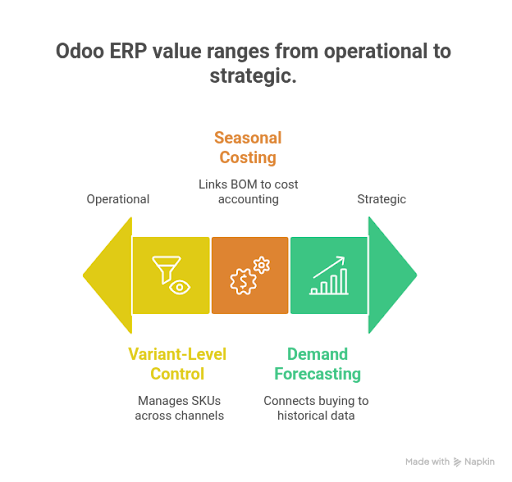
Variant-Level Inventory Control
Odoo ERP for the fashion retail industry supports native product variant management, allowing businesses to define size, color, material, and fit as configurable attributes and automatically generate the complete SKU matrix. Real-time stock visibility across multiple warehouse locations gives operations teams the information they need to make accurate allocation, replenishment, and markdown decisions. For fashion brands managing thousands of active SKUs across physical and digital channels simultaneously, this level of granular control is a core operational requirement, not a premium feature.
-
Retail Cost Management and Margin Protection
One area where Odoo ERP for fashion retail businesses provides distinctive value is by linking purchasing costs directly with inventory and sales data. Retailers can track supplier pricing, landed costs, and procurement expenses associated with each style and SKU.
This means that when supplier prices shift or logistics costs change, the impact automatically reflects in margin calculations. Merchandising teams, retail operations managers, and finance teams work from the same numbers, eliminating the version-control problems that often arise when teams rely on disconnected spreadsheets.
The result is more accurate seasonal profitability forecasting and faster response to cost changes during buying cycles.
-
Demand Forecasting Tied to Real Buying Decisions
Odoo’s forecasting capability uses historical sales data, seasonal patterns, and configurable reorder rules to generate stock replenishment recommendations. For fashion brands, this connects directly to the pre-season buying process. Rather than relying on intuition or isolated spreadsheet models, buyers can use system-generated demand signals to inform order quantities by style, size, and color. This directly addresses the size-buying inaccuracy problem identified by the McKinsey data as a primary source of margin loss in apparel.
Omnichannel Synchronization: Where Odoo Proves Its Real-World Value
Technology alone rarely determines ERP success. The real difference between a successful implementation and an underperforming one lies in how well the system is configured to match the operational realities of the business using it. In the fashion and apparel retail industry, where variant complexity, supplier coordination, and omnichannel inventory visibility intersect daily, the role of experienced implementation partners becomes even more critical.
This is where Odoo Implementation Services, provided by experienced Odoo partners, such as Ksolves, play a significant role. Rather than deploying Odoo as a generic ERP platform, these services focus on tailoring the system to the specific workflows of fashion brands, garment manufacturers, and apparel retailers.
A Practical Explanation
One of the most significant benefits of Odoo ERP for apparel companies operating across multiple sales channels is the platform’s ability to maintain a single & consistent inventory record regardless of where sales occur. This is not a theoretical capability. It has been proven in demanding real-world conditions.
A high-volume fast-fashion retailer managing 50 physical stores across India and a global Shopify storefront was struggling with stock mismatches, chronic overselling during flash sales, and order import delays under their legacy integration. After implementing the Ksolves Odoo-Shopify Connector, the transformation was measurable across every critical metric:
| Metric | Before Odoo | After Odoo |
| Stock Mismatch Rate | 12% | Below 1.5% |
| Order Import Lag | 2+ hours | Under 15 minutes |
| Q1 Revenue Growth | Baseline | +18% Year-over-Year |
| Peak Event Capacity | System failures during flash sales | 150,000+ orders in 80 minutes |
| API Reliability | Frequent timeouts | Zero failed API calls |
Read the full case here.
Odoo vs. Traditional ERP: A Strategic Business Case, Not a Feature Comparison
For technology decision-makers evaluating the best ERP for the apparel industry, the comparison between Odoo and traditional enterprise platforms such as SAP or Oracle ultimately comes down to three strategic dimensions.
Total cost and speed of value: Traditional enterprise ERP platforms carry substantial upfront licensing costs, extended implementation cycles that often stretch beyond twelve months, and ongoing customization expenses that require specialist consultants. Odoo’s modular structure means fashion retail businesses activate and pay for the capabilities they need, from inventory and manufacturing through to accounting and e-commerce, without unnecessary overhead. Well-structured mid-sized apparel implementations routinely achieve full go-live in six to ten weeks.
Flexibility to match fashion workflows: Legacy ERP platforms impose process structures that businesses must adapt to. Odoo, as an open-source platform, can be configured to reflect how a specific fashion retail business actually operates. Whether that means tracking sampling approval stages, managing vendor-specific fabric rates, or automating reorder triggers at the style-color-size level, the platform bends to the operation rather than the other way around.
Scalability without re-platforming: Odoo for the fashion retail industry is modular by design. A brand that starts with inventory and sales management can expand into manufacturing, quality control, financial reporting, and multi-channel e-commerce integration without changing platforms. This matters significantly to digital transformation leaders who are building infrastructure intended to support the business’s two or three growth stages ahead.
For very large enterprises with deeply embedded legacy systems and dedicated ERP operations teams, traditional platforms may still be the appropriate choice. For the broad majority of mid-sized and scaling fashion brands, Odoo ERP for the clothing business represents a more agile, more affordable, and more adaptable path forward.
Also Read – Odoo vs. Traditional ERPs
A Practical Evaluation Framework for ERP Decision-Makers
Before finalizing any apparel ERP platform, senior decision-makers should stress-test candidates against five questions that are specific to the fashion and apparel retail operating environment.
Can the platform manage variant-level inventory across the full size-color matrix without requiring manual workarounds? Does it support accurate product costing linked to supplier purchases? Can it synchronize stock and orders in real time across physical, wholesale, and digital sales channels? Does it provide forward-looking demand signals that can feed directly into pre-season buying decisions? And does the implementation and support model from your chosen partner include experience with fashion retail configuration?
Odoo ERP for the fashion industry performs strongly across all five criteria, particularly when implemented by a partner with proven experience in retail and omnichannel environments.
Conclusion
The fashion and apparel industry does not need a generic ERP solution configured to look vertical-specific. Rather, it needs a platform built for the complexity of variant-driven inventory, the pressure of seasonal buying cycles, the realities of omnichannel retail, and the growing weight of sustainability compliance. Odoo ERP for the fashion retail industry addresses each of these requirements with a combination of native functionality, open-source flexibility, and a track record of real-world performance backed by measurable outcomes.
For ERP and digital transformation leaders evaluating their next platform investment, Odoo deserves serious consideration as the ERP system for modern fashion and apparel retail businesses.
Frequently Asked Questions
Is Odoo ERP suitable for apparel businesses that manage complex size and color-variant catalogs?
Yes. Odoo natively supports product variant management at the attribute level, allowing businesses to define size, color, fit, and material as configurable dimensions and generate the full SKU matrix automatically. Real-time inventory tracking at the variant level is a core capability, not a custom add-on.
Why do fashion brands choose Odoo ERP over larger enterprise platforms like SAP?
The primary reasons are cost structure, implementation speed, and flexibility. Odoo’s modular pricing model and open-source architecture allow fashion brands to build the exact capability stack they need without enterprise licensing costs or rigid implementation timelines.
Is Odoo good for fashion industry businesses dealing with seasonal demand planning?
Yes. Odoo’s integrated forecasting capability uses historical sales data and configurable reorder logic to generate demand signals that can feed directly into pre-season buying decisions. This helps buying teams reduce both overstock and stockout exposure.
How does Odoo ERP for garment manufacturing handle costing across complex bills of materials?
Odoo supports multi-level bills of materials that can incorporate every component of garment construction, from fabric yardage to trims, labels, and labor. Each BOM connects directly to the product costing module, meaning that raw material price changes flow automatically into margin calculations. This gives finance, merchandising, and production teams a consistent and current view of profitability without manual reconciliation.






























AUTHOR
Odoo
Share with