



ServiceNow GRC Implementation: A Step-by-Step Guide for Compliance-Heavy Organizations
ServiceNow
5 MIN READ
July 7, 2026

For organizations operating in highly regulated industries, governance, risk, and compliance (GRC) is no longer just about passing audits. It’s about protecting the business from regulatory penalties, operational disruptions, cyber threats, and reputational damage.
Yet many compliance programs still rely on spreadsheets, emails, and disconnected tools that make it difficult to maintain accurate risk visibility and demonstrate continuous compliance. Controls are manually attested, audit preparation becomes a recurring scramble, and risk data quickly becomes outdated.
ServiceNow GRC (now known as Integrated Risk Management or IRM) transforms this approach by bringing governance, risk, compliance, audit, and operational data onto a single platform. Instead of treating compliance as a periodic exercise, organizations gain real-time visibility, automated control testing, and evidence-based assurance across their enterprise.
In this guide, we’ll walk through the key steps to successfully implement ServiceNow GRC and build a scalable, continuous compliance program for regulated organizations.
Why Most GRC Programs Lose Momentum
Technology is rarely the reason GRC initiatives struggle. The pattern is surprisingly consistent across industries.
An organization invests in a GRC platform, uploads policy documents, imports controls, completes one assessment cycle, and then gradually watches the platform become another compliance repository that nobody fully trusts.
Three common challenges are usually responsible.
1. Controls Are Disconnected from Operations
Many compliance programs depend on questionnaires asking system owners whether controls are functioning.
For example, a policy requiring critical servers to be patched within a specific timeframe often relies on someone confirming that the work was completed.
Without direct validation from operational systems, compliance becomes an exercise in trust rather than evidence.
2. Manual Assessments Create Fatigue
Quarterly questionnaires consume countless hours. Control owners repeatedly gather screenshots, collect evidence, complete spreadsheets, and answer identical questions every audit cycle.
By the time reviews are complete, much of the information has already become outdated.
3. Accountability Is Difficult to Maintain
When risks, controls, policies, audit findings, and remediation tasks live in different systems, ownership becomes fragmented.
Leaders struggle to answer simple questions such as:
- Which controls are failing today?
- Which business units carry the highest compliance risk?
- Who owns remediation?
- Which findings remain unresolved?
Without a single source of truth, governance becomes reactive rather than proactive.
The solution isn’t another spreadsheet or another standalone application.
It is a connected platform where evidence, risk, compliance, and operational data work together continuously.
What ServiceNow GRC Actually Delivers
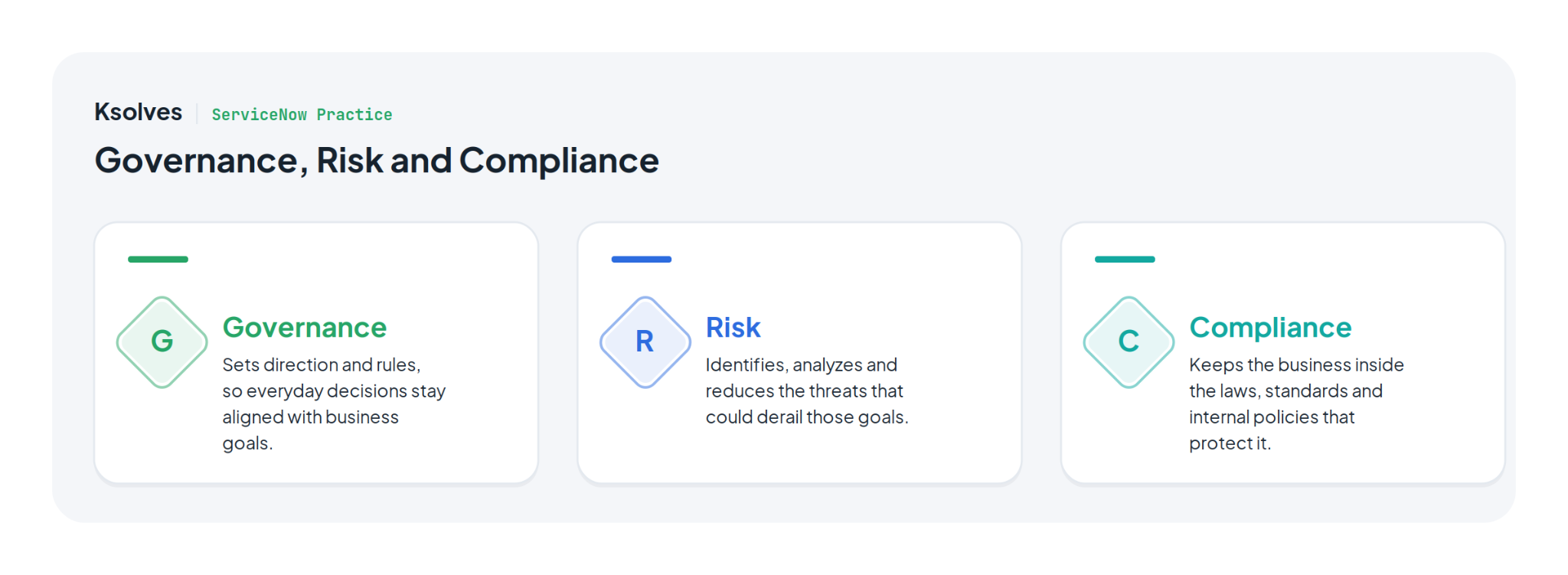
Governance, risk, and compliance each serve a different purpose:
- Governance establishes policies, standards, and decision-making structures.
- Risk Management identifies, measures, and mitigates threats to business objectives.
- Compliance ensures adherence to internal policies, industry standards, and regulatory requirements.
Rather than treating these as independent disciplines, ServiceNow connects them into one operational system.
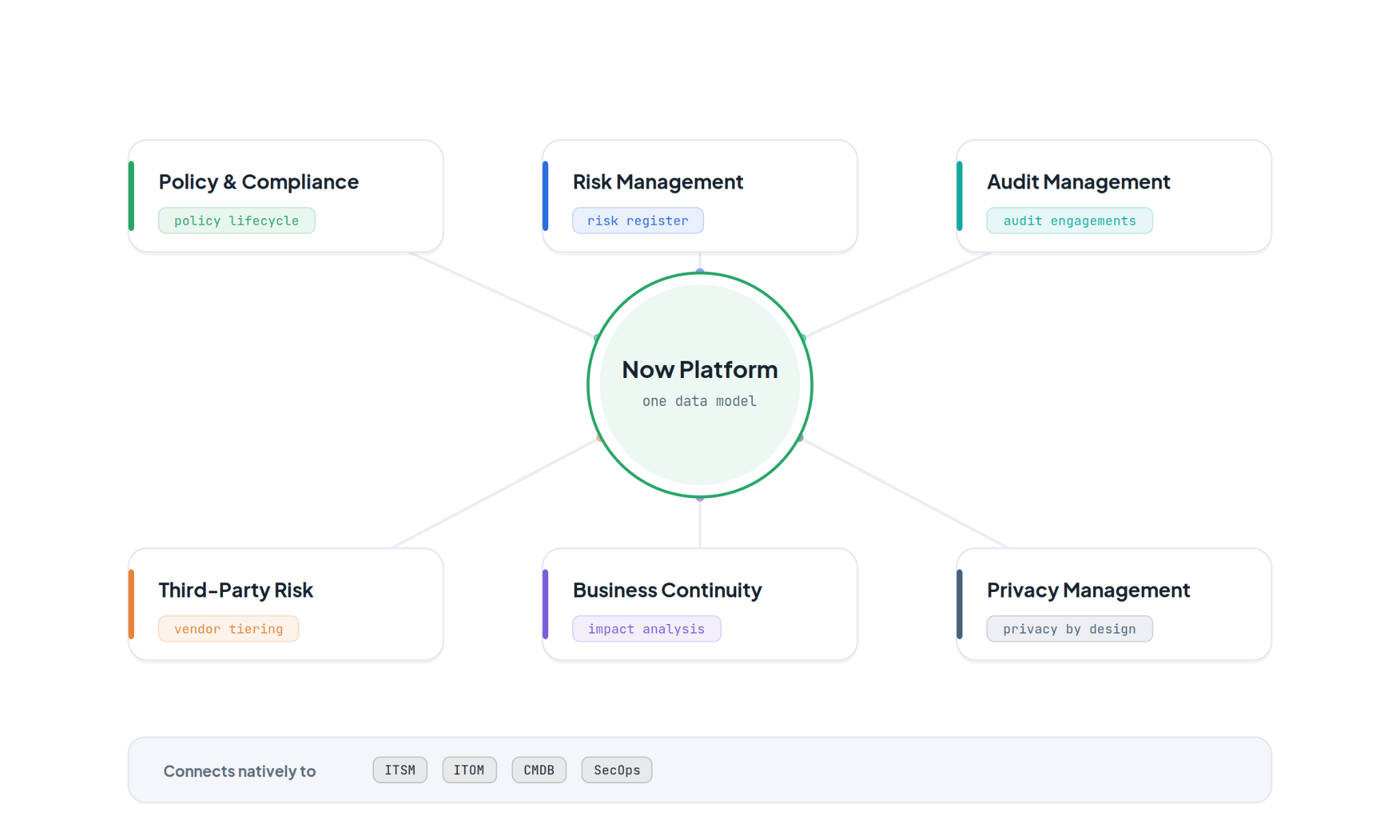
At the center of this ecosystem is the Now Platform.
The ServiceNow GRC suite includes:
- Policy and Compliance Management.
- Risk Management.
- Audit Management.
- Third-Party Risk Management.
- Business Continuity Management.
- Privacy Management.
Because every module shares the same data model, information flows naturally across ITSM, ITOM, CMDB, SecOps, and Security Operations without requiring duplicate data entry or disconnected workflows.
The Architecture That Makes GRC Work
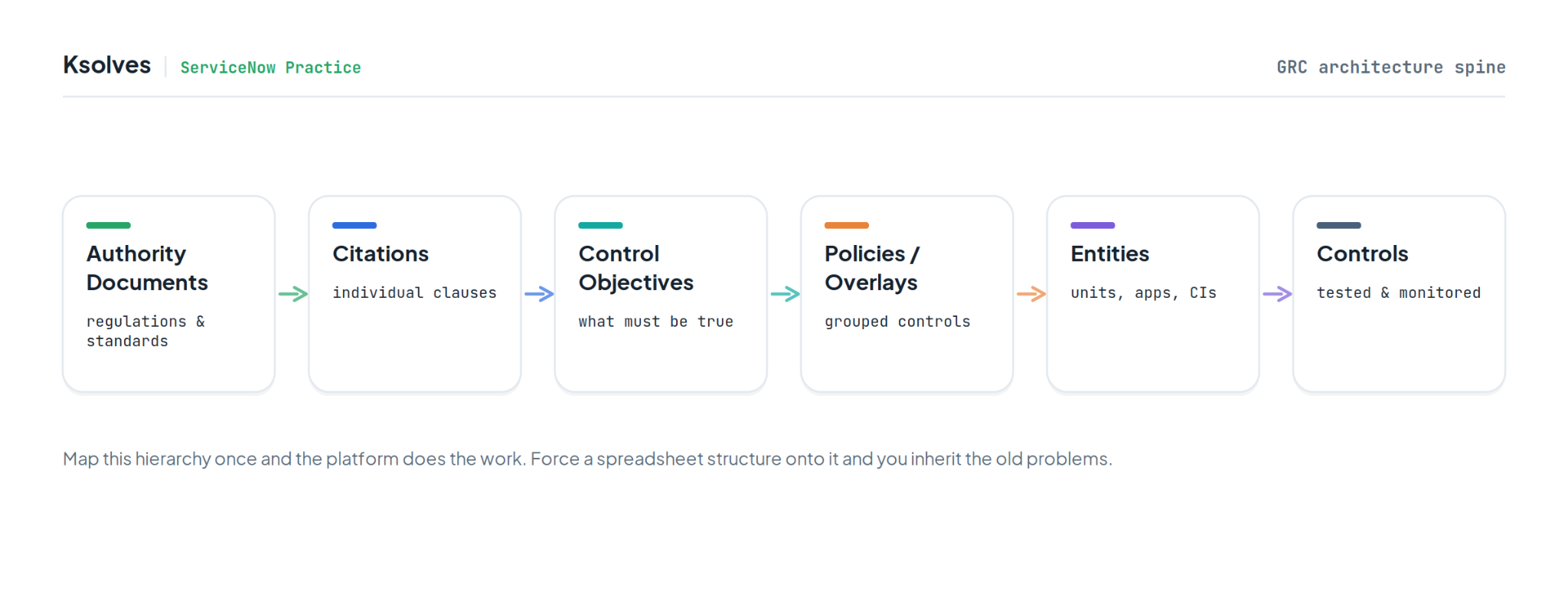
Successful ServiceNow GRC implementations are built on a structured hierarchy. Regulations and standards become Authority Documents. These generate Citations, which map to Control Objectives.
Control Objectives are grouped into Policies or Control Overlays, which are then assigned to business entities, applications, infrastructure, or CMDB configuration items.
Once this architecture is established correctly, controls can be inherited, reused, tested automatically, and reported consistently across multiple regulatory frameworks.
Attempting to replicate legacy spreadsheet structures inside ServiceNow removes many of these advantages and creates unnecessary technical debt.
Step-by-Step ServiceNow GRC Implementation
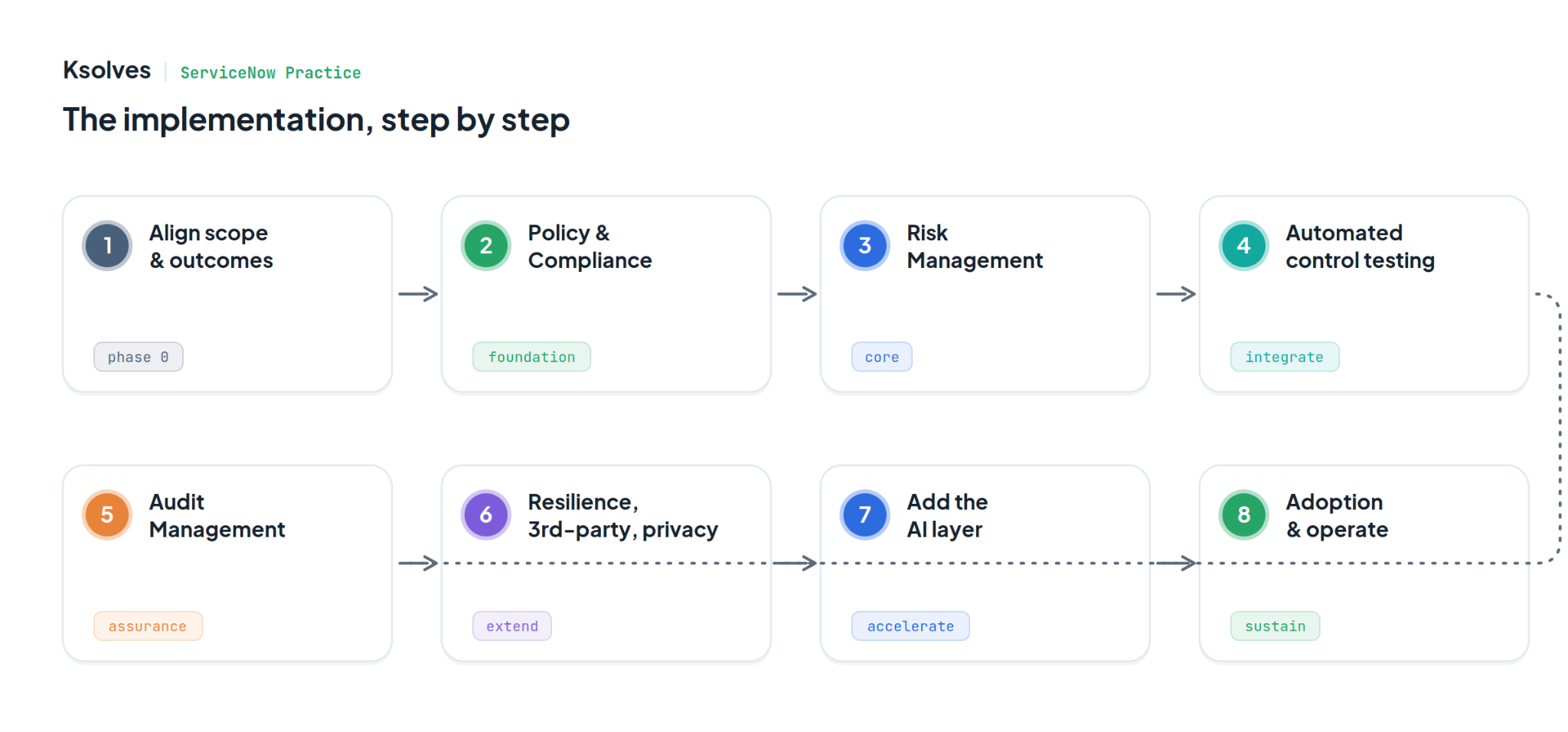
Step 1: Align Business Outcomes Before Configuration
ServiceNow GRC Implementation should never begin with workflows or forms. It begins with business alignment.
Identify which regulatory frameworks truly matter.
Examples include:
- SOX
- PCI DSS
- HIPAA
- GDPR
- ISO 27001
- Regional privacy regulations
Define executive success metrics early. Examples include:
- Faster audit readiness.
- Reduced compliance effort.
- Lower control failure rates.
- Improved risk visibility.
- Shorter remediation timelines.
Rather than deploying every available module immediately, begin with a focused roadmap that delivers measurable value at each phase.
Step 2: Build the Policy and Compliance Foundation
Policy and Compliance Management provides the foundation for every other GRC capability.
Begin by modeling organizational entities, including:
- Business units
- Applications
- Services
- Infrastructure
- Departments
Next, establish the complete policy lifecycle:
- Draft
- Review
- Approval
- Publication
- Employee acknowledgment
- Retirement
Policy acknowledgment tracking becomes especially valuable during regulatory audits because organizations can demonstrate exactly who accepted which policy and when.
Framework mapping provides another major advantage.
A single technical control, for example, encryption at rest, can satisfy multiple regulatory obligations simultaneously.
Using Unified Compliance Framework content, organizations assess the control once while generating evidence across several regulations.
This dramatically reduces duplicated compliance work.
Step 3: Establish Enterprise Risk Management
With policies established, organizations can begin building their enterprise risk program.
Each identified risk should include:
- Category
- Business impact
- Owner
- Likelihood
- Financial impact
- Response strategy
Organizations may choose qualitative scoring, quantitative financial scoring, or a hybrid approach depending on maturity.
Every significant risk should connect directly to the controls designed to mitigate it.
This creates complete traceability between business objectives, identified risks, implemented controls, and audit evidence.
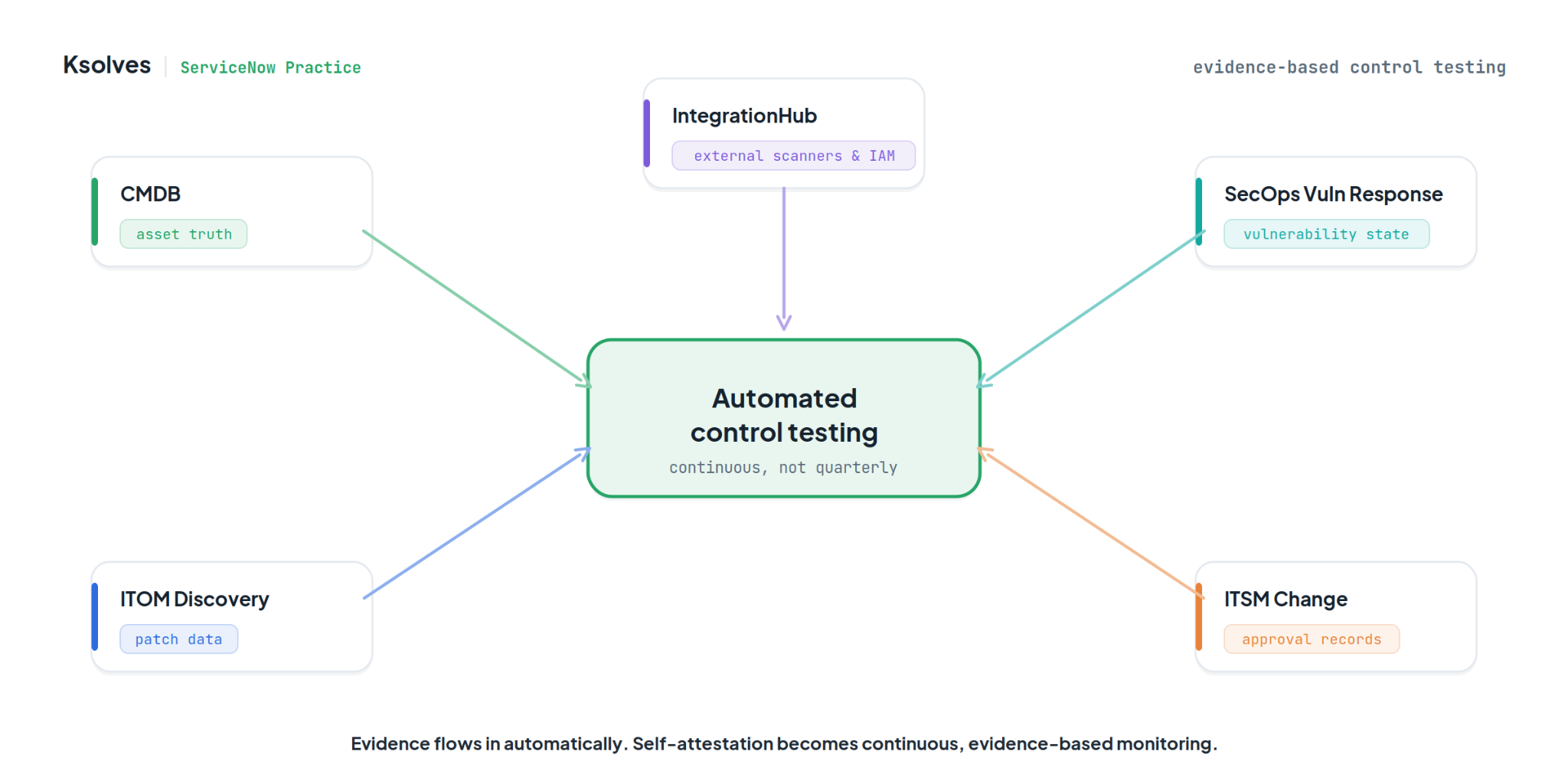
Step 4: Automate Control Testing
Automation is where ServiceNow GRC delivers its greatest value.
Instead of relying on quarterly attestations, organizations continuously validate controls using operational data.
Examples include:
- MFA configurations.
- Patch compliance.
- Vulnerability remediation.
- Change approval workflows.
- Asset inventories.
- Configuration compliance.
IntegrationHub allows ServiceNow to collect evidence from external security tools, identity platforms, scanners, and enterprise applications.
When a control fails, ServiceNow automatically creates compliance issues, assigns ownership, tracks remediation, and can initiate ITSM workflows for corrective action.
Compliance becomes continuous rather than periodic.
Step 5: Modernize Audit Management
With risk and compliance operating together, audit teams no longer spend weeks requesting evidence.
Audit Management enables organizations to:
- Plan audits using risk-based prioritization
- Manage engagements
- Collect evidence
- Track workpapers
- Monitor findings
- Verify remediation
Everything remains linked back to risks, controls, and policies, creating complete audit traceability.
Step 6: Expand into Operational Resilience
Once the core implementation stabilizes, organizations can introduce additional capabilities based on business priorities.
- Business Continuity Management
Connects business impact analysis with CMDB dependencies to understand operational exposure during disruptions.
- Third-Party Risk Management
Evaluates vendors throughout their lifecycle using inherent risk scoring, due diligence workflows, continuous monitoring, and ongoing assessments.
- Privacy Management
Automates privacy impact assessments, supports privacy-by-design initiatives, and manages data subject requests across jurisdictions.
Step 7: Introduce AI Governance
Artificial intelligence affects GRC in two important ways.
First, AI improves GRC operations themselves.
Now Assist accelerates assessments, summarizes findings, drafts documentation, and reduces repetitive administrative work.
Second, organizations increasingly need governance for AI systems.
As AI becomes embedded within business operations, organizations must manage:
- Model inventories
- Ownership
- Bias monitoring
- Policy compliance
- Data governance
- Decision traceability
Managing AI within the existing GRC framework ensures consistent governance across both traditional systems and emerging technologies.
Step 8: Drive Adoption and Continuous Improvement
Technology alone does not create governance maturity.
Successful implementations invest equally in adoption.
Provide role-specific workspaces for:
- IT
- Risk teams
- Internal audit
- Finance
- Legal
- Compliance
Support deployment with structured training, executive sponsorship, and ongoing platform governance.
Finally, monitor measurable outcomes over time.
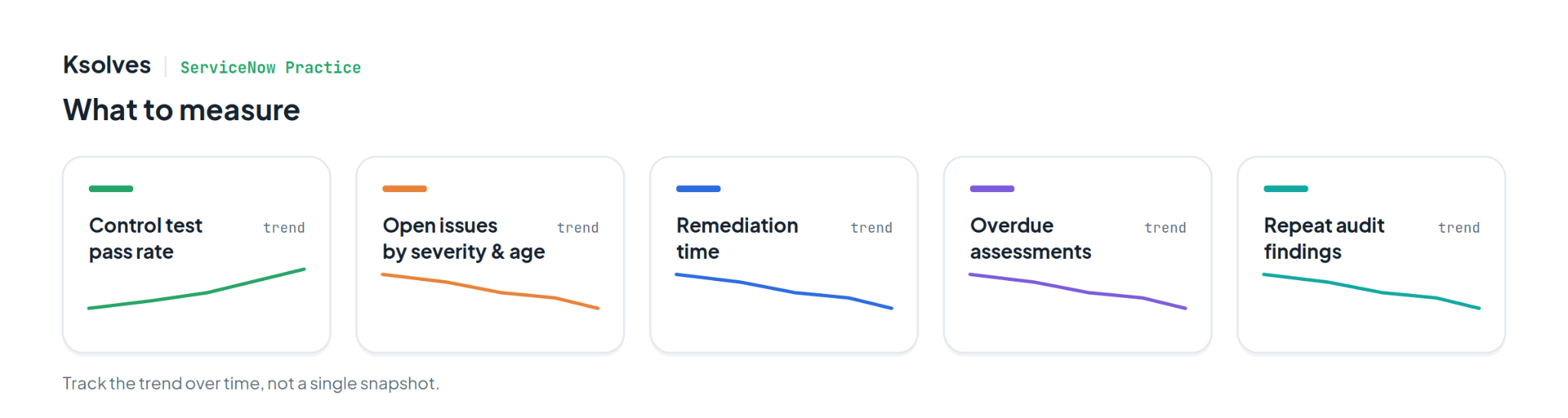
Track metrics such as:
- Control test pass rates.
- Remediation timelines.
- Repeat audit findings.
- Overdue assessments.
- Open issues by severity.
These trends reveal whether the GRC program is genuinely improving organizational resilience.
Common ServiceNow GRC Implementation Pitfalls
Even mature organizations can undermine their GRC initiatives by making avoidable implementation decisions.
Common mistakes include:
- Over-customizing out-of-the-box workflows.
- Replicating spreadsheet-based processes.
- Deploying every module simultaneously.
- Ignoring user experience.
- Treating change management as an afterthought.
A phased implementation built around standard platform capabilities almost always delivers faster adoption, lower maintenance costs, and better long-term scalability.
Compliance Should Become Continuous
The strongest GRC programs no longer prepare for audits. They remain audit-ready every day.
When policies, risks, controls, operational systems, and evidence exist within one connected platform, compliance becomes an ongoing operational capability rather than a periodic project.
Organizations gain greater confidence in their controls, faster remediation, stronger executive visibility, and better resilience against evolving regulatory requirements.
Achieving that outcome requires more than technical implementation. It requires designing the right governance model, building reusable compliance frameworks, integrating operational data sources, and ensuring the platform continues to evolve alongside the business.
How Ksolves Helps Organizations with ServiceNow GRC Implementation
At Ksolves, an AI-first ServiceNow consulting partner, we approach ServiceNow GRC implementations as business transformation initiatives rather than technology deployments.
Our ServiceNow consultants work closely with stakeholders to design governance frameworks that align with regulatory obligations, operational processes, and long-term business objectives. From modeling authority documents and control hierarchies to integrating CMDB, ITSM, SecOps, and third-party systems, we help organizations build GRC programs that are scalable, evidence-driven, and built for continuous compliance.
As an NSE and BSE-listed, AI-first technology company with CMMI Level 3 appraisal and ISO-certified delivery practices, Ksolves combines certified ServiceNow expertise with deep experience across Policy and Compliance Management, Risk Management, Audit Management, Third-Party Risk Management, Business Continuity Management, and Privacy Management.
Our focus extends well beyond implementation. We partner with organizations to optimize adoption, streamline operations, and continuously improve their governance posture as regulations and business priorities evolve.
Final Words
ServiceNow GRC implementation is an opportunity to build a resilient, scalable governance framework that keeps your organization compliant, reduces risk, and strengthens operational efficiency. With the right strategy, GRC becomes a continuous business capability rather than a periodic compliance exercise.
At Ksolves, a trusted ServiceNow consulting partner, we help organizations unlock the full potential of ServiceNow GRC through tailored implementation, seamless integrations, and industry best practices. From planning and deployment to ongoing optimization, our experts ensure your GRC program delivers measurable business value and long-term success.
Looking to implement or optimize ServiceNow GRC? Our certified ServiceNow specialists can help you design, deploy, and scale a GRC solution!

































AUTHOR
ServiceNow
Share with