



Why You Should Migrate to Apache Cassandra 5.x?
Apache Cassandra
5 MIN READ
February 26, 2026

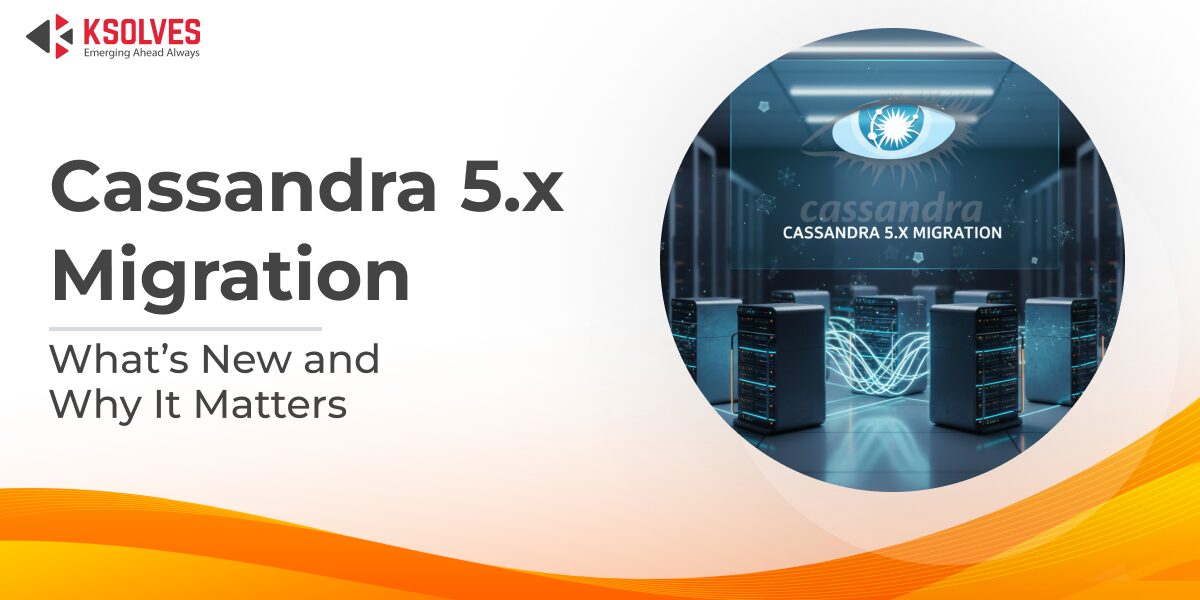
Apache Cassandra has long been the go-to NoSQL database for applications requiring high availability, linear scalability, and massive throughput. But with the release of Apache Cassandra 5.x, the game has changed. This new version isn’t just an iteration; it’s a major step forward that introduces powerful indexing, AI-ready features, operational improvements, and cost-saving capabilities. In this blog, we’ll explore why migrating to Cassandra 5.x is a strategic move, breaking down its key features, how they solve real-world problems, and the benefits you can expect across performance, cost, and future-readiness.
Key Reasons Why Move to Cassandra 5.x
- Advanced Querying with Storage-Attached Indexes (SAI)
Earlier versions of Cassandra had limited support for secondary indexes, and they often caused performance bottlenecks or failed to scale well. Cassandra 5.x introduces Storage-Attached Indexes (SAI), a completely re-engineered indexing system that works directly with the underlying storage engine.
Why It Matters:
- Smarter Queries: You can now perform range, prefix, suffix, and multi-column queries directly without expensive data modeling workarounds.
- Lower Overhead: Unlike legacy indexes, SAI operates close to the storage engine (on Memtables and SSTables), ensuring high performance with minimal disk or memory impact.
- Built for Scale: Whether you’re dealing with billions of rows or petabytes of data, SAI is optimized to keep performance consistent and queries fast.
Use Case Example:
If you are running a product catalog with millions of SKUs and you want to search by attributes like brand, price range, or color. With SAI, you can query directly without denormalizing your data or creating materialized views, keeping your system fast and clean.
- High-Speed Performance with Trie Memtables & SSTables
Cassandra 5.x introduces Trie Memtables and Trie SSTables, replacing traditional hash-based data structures. This new system stores data in a prefix-compressed format that is memory-efficient and faster to search.
Why It Matters:
- Faster Lookups: Trie structures accelerate read and write access by organizing data more efficiently.
- Reduced Disk Footprint: Data is compressed more effectively without sacrificing access speed.
- Improved Write Throughput: Perfect for write-heavy applications like logging, event streams, or IoT telemetry.
Use Case Example:
If you’re operating a real-time application like a trading platform or a telemetry ingestion service, a Cassandra 5x speed improvement could result in lower latency and fewer dropped records, even under peak loads.
- Built-In AI & Vector Search Capabilities
One of the biggest innovations in Cassandra 5.x is native vector support, including vector data types and Approximate Nearest Neighbor (ANN) indexing.
Why It Matters:
- AI/ML Ready: Power AI-driven applications like recommendation systems, image recognition, semantic search, and fraud detection natively in Cassandra.
- No Extra Tools Needed: Avoid maintaining separate vector databases or hybrid architectures.
- Seamless Integration: Store scalar and vector data side-by-side and query both with simple CQL.
Use Case Example:
In personalized content delivery, Cassandra 5.x can store user interaction embeddings and run vector similarity searches in milliseconds, without leaving the database.
- Unified Compaction Strategy (UCS) for Simplified Operations
Managing compaction in previous Cassandra versions required choosing between several strategies, like STCS, LCS, and TWCS, each with trade-offs. Misconfiguration could cause performance issues or disk bloat. With Cassandra 5.x, Unified Compaction Strategy (UCS) is capable of:
- Adapts automatically to different workloads.
- Balances write amplification and read latency.
- Minimizes operational overhead.
Why It Matters:
You spend less time tuning the database and more time delivering value. It ensures your clusters remain fast and efficient under different traffic patterns.
Use Case Example:
If your application mixes batch loads, real-time inserts, and time-series updates, UCS balances them intelligently, avoiding performance degradation.
-
Enhanced CQL with Built-in Math Functions & Dynamic Data Masking
Cassandra 5.x upgrades the CQL language with:
- Dynamic Data Masking: Enables runtime redaction of sensitive fields (like PII) without duplicating data or changing application code.
- Built-in math functions like abs(), round(), exp(), log() for lightweight in-query computation.
Why It Matters:
- Stronger Privacy Controls: Ideal for regulated industries like healthcare, finance, and government.
- More Power to Analysts: Perform calculations directly in queries, reducing the need for downstream ETL.
Use Case Example:
Customer service agents can see partially masked user IDs in real time, while backend systems have full access, with no need to duplicate or anonymize the data manually.
-
Performance Boost with Java 17 Support
Cassandra 5.x fully supports Java 17, bringing modern JVM improvements:
- Modern GC Algorithms: ZGC and G1 enhancements mean better memory management.
- Improved Throughput: More stable, predictable latency for read/write operations
- Better Security: Access to the latest JVM-level patches and crypto enhancements.
Why It Matters:
You get a future-ready runtime environment, lower garbage collection pauses, and increased throughput, all while keeping operational overhead low.
- Enterprise-Grade Security and Governance
Cassandra 5.x adds more security guardrails, governance controls, and audit-friendly features:
- Field-level masking
- Access guardrails
- Audit-friendly controls
Why It Matters:
- Helps meet data privacy laws (GDPR, HIPAA, CCPA) out-of-the-box.
- Enables secure data sharing between teams, partners, or AI systems without compromising sensitive fields.
Use Case Example:
In healthcare analytics, patient identifiers can be masked in dashboards while full data remains accessible to backend processors with the right privileges.
-
Cost Efficiency and Cluster Optimization
By optimizing core systems and reducing dependencies:
- SAI and Trie indexes reduce hardware needs by improving storage efficiency.
- UCS cuts down compaction-related I/O, reducing disk churn.
- Built-in AI/vector support means fewer external tools are needed.
Why It Matters:
You can scale up intelligently, not reactively, reducing your total cost of ownership (TCO) and complexity.
-
End-of-Life for Cassandra 3.x & Limited 4.x Support
Cassandra 3.x is officially retired, and even Cassandra 4.x will eventually phase out. Running on older versions means Security patches, Performance fixes, and Community support. Even Cassandra 4.x will eventually phase out in favor of 5.x, which has become the active focus of development.
Why It Matters:
Running outdated versions creates risks from compliance issues to cluster instability. Upgrading ensures:
- Long-term support
- Access to the latest innovations
- Continued ecosystem compatibility (e.g., drivers, tools, integrations)
Trust Ksolves for a Hassle-Free Apache Cassandra 5.x Migration
At Ksolves, we specialize in helping enterprises modernize their data infrastructure through seamless and secure Apache Cassandra 5.x upgrade services. Whether you’re upgrading from older Cassandra versions or transitioning from legacy databases, our certified Cassandra architects ensure zero data loss, minimal downtime, and full compatibility with your existing applications.
From assessment and PoC setup to schema optimization, index restructuring, and post-migration and 24×7 support, we deliver an end-to-end migration experience tailored to your business needs. With Ksolves, you get the confidence of working with a trusted partner who understands the complexity of distributed systems and knows how to simplify them.
Wrapping up
Cassandra 5.x not only fixes the challenges with previous versions but also builds for the future. Whether your goal is better performance, tighter compliance, lower costs, or AI integration, the features in 5.x make a compelling case for immediate migration. If you’re planning for Cassandra 5.x migration, then contact our experts.
 Anil Kushwaha
You add 50 servers to your Apache HBase cluster expecting it to run faster. Instead, everything slows down. You open […]
 Anil Kushwaha
For an enterprise, “real-time” has a specific, measurable bar: dashboards that update within seconds of an event happening, and queries […]






























Author
About the Author Editorial Team The Ksolves Editorial Team includes certified Salesforce experts, Big Data engineers, AI/ML specialists, Zoho consultants, and experienced technology writers focused on delivering clear, actionable insights for modern businesses. With hands-on experience across Salesforce, Big Data platforms, AI/ML solutions, application development, software testing, and Zoho ERP/CRM, the team publishes practical guides, real-world use cases, and industry updates that support smarter decisions and faster growth. Every article is created to solve business challenges, guide technology adoption, and keep organizations aligned with evolving digital ecosystems.
Share with