



Automating Banking Operations with Agentforce Voice
Agentforce
5 MIN READ
April 17, 2026

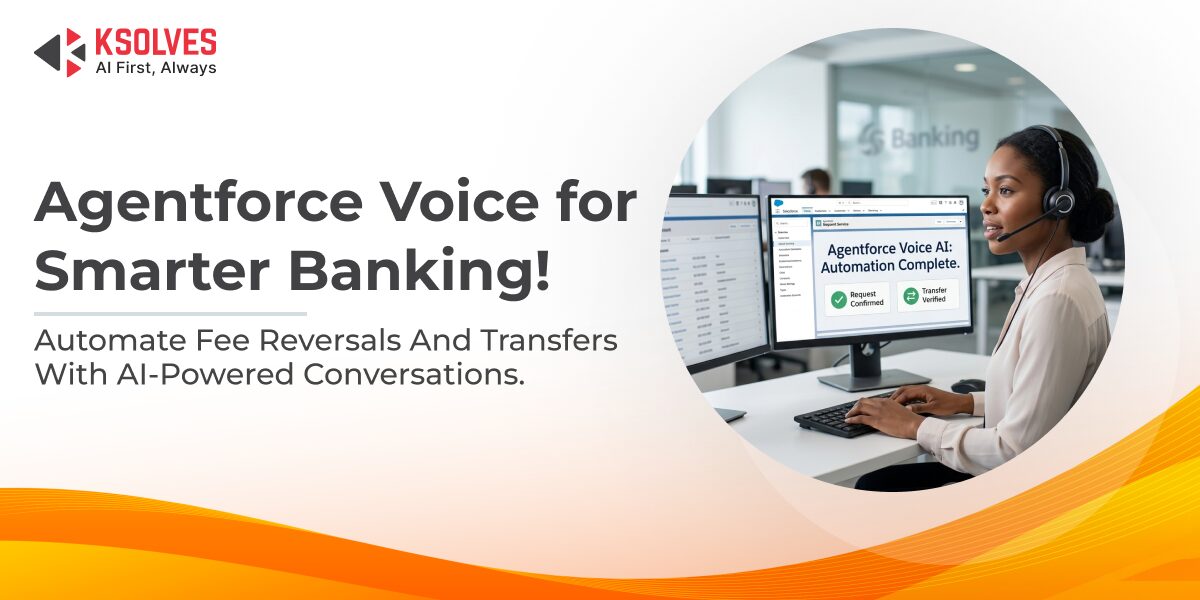
Fee reversals and fund transfer requests are among the most common and repetitive calls in any bank’s contact centre. Every day, thousands of customers contact their bank to dispute charges, request refunds, or move money between accounts. Although these queries are straightforward, they consume a large share of call centre time and resources.
The result is longer wait times for customers, rising operational costs for banks, and agents repeatedly handling the same routine tasks. Even with modern digital banking platforms, many institutions still depend on manual processes to resolve these high-volume requests.
The pressure to improve efficiency is increasing. In 2025, banks that implemented AI-powered chatbots reported a 38 percent reduction in average case resolution time. This highlights a clear shift toward automation in customer service operations.
The real challenge is not whether fee reversals and transfers can be automated. It is how quickly banks can adopt intelligent voice solutions that reduce costs, improve speed, and enhance the overall customer experience.
What Is Agentforce Voice?
Agentforce Voice is an AI-powered conversational solution built within the Salesforce ecosystem that enables banks to automate customer conversations over voice channels. Instead of simply routing calls like a traditional IVR system, Agentforce Voice understands what the customer is asking, reasons through the request, and takes action in real time.
Unlike basic chatbots or menu-based phone systems that rely on fixed scripts, Agentforce Voice is designed to function as an intelligent agent. It can interpret natural language, identify intent, access customer data securely within Salesforce, and complete tasks such as initiating a fee review, processing a transfer request, or escalating complex cases when necessary.
Because it operates inside the Salesforce environment, it connects directly with systems such as Service Cloud, core banking integrations, and customer records. This allows it to deliver personalized responses based on account history, eligibility rules, and compliance policies.
In simple terms, Agentforce Voice is not just a voice bot that answers questions. It is a reasoning, action-taking digital agent that can resolve routine banking requests from start to finish while maintaining accuracy, security, and auditability.
The Fee Reversal Use Case: Step by Step
To see how this works in practice, let’s walk through a real-world fee reversal scenario inside a bank using Agentforce Voice.
Step 1: Customer Calls About an Unexpected Fee
A customer notices a maintenance fee or overdraft charge on their account and calls the bank. Instead of navigating multiple IVR menus, the customer simply explains the issue in natural language:
“I was charged a fee yesterday, and I don’t understand why.”
Agentforce Voice detects the intent as a fee dispute or reversal request and moves to verification.
Step 2: Identity Verification and Data Retrieval
The system verifies the customer using secure authentication methods such as OTP, account details, or voice authentication.
Once verified, Agentforce Voice retrieves:
- Account history
- Recent transactions
- Previous reversal records
- Customer profile data
This information is pulled in real time from Salesforce Data Cloud and connected banking systems.
Step 3: Policy-Based Eligibility Check
Agentforce Voice evaluates the request against predefined bank policies configured in Salesforce.
For example, it checks:
- Has the customer already received a fee reversal in the past 12 months?
- Is the account in good standing?
- Does this fee type qualify for automatic reversal?
Because the rules are standardized, the decision is consistent and compliant.
Step 4: Execute or Escalate with Context
If the customer meets the criteria, Agentforce Voice processes the reversal instantly and confirms the action during the same call.
If the case requires human approval, the request is escalated to a live agent. The key difference is that the agent receives full context:
- Customer details
- Transaction history
- Policy checks performed
- Summary of the conversation
The customer does not need to repeat their issue.
Step 5: Automatic CRM Logging
After the interaction, the system automatically logs:
- The conversation transcript
- The decision outcome
- The action taken
- Time stamps and audit trail
Everything is stored in Salesforce CRM without manual data entry. This supports compliance, reporting, and performance tracking.
The Fund Transfer Use Case: Step by Step
Fund transfers are another high-volume request in banking contact centres. While many customers use mobile apps, a significant number still call for assistance, especially for large transfers, urgent payments, or when they face digital access issues. Here is how Agentforce Voice handles a transfer request securely and compliantly.
Step 1: Customer Requests a Transfer
The customer calls and says:
“I need to transfer 5,000 dollars from my savings account to another bank account today.”
Agentforce Voice understands the intent as a fund transfer request and begins the secure workflow.
Step 2: Identity Verification Through Voice Authentication
Before taking any action, the system verifies the customer’s identity.
This can include:
- Voice biometrics
- One-time password verification
- Security questions
Voice authentication adds an extra layer of protection, helping prevent fraud and unauthorized access. Only after successful verification does the process continue.
Step 3: Confirm Transfer Details and Perform Compliance Checks
Agentforce Voice confirms:
- Source account
- Destination account
- Transfer amount
- Transfer timing
It then performs real-time checks, including:
- Daily and transaction limits
- Suspicious activity flags
- Sanctions screening
- Internal fraud monitoring rules
For Australian banks, compliance is critical. The system supports regulatory requirements under APRA guidelines for operational risk management and data security. It also aligns with CDR frameworks by ensuring secure data handling, customer consent tracking, and audit transparency.
Every step is logged and traceable, which is essential for regulatory audits.
Step 4: Execute or Escalate with Full Audit Trail
If all checks pass, Agentforce Voice executes the transfer immediately and confirms the transaction details to the customer.
If the transfer exceeds limits or triggers compliance flags, the system escalates the case to a human agent. The agent receives:
- Verified customer identity status
- Transfer details
- Compliance checks performed
- Risk flags or alerts
The full audit trail remains intact, ensuring accountability and transparency.
Real-World Reference: How Leading Banks Are Doing It
One of the strongest examples of conversational AI success in banking is Bank of America’s virtual assistant, Erica.
Designed to help customers manage everyday banking needs, Erica supports balance inquiries, transaction searches, bill payments, credit card assistance, and personalized financial insights. By August 2025, Erica had surpassed 3 billion total client interactions, averaging around 58 million interactions per month.
These numbers highlight two key realities:
- Customers are increasingly comfortable using AI for financial interactions.
- High-volume banking queries can be automated at scale while maintaining trust and service quality.
Erica demonstrates that conversational AI is no longer experimental. It has become a mainstream service channel capable of handling millions of interactions consistently and efficiently.
Positioning Agentforce Voice
Agentforce Voice follows the same principle but operates natively within the Salesforce ecosystem. Instead of acting as a standalone assistant, it connects directly to Salesforce CRM, Data Cloud, workflows, and compliance rules.
This enables banks to:
- Automate routine requests such as fee reversals and fund transfers
- Apply policy-based decision logic consistently
- Maintain complete audit trails
- Escalate complex cases with full context
If Erica represents the benchmark for large-scale AI adoption in banking, Agentforce Voice represents a structured, Salesforce-native approach to achieving similar automation outcomes within existing enterprise systems.
How Ksolves Deploys Agentforce Voice for Banking
Deploying Salesforce Agentforce Voice in a banking environment requires more than just technical setup. It demands domain understanding, regulatory awareness, seamless integration, and a structured rollout plan.
At Ksolves, we follow a proven, outcome-driven approach to ensure secure, compliant, and scalable deployment.
1. Discovery & Assessment
As part of our Agentforce consulting services, we begin with a structured discovery phase to understand:
- Existing telephony and IVR systems
- Core banking integrations
- Compliance requirements and audit expectations
- Customer service workflows and escalation paths
- Data architecture across Sales, Service, and risk systems
This phase helps define clear KPIs such as call containment rate, average handling time (AHT), first-contact resolution (FCR), and compliance traceability.
2. Solution Design & Configuration
Once requirements are defined, we design a Salesforce-native architecture using:
- Agentforce Voice
- Salesforce Service Cloud
- Salesforce Data Cloud
- Salesforce Flow and Automation
- Secure identity verification mechanisms
We configure:
- Intelligent voice bots for fund transfers, balance inquiries, and card services
- Automated authentication workflows
- Compliance checkpoints and transaction thresholds
- Escalation rules to live agents with full context transfer
Everything is built within the Salesforce ecosystem to ensure unified case management and real-time visibility.
3. Data Cloud Integration
A major differentiator is how we leverage Salesforce Data Cloud to create a unified customer profile.
We integrate:
- Core banking transaction data
- CRM interaction history
- Risk and compliance flags
- Customer segmentation and behavioral data
This enables:
- Context-aware conversations
- Personalized responses
- Real-time eligibility and limit checks
- Stronger audit trails
The result is voice interactions that are not just automated, but intelligent and secure.
4. Compliance & Testing Framework
Banking deployments require rigorous testing. Our approach includes:
- End-to-end voice journey testing
- Compliance rule validation
- Identity verification accuracy testing
- Load and performance testing
- Audit log verification
We ensure every transfer request is traceable, authenticated, and compliant with regulatory standards and internal governance policies.
5. Go-Live & Hypercare
Before launch, we:
- Conduct UAT with banking stakeholders
- Provide structured training for service teams
- Set up monitoring dashboards
- Enable real-time reporting in Salesforce
Post go-live, we provide hypercare support to fine-tune flows, optimize containment rates, and ensure smooth adoption.
Final Thoughts
Fee reversals and fund transfers will always be high-volume banking requests. The difference now is how intelligently they handled. With Agentforce Voice, banks can move beyond basic automation and deliver fast, secure, and policy-driven resolutions through conversational AI.
By combining real-time data, compliance checks, and automated actions inside the Salesforce ecosystem, financial institutions can reduce operational costs while improving customer satisfaction.
Partner with Ksolves to implement Agentforce Voice effectively. Speak to our experts and book your consultation today.
Frequently Asked Questions
What is Agentforce Voice and how does it work in banking?
What happens if banks continue to rely on manual processes for high-volume call centre requests?
How does Agentforce Voice handle a fund transfer request securely?
How does Agentforce Voice compare to a standard IVR or basic chatbot for banking?
How long does it take to deploy Agentforce Voice in a banking environment?
Which Salesforce partner can help banks implement Agentforce Voice?
What is the business impact of automating banking operations with Agentforce Voice?
Have questions about Agentforce Voice for your bank? Contact our team to book a consultation.
































Author
About the Author Editorial Team The Ksolves Editorial Team includes certified Salesforce experts, Big Data engineers, AI/ML specialists, Zoho consultants, and experienced technology writers focused on delivering clear, actionable insights for modern businesses. With hands-on experience across Salesforce, Big Data platforms, AI/ML solutions, application development, software testing, and Zoho ERP/CRM, the team publishes practical guides, real-world use cases, and industry updates that support smarter decisions and faster growth. Every article is created to solve business challenges, guide technology adoption, and keep organizations aligned with evolving digital ecosystems.
Share with