



Salesforce Testing Lifecycle Explained: From Requirements to Release
Salesforce
5 MIN READ
March 27, 2026

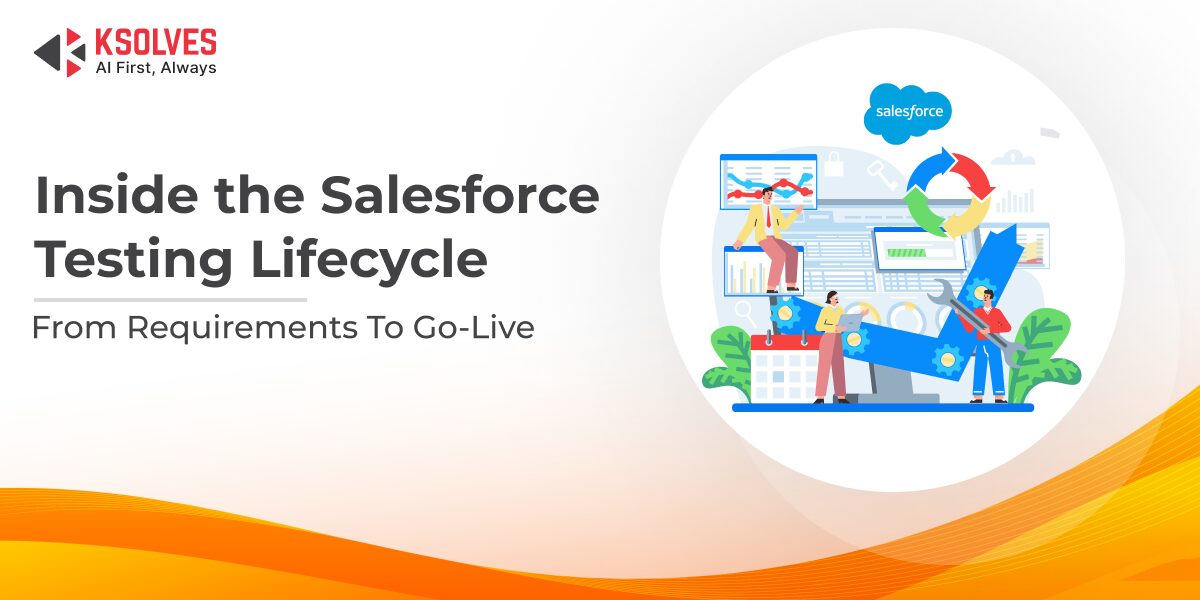
Salesforce has maintained its position as the world’s number one CRM provider, commanding a 20.7% market share and serving over 150,000 companies globally. The platform has become the backbone of customer relationship management for organizations ranging from startups to Fortune 500 enterprises. However, implementing Salesforce successfully requires more than just purchasing licenses; it demands a rigorous testing strategy that ensures your CRM solution delivers on its promise.
The success of any Salesforce implementation heavily depends on a robust testing lifecycle. A well-structured approach ensures that your CRM solution is reliable, scalable, and aligned with your business objectives. From custom Apex code and Lightning components to complex integrations and automated workflows, every element must function flawlessly before reaching production.
Let’s explore the comprehensive journey from requirements gathering to production release and understand how proper testing transforms Salesforce implementations from risky projects into strategic business advantages.
Understanding the Salesforce Testing Lifecycle
The Salesforce testing involves a systematic approach that encompasses all testing activities from the initial requirements phase through to post-deployment monitoring. Unlike traditional software testing, Salesforce testing requires specialized knowledge of the platform’s declarative features, custom code, and integration capabilities.
This lifecycle ensures that every component, from workflows and process builders to custom Apex code and Lightning components, functions flawlessly in production.
Key Phases of the Salesforce Testing Lifecycle
The testing lifecycle consists of several interconnected phases, each critical to delivering a high-quality Salesforce solution. Understanding these phases helps organizations plan effectively, allocate resources appropriately, and ensure comprehensive test coverage.
Let’s examine each phase in detail to understand how they contribute to a successful Salesforce implementation.
1. Requirements Gathering & Analysis: The Foundation
Every successful testing initiative begins with a thorough understanding of business requirements. During this phase, testing teams collaborate with business analysts, developers, and stakeholders to comprehend what the Salesforce implementation aims to achieve. The key is translating these business requirements into testable scenarios.
For instance, if a requirement states that “sales representatives should receive automated notifications when a lead score exceeds 80,” the testing team must define how to validate this functionality across different user profiles and scenarios.
Creating a requirements traceability matrix at this stage ensures that every business requirement has corresponding test cases, preventing gaps in test coverage and ensuring nothing falls through the cracks.
2. Test Planning: Charting the Course
With the requirements in hand, the next step is to develop a comprehensive test plan. This strategic document outlines the testing approach, defines the scope, identifies resources, and establishes timelines. In Salesforce testing, selecting the appropriate sandbox environment is crucial. Developer sandboxes work well for unit testing, while Partial Copy or Full Sandboxes are better suited for integration and UAT phases where production-like data is necessary.
The test plan also addresses test data strategy, a critical consideration in Salesforce. Will you use anonymized production data, synthetic data, or a combination? How will you maintain data consistency across test cycles? These decisions significantly impact the quality and reliability of your testing efforts.
3. Test Design: Building the Blueprint
Test design transforms your test plan into actionable test cases and scripts. For Salesforce implementations, this means creating test scenarios that cover declarative configurations (workflows, validation rules, process builders), custom code (Apex classes, triggers, Visualforce pages), and Lightning components. Each test case should clearly define preconditions, test steps, expected results, and post-conditions.
A robust test design includes both positive scenarios (testing expected functionality) and negative scenarios (testing system behavior under invalid inputs or edge cases). For example, when testing a custom opportunity approval process, you’d verify both successful approvals and rejection scenarios, along with edge cases like what happens when an approver is inactive.
4. Test Execution: Where Theory Meets Practice
Test execution is where your preparation comes to life. In Salesforce, this phase follows a structured progression:
- Unit testing is the first layer of Salesforce testing, validating Apex methods, triggers, and classes. Salesforce requires 75% org-wide code coverage for production deployments, but best practices target 85–90% with strong assertions, negative scenarios, and bulk data validation to ensure reliable code.
- Integration Testing validates how Salesforce interacts with external systems through APIs, web services, or middleware platforms. This testing ensures data flows correctly between systems and that error handling mechanisms work as expected.
- System Testing examines end-to-end business processes to ensure that all components work together seamlessly. For instance, testing the complete lead-to-cash process validates that leads convert properly, opportunities progress through stages correctly, and quotes are generated accurately.
- User Acceptance Testing (UAT) brings business users into the process to validate that the solution meets their needs and expectations. Their feedback is invaluable for catching usability issues and ensuring the system aligns with real-world workflows.
- Regression Testing becomes increasingly important with each release cycle, ensuring that new changes haven’t broken existing functionality. Automated regression test suites can significantly reduce testing time and improve reliability.
5. Defect Management: Maintaining Quality
Even with meticulous testing, defects are inevitable. An effective defect management process ensures issues are logged, tracked, prioritized, and resolved efficiently. Each defect should be classified by severity (Critical, High, Medium, Low) and priority, enabling teams to focus on the most impactful issues first. Modern defect tracking tools integrate with development environments, creating seamless workflows from bug identification to resolution and retesting.
6. Pre-Deployment and Release
As you approach production deployment, the intensity of testing increases. Final regression testing, performed in a production-like environment, serves as the last checkpoint before go-live. Release notes documenting all changes, known issues, and user impacts should be prepared. Equally important is a rollback plan, knowing how to quickly revert changes if critical issues emerge post-deployment.
Production deployment should be followed immediately by smoke testing to verify that core functionalities work correctly in the live environment. This quick validation catches deployment-related issues before they impact end users.
7. Post-Release: Continuous Improvement
The testing lifecycle doesn’t end at deployment. Post-release activities include hypercare support (intensive monitoring during the initial period after go-live), gathering lessons learned, and archiving test artifacts for future reference. These insights feed into continuous improvement processes, making subsequent releases smoother and more efficient.
Ksolves: Your Partner for Expert Salesforce Testing Services
Navigating the complexities of Salesforce testing requires specialized expertise and experience. This is where partnering with a seasoned Salesforce implementation partner becomes invaluable. Ksolves offers comprehensive Salesforce testing services designed to ensure your CRM investments deliver maximum value.
With deep expertise across the Salesforce ecosystem, Ksolves provides end-to-end testing solutions, including functional testing, performance testing, integration testing, and automated testing framework development. Their testing specialists understand the nuances of Salesforce’s multi-tenant architecture, governor limits, and best practices, ensuring your implementation is not just functional but optimized for performance and scalability. As a certified Salesforce implementation service provider, Ksolves brings structured delivery frameworks that align every testing phase with your broader deployment roadmap.
Ksolves testing approach combines industry best practices with Salesforce-specific methodologies, helping organizations reduce defects, accelerate time-to-market, and minimize post-deployment issues. Whether you’re implementing Salesforce for the first time or upgrading existing instances, their testing services provide the quality assurance necessary for successful digital transformation.
Conclusion
The Salesforce testing lifecycle is a comprehensive journey that demands attention to detail, technical expertise, and strategic planning. From the initial requirements analysis through production release and beyond, each phase plays a critical role in ensuring your Salesforce solution delivers on its promise. By following a structured testing approach, organizations can minimize risks, reduce costs associated with post-deployment fixes, and ensure user adoption.
Remember, quality isn’t an afterthought; it’s built into every phase of the lifecycle. Whether you’re managing testing internally or partnering with experts like Ksolves, investing in robust testing processes pays dividends in system reliability, user satisfaction, and business outcomes. In the competitive landscape of modern business, a well-tested Salesforce implementation isn’t just a technical achievement; it’s a strategic advantage. For more information, contact our experts at [email protected].
































Author
About the Author Editorial Team The Ksolves Editorial Team includes certified Salesforce experts, Big Data engineers, AI/ML specialists, Zoho consultants, and experienced technology writers focused on delivering clear, actionable insights for modern businesses. With hands-on experience across Salesforce, Big Data platforms, AI/ML solutions, application development, software testing, and Zoho ERP/CRM, the team publishes practical guides, real-world use cases, and industry updates that support smarter decisions and faster growth. Every article is created to solve business challenges, guide technology adoption, and keep organizations aligned with evolving digital ecosystems.
Share with