



Apache NiFi vs StreamSets: Best Data Pipeline Tool?
Big Data
5 MIN READ
April 2, 2026

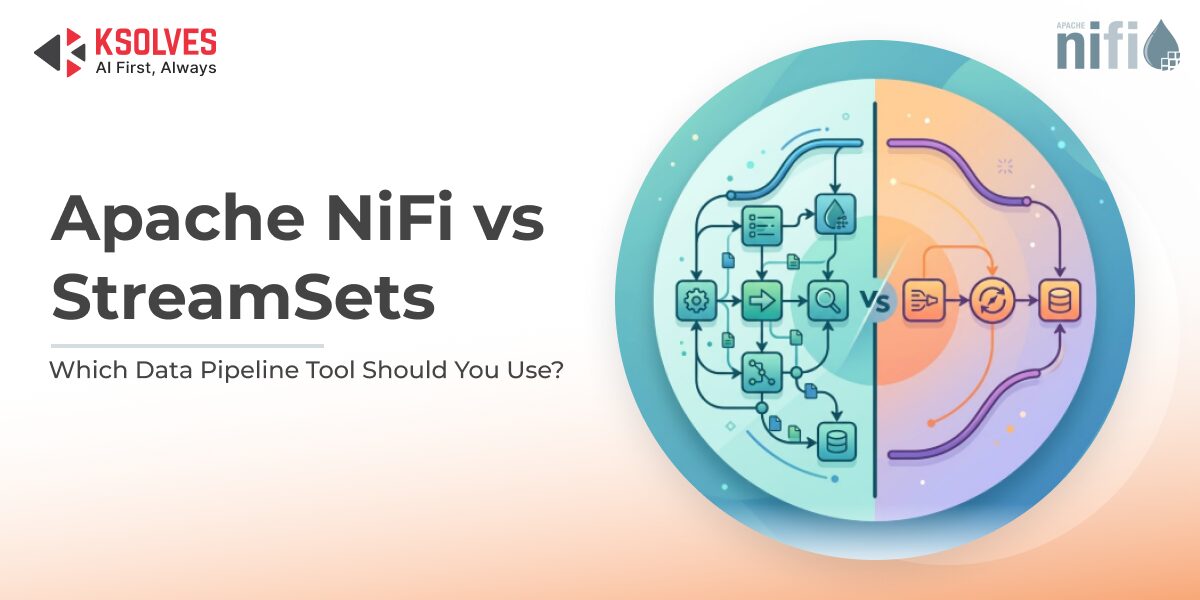
When you are evaluating open source data pipeline tools, Apache NiFi and StreamSets will show up on almost every shortlist. Both automate data ingestion, transformation, and routing. Both offer visual interfaces that reduce the need for manual coding. And both are trusted by enterprise teams managing complex, real-world data infrastructure.
But they are not the same tool, and picking the wrong one creates expensive problems later. This blog breaks down exactly how Apache NiFi and StreamSets differ, where each one excels, and how to make the right call for your team based on real technical criteria.
What Is Apache NiFi?
Apache NiFi is an open source data flow automation platform originally developed by the NSA and donated to the Apache Software Foundation in 2014. It is one of the most widely used Apache ETL tools in the industry, built for automating real-time data movement across distributed systems.
If you are new to it, a good starting point is understanding what Apache NiFi is and how it works before diving into comparisons.
NiFi uses a flow-based programming model. Data is represented as FlowFiles, objects carrying both content and metadata, moving through a visual directed graph of processors. Engineers drag, drop, and connect over 300 built-in processors to build pipelines without writing repetitive boilerplate. Apache NiFi ETL capabilities span relational databases, NoSQL stores, Kafka, REST APIs, SFTP, HDFS, Amazon S3, Google Cloud Storage, and many more systems.
Its core strengths make it particularly valuable for regulated industries:
- Guaranteed delivery with zero data loss
- Complete data provenance tracking from source to destination
- Backpressure controls that protect downstream systems during traffic spikes
- SSL encryption and fine-grained role-based access controls
For teams asking what Apache NiFi is used for in practice, the answer ranges from real-time IoT data ingestion and log processing to complex multi-source ETL pipelines and compliance-critical healthcare and financial data flows.
What Is StreamSets?
StreamSets launched in 2014 with a different design philosophy: pipelines should survive change. In production environments, upstream schemas evolve constantly, and most tools break or require manual fixes when that happens. StreamSets was built to detect and adapt to schema drift automatically, keeping pipelines running without engineer intervention.
It processes data through a linear pipeline model with four stage types: origins (data sources), processors (transformations), destinations (targets), and executors (event-driven actions). All data is automatically converted to a standardized record format, making transformations consistent across source types.
StreamSets has since evolved into a full DataOps platform. Its commercial Control Hub offering adds centralized orchestration, CI/CD pipeline promotion, version control, and multi-cloud management from a single interface, which makes it appealing to large teams managing dozens of pipelines across hybrid environments.
-
Architecture: The Core Difference
This is where the two tools diverge most meaningfully.
Apache NiFi uses a directed acyclic graph where queues between processors are visible on the canvas. Engineers can see exactly where data is sitting, how fast it is moving, and where bottlenecks are forming in real time. Critically, individual processors can be stopped, reconfigured, and restarted independently without disrupting the rest of the pipeline. This makes zero-downtime maintenance practical in long-running production flows. To understand how this architecture handles real-world complexity, see 10 common data flow challenges solved by Apache NiFi.
StreamSets takes a cleaner, more linear approach. There are no visible queues between stages. Any configuration change requires stopping and restarting the entire pipeline. StreamSets compensates with a live debugging console that shows per-record statistics and flags bad records during execution, making it easier to catch issues without deep operational visibility into the flow itself.
Comparing Key Capabilities
Apache NiFi ETL and Data Ingestion
Apache NiFi data ingestion is one of its most mature capabilities. It handles structured, semi-structured, binary, multimedia, and mixed-format data natively. Custom queue policies give engineers fine-grained control over data prioritization. NiFi uses Java NIO MappedByteBuffer for high-speed file transfer and non-blocking I/O for consistent throughput under load. Its clustering model scales horizontally with shared state across nodes, ensuring no single point of failure.
For teams running Apache NiFi alongside Kafka and Spark as part of a broader big data stack, the combination is highly effective for real-time analytics. You can explore how these tools work together in big data workflow optimization with Spark, NiFi, and Kafka.
StreamSets Data Integration
StreamSets is stronger when pipeline resilience and governance are the priority. Its automatic schema drift detection is genuinely best-in-class. When fields are added, renamed, or removed upstream, StreamSets adapts without manual reconfiguration. The Control Hub brings pipeline version control, role-based access, and CI/CD workflows that DataOps teams running multi-cloud deployments will find essential. If you treat pipeline promotion like software deployment, StreamSets provides the framework for it.
Security and Compliance
NiFi’s built-in data provenance tracking creates a full audit trail of every record from ingestion to destination. This is not optional in regulated industries. Combined with SSL encryption and access controls, it meets the requirements of HIPAA, GDPR, and SOC 2 out of the box. Ksolves has extensive experience building compliance-ready Apache NiFi pipelines for healthcare and financial services clients.
StreamSets focuses more on data quality governance and schema lifecycle management than on audit-level provenance, making NiFi the stronger compliance choice for most regulated use cases.
Apache NiFi Alternatives: Where StreamSets Sits
When evaluating Apache NiFi alternatives and its competitors, StreamSets is the closest structural counterpart. Tools like Apache Airflow focus on workflow orchestration, not data movement. Talend is a full enterprise ETL suite with significant licensing costs. AWS Glue is cloud-native and tightly coupled to the AWS ecosystem. Apache NiFi vs Talend is a common comparison for teams with heavy transformation needs, and Apache NiFi vs Airflow is essential reading for teams deciding between pipeline automation and workflow scheduling.
StreamSets addresses the same core problem as NiFi, automated data pipeline management, but from a governance-first perspective rather than a flow-control-first perspective.
Which Tool Is Right for You?
Choose Apache NiFi when you need precise flow-level control over routing and transformation, strong data provenance for compliance, open source flexibility with no vendor dependency, and high-throughput apache NiFi data ingestion across diverse formats and systems.
Choose StreamSets when your environment faces frequent schema changes, your team follows DataOps practices with CI/CD pipeline workflows, you need centralized governance across multi-cloud deployments, and pipeline resilience matters more than granular processing control.
Both tools can also work together. NiFi handles high-speed ingestion and complex routing at the source layer, while StreamSets manages governance and lifecycle across production environments.
How Ksolves Supports Apache NiFi Teams
Ksolves is a dedicated Apache NiFi development company with over a decade of experience delivering production-grade NiFi data pipelines for enterprises in healthcare, finance, telecom, logistics, and e-commerce. Our certified engineers handle the full lifecycle: custom processor development, NiFi cluster setup, performance tuning, MiNiFi edge deployments, NiFi Registry configuration, automated disaster recovery, and 24/7 monitoring and support.
Whether you are building real-time streaming pipelines, migrating from a legacy Apache ETL tool, or making your data flows audit-ready, the Ksolves team builds solutions that scale reliably. Explore our comparison guides, including Apache NiFi vs Azure Data Factory and Apache NiFi vs Oracle Data Integrator, to go deeper, or contact our experts today to start building data infrastructure that works.
Frequently Asked Questions
What is the main difference between Apache NiFi and StreamSets?
What happens if I choose the wrong data pipeline tool for my architecture?
How does Apache NiFi handle real-time data ingestion at scale?
Is Apache NiFi better than StreamSets for compliance and regulated industries?
When should I choose StreamSets over Apache NiFi?
Who can help us implement and maintain Apache NiFi pipelines in production?
Can Apache NiFi and StreamSets work together in the same data architecture?































AUTHOR
Big Data
Anil Kushwaha, Technology Head at Ksolves, is an expert in Big Data. With over 11 years at Ksolves, he has been pivotal in driving innovative, high-volume data solutions with technologies like Nifi, Cassandra, Spark, Hadoop, etc. Passionate about advancing tech, he ensures smooth data warehousing for client success through tailored, cutting-edge strategies.
Share with