



Top Security Considerations for Enterprise NiFi Development
Big Data
5 MIN READ
June 1, 2026

In modern data ecosystems, Apache NiFi often sits at the heart of real-time data movement, connecting diverse systems and handling sensitive information as it flows across the enterprise. Its flexibility and ease of use make it a favorite for data engineers, but those same strengths can create serious security gaps if left unaddressed. A single misconfiguration or unencrypted channel can expose confidential data, compromise compliance requirements, and disrupt critical business operations.
This article explores the key security considerations every organization should prioritize when developing and deploying enterprise NiFi solutions. From encrypting communications and safeguarding repositories to enforcing fine-grained access controls and hardening the runtime environment, these best practices will help you build a resilient, compliant, and trustworthy dataflow infrastructure.
Critical Security Challenges in Streaming and Real-Time Data Architectures
Real-time data pipelines continuously ingest and route information from diverse sources such as IoT sensors, transactional databases, and external APIs to destinations like data lakes, analytics platforms, and live dashboards, often within milliseconds. This speed and heterogeneity enable powerful business insights but also create a broad attack surface. Apache NiFi, as a central orchestrator of these flows, must therefore be secured against multiple categories of threats.
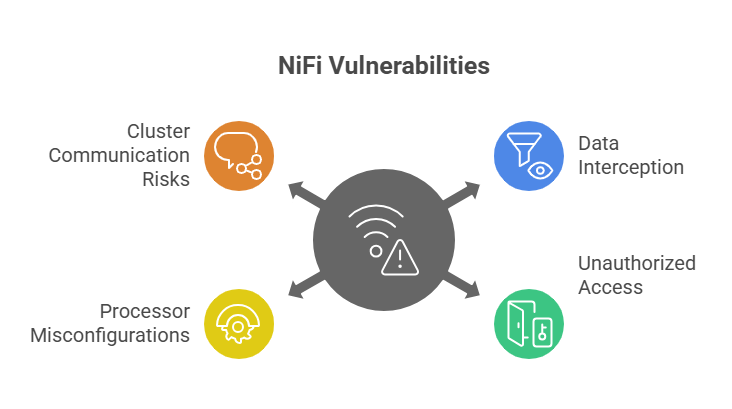
Key Vulnerabilities You Should Consider
- Data Interception
Without end-to-end encryption, data packets traveling across networks can be intercepted by malicious actors. Sensitive fields, customer identifiers, financial transactions, or proprietary metrics are especially vulnerable during transit over public or shared infrastructure.
- Unauthorized Access
Weak or poorly enforced access controls invite trouble. If roles and permissions are not clearly defined, internal users or external attackers could gain the ability to view, modify, or even halt critical dataflows, leading to data breaches or operational downtime.
- Processor Misconfigurations
NiFi’s rich set of processors is a double-edged sword. Incorrect settings, such as overly permissive input/output ports, unvalidated parameters, or scripts from unverified sources, can inadvertently expose data to unintended systems or leak credentials.
- Cluster Communication Risks
In a clustered NiFi deployment, nodes communicate frequently to maintain flow consistency. If Secure Sockets Layer/Transport Layer Security (SSL/TLS) is not properly configured, these internal exchanges become susceptible to spoofing, man-in-the-middle attacks, or unauthorized node injection.
Best Practices to Secure Data Pipelines in Apache NiFi
Securing data pipelines in Apache NiFi is critical for enterprises that handle sensitive, regulated, or high-value data. Proper security ensures data confidentiality, integrity, and availability, while reducing compliance and operational risks. The following best practices focus on building a robust security posture for NiFi pipelines.
- Encrypt All Communication (TLS Everywhere)
Encryption ensures that data remains confidential and tamper-proof while in transit. TLS protects the NiFi UI, REST API, and cluster node communications.
Implementation Tips:
- Configure TLS for every network channel, including internal node-to-node communication.
- Use certificates issued by trusted authorities or internal PKI.
- Rotate certificates regularly and enforce strict hostname verification.
- For multi-tenant environments, use separate certificates per tenant to isolate flows.
Example: Enabling HTTPS on NiFi and configuring inter-node TLS ensures that even if an attacker gains access to the network, data cannot be intercepted or altered.
- Strong Authentication
Authentication verifies identities before granting access. Centralized identity providers simplify management and enhance security.
Options:
- LDAP/Active Directory: Centralize user accounts and manage roles.
- Kerberos: Provides strong ticket-based authentication for large enterprise clusters.
- OpenID Connect (OIDC): Enables SSO and MFA integration for modern enterprise environments.
Best Practice: Avoid using local accounts in production environments; they lack auditing and are harder to rotate securely.
- Fine-Grained Authorization & Role-Based Access Control (RBAC)
NiFi’s RBAC system allows administrators to assign specific permissions at granular levels, including process groups, components, and NiFi Registry flows.
Implementation Tips:
- Apply least privilege principles, giving users only the permissions they need.
- Define separate roles for developers, administrators, and auditors.
- Regularly review and update policies as team responsibilities evolve.
- Use NiFi Registry policies to restrict who can modify or deploy versioned flows.
Example: Only the data engineering team may modify production flows, while auditors have read-only access to provenance.
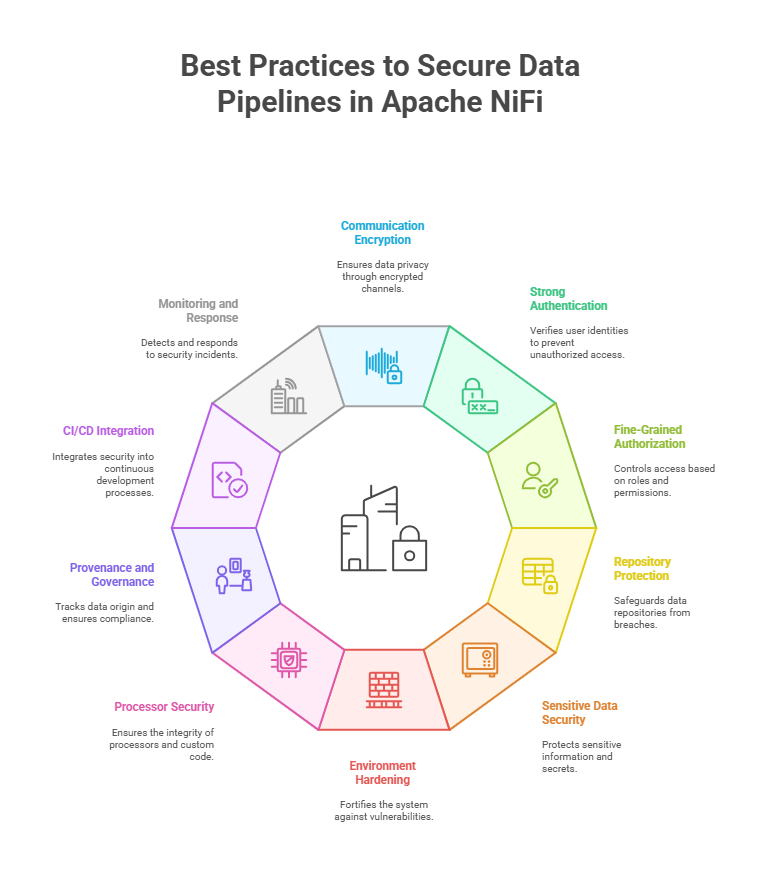
- Repository and Data Protection
NiFi stores content, flowfile, and provenance repositories on disk. These repositories may contain sensitive or regulated information.
Security Measures:
- Enable repository encryption to protect data at rest.
- Set strict OS-level permissions to restrict access to NiFi service accounts.
- Consider disk-level encryption for an added security layer.
- Backup repositories securely to protect against ransomware or accidental deletion.
- Secure Sensitive Properties and Secrets
NiFi often manages database credentials, API keys, and connection passwords. Storing them unencrypted is a serious risk.
Recommendations:
- Use NiFi sensitive property encryption in configuration files.
- Secure keystore and truststore locations and passwords.
- Integrate with external key management solutions or HSMs for regulated environments.
- Use FIPS-compliant cryptography if compliance standards require it.
Example: Encrypting database credentials in nifi.properties ensures that even if configuration files are exposed, sensitive information remains protected.
- Hardening the Environment
NiFi’s runtime environment including OS, JVM, and network is a critical security boundary.
Key Steps:
- Run NiFi under a dedicated, least-privileged service account.
- Regularly patch the OS and JVM to fix vulnerabilities.
- Restrict network access using firewalls and segmentation.
- For containerized deployments, implement network policies and limit inter-service communication.
It is also worth noting that teams still running older NiFi versions face compounding risks, as NiFi 1.x end-of-life means security patches are no longer available for an increasingly targeted codebase.
- Secure Processors and Custom Code
NiFi processors can execute scripts or interact with external systems, creating potential attack vectors.
Best Practices:
- Whitelist only the processors that are required for your workflows.
- Review all custom processors for security flaws.
- Use parameter contexts for credentials instead of hardcoding secrets.
- Avoid using processors that allow arbitrary code execution unless strictly controlled.
NiFi provenance logs track the lifecycle of data. While crucial for auditing, they can contain sensitive information.
- NiFi Registry and CI/CD Integration
Versioned flows in NiFi Registry provide governance, rollback, and traceability.
Best Practices:
- Use Registry to manage production flows.
- Restrict who can commit or deploy changes.
- Implement approval workflows for deploying new versions.
- Maintain an audit trail for all flow changes.
- Monitoring, Alerting, and Incident Response
Even a secure deployment can be compromised. Continuous monitoring and alerting are essential for:-
- Forward NiFi logs to centralized SIEM solutions.
- Monitor for unusual API calls, failed authentication, or unexpected changes in flows.
- Create incident response playbooks covering key scenarios: stolen credentials, expired certificates, or repository breaches.
- Conduct regular penetration testing and security audits.
Conclusion
Securing Apache NiFi data pipelines is a multi-layered, ongoing process. From encrypting communications and enforcing strong authentication to managing sensitive repositories, hardening the environment, and monitoring flows, every layer contributes to a resilient and compliant data infrastructure. By following these best practices, enterprises can ensure their real-time data pipelines remain secure, reliable, and fully auditable.
If you want expert NiFi development services or 24×7 NiFi support, Ksolves is here to help. Our team of highly experienced professionals specializes in designing, implementing, and managing secure NiFi environments for enterprises worldwide. Partner with us to prevent your data pipelines, optimize performance, and ensure business continuity with trusted, round-the-clock support. Contact Ksolves today to explore how we can secure and scale your NiFi deployments.




































AUTHOR
Big Data
Anil Kushwaha, Technology Head at Ksolves, is an expert in Big Data. With over 11 years at Ksolves, he has been pivotal in driving innovative, high-volume data solutions with technologies like Nifi, Cassandra, Spark, Hadoop, etc. Passionate about advancing tech, he ensures smooth data warehousing for client success through tailored, cutting-edge strategies.
Share with