



RocksDB State Management in Apache Flink
Apache Flink
5 MIN READ
July 24, 2026

Apache Flink is the backbone of real-time data pipelines across financial services, e-commerce, IoT, and logistics. But as the state grows from megabytes to hundreds of gigabytes, the default heap-based approach breaks down fast. JVM garbage collection pauses spike, TaskManagers crash with OutOfMemoryError, and checkpoint times balloon.
RocksDB state management in Apache Flink solves this directly. It replaces the JVM heap as the primary state store with an embedded, high-performance key-value engine that lives on local disk, not in volatile RAM.
In this guide, you will learn exactly how it works, why it matters at scale, and how to configure it correctly in production.
What is RocksDB State Management?
The Baseline: Where Flink State Actually Lives
To understand why the backend choice matters, you first need a clear picture of Flink’s runtime architecture. A Flink cluster has two distinct roles: the Job Manager, which coordinates the distributed execution plan, and the Task Managers, which do the actual work. Every operator in your job (a ProcessFunction, a windowed aggregation, a keyed join) runs inside a Task Manager slot.
The state is always local to the Task Manager that owns the partition. There is no shared state store, and no external cache — the state lives where the computation lives.
Your application code never interacts with the storage layer directly. It calls abstractions such as ValueState, MapState, and ListState, and Flink routes those calls to whatever backend is configured for the job. That routing decision is where everything diverges.
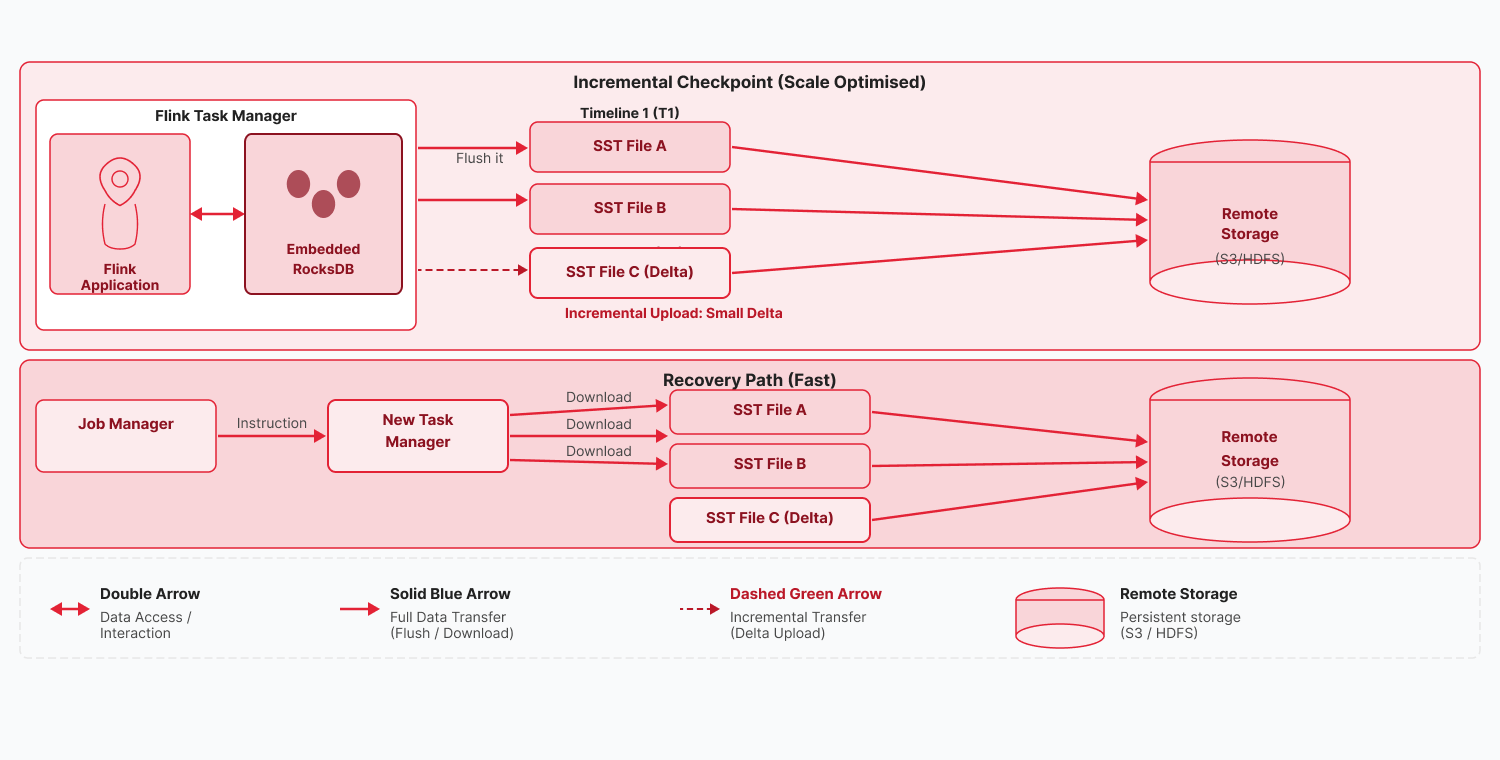
Figure 1: Baseline Conceptual Architecture. A Task Manager showing a Flink application interacting with a generic MapState managed by the cluster framework.
The Problem: Traditional On-Heap State Management
In standard streaming applications, keeping state inside the JVM heap using HashMapStateBackend works reliably at a small scale. Under high-throughput, large-scale conditions, it creates three compounding operational problems that no amount of tuning can fully resolve.
- Memory limits: State size is strictly bounded by the -Xmx heap allocation of the Task Manager JVM. There is no spill-to-disk mechanism. When the heap is exhausted, the Task Manager throws an OutOfMemoryError and crashes with no graceful degradation.
- Garbage collection pauses: As the state grows into tens of gigabytes, the JVM’s old generation fills with accumulated state objects. Major GC cycles freeze the entire application for the duration of collection, and pauses long enough to breach Flink’s heartbeat timeout trigger unnecessary Task Manager failovers, even when the underlying hardware is healthy.
- Expensive full snapshots: Every checkpoint requires serialising and transferring the complete in-memory state to remote storage, regardless of how little has changed since the last interval. For a large state, this creates recurring CPU and network spikes that directly compete with live processing throughput.
The Solution: RocksDB State Backend
Flink resolves all three constraints by embedding RocksDB directly inside the Task Manager process. RocksDB is a high-performance, persistent key-value store written in C++, purpose-built for fast local storage media like NVMe and SSD. It runs in-process, communicating with Flink’s Java runtime through the Java Native Interface (JNI), keeping the JVM heap entirely out of the primary state storage path.
RocksDB acts as Flink’s embedded state backend for local state storage, allowing state to grow to terabytes, limited by disk space rather than heap capacity.
Here are the key benefits:
- Off-heap storage: Working state is written into native off-heap memory and flushed to local NVMe or SSD as immutable SST files. State capacity is bounded by disk rather than RAM.
- Column families per state: Flink maps each declared state primitive (ValueState, MapState, ListState) to an independent RocksDB Column Family, providing full isolation between different state objects within the same operator.
- Incremental checkpointing: RocksDB’s append-only LSM-tree architecture lets Flink upload only the SST (Sorted String Table) files that changed since the last checkpoint, making snapshot cost proportional to the rate of change rather than total state size.
- Predictable latency: Because the primary state never lives on the JVM heap, the GC has nothing substantial to collect. Stop-the-world pauses effectively disappear from your latency profiles regardless of how large your state grows.
Why the ROI Matters: Performance, Storage, and Scaling
Switching to EmbeddedRocksDBStateBackend has a direct, measurable impact on infrastructure cost, operational stability, and the practical ceiling of what your streaming jobs can handle.
Scale-out capabilities come from RocksDB’s Log-Structured Merge-tree (LSM-tree) architecture, which converts random writes into sequential disk writes, sustaining high ingestion rates without the write amplification that affects B-tree stores under streaming workloads. More importantly, it decouples state capacity from RAM entirely. Instead of provisioning expensive memory-optimised instances, you scale local NVMe storage at a fraction of the cost. If your state reaches 10 TB, you add a disk, not RAM.
Operational efficiency comes through incremental checkpoints. HashMapStateBackend transfers the entire state on every checkpoint interval regardless of what changed — for a job holding 300 GB of state, that is 300 GB on the wire every interval. RocksDB eliminates this. After an initial baseline, only modified SST files are uploaded. In most production workloads, that delta is 1 to 5 percent of total state size, cutting checkpoint network overhead by 95 percent or more. Checkpoint duration stays nearly constant as state grows, which is what separates stable terabyte-scale jobs from progressively fragile ones.
Summary of ROI
| Benefit | Impact |
|---|---|
| Out-of-Core State Scaling | Maintain terabytes of state per job without OOM crashes. |
| Native Incremental Checkpoints | Fast, lightweight snapshots minimize network and CPU spikes. |
| Deterministic Memory Footprint | Decoupled from JVM Garbage Collection; no stop-the-world pauses. |
| Cost Optimization | Lower TCO by swapping premium high-RAM nodes for high-density NVMe/SSD storage. |
Struggling With Flink State at Scale? Let’s Fix That
Comparing Heap-Based and RocksDB-Enabled State Models
The most effective way to understand what the backend switch actually changes is to look at identical application code running under both configurations. The state descriptor is the same, and the operator logic is the same — only the backend differs, and that single change completely transforms how Flink stores and accesses state at runtime. If you’re also weighing whether to move an existing job from Spark to Flink, our Spark-to-Flink migration guide walks through that process end to end.
1. Traditional Model: On-Heap Configuration
Scenario: Your job consumes a high-frequency event stream, keys it by user_id, and maintains each user’s full profile history as a stateful window. At peak load, this means millions of active partition keys, each holding a live UserProfile object in state.
import org.apache.flink.runtime.state.hashmap.HashMapStateBackend;
import org.apache.flink.streaming.api.environment.StreamExecutionEnvironment;
import org.apache.flink.api.common.state.MapStateDescriptor;

// 1. Initialize environment
StreamExecutionEnvironment env = StreamExecutionEnvironment.getExecutionEnvironment();

// 2. Explicitly configure the On-Heap HashMap Backend
env.setStateBackend(new HashMapStateBackend());

// 3. Declare the state descriptor
MapStateDescriptor<String, UserProfile> descriptor = new MapStateDescriptor<>("userProfiles", String.class, UserProfile.class);
Because the HashMapStateBackend is configured, Flink takes this code literally: it creates a raw Java HashMap on the JVM heap. Every user profile is kept as a live object on the heap, so if you have 20 million users, you have millions of raw Java objects floating around.
When updating a profile, the JVM must navigate this massive web of objects. This triggers heavy Garbage Collection (GC) pauses — where your whole application freezes to clean up memory — and eventually causes a devastating OutOfMemoryError (OOM) crash.
2. RocksDB-Enabled Model (Off-Heap Configuration)
Now watch what happens when we use the exact same MapStateDescriptor snippet, but swap out the underlying state backend environment configuration:
import org.apache.flink.state.embedded.rocksdb.EmbeddedRocksDBStateBackend;
import org.apache.flink.streaming.api.environment.StreamExecutionEnvironment;
import org.apache.flink.api.common.state.MapStateDescriptor;

// 1. Initialize environment
StreamExecutionEnvironment env = StreamExecutionEnvironment.getExecutionEnvironment();

// 2. Explicitly configure the Off-Heap RocksDB Backend (True enables incremental checkpoints)
env.setStateBackend(new EmbeddedRocksDBStateBackend(true));

// 3. Declare the EXACT SAME state descriptor
MapStateDescriptor<String, UserProfile> descriptor = new MapStateDescriptor<>("userProfiles", String.class, UserProfile.class);
With this configuration, your state access profile completely shifts. Flink ignores the JVM heap for state storage entirely. Instead, it creates an independent RocksDB Column Family living safely off-heap on your local storage disk. Every single sub-key inside that MapState maps to an individual key-value entry in an LSM-tree (Log-Structured Merge-tree).
When you call userProfiles.put("attr_1", profile), Flink serializes the data across the JNI (Java Native Interface) boundary into a raw byte array. RocksDB writes it to an in-memory MemTable and flushes it to local NVMe/SSD SST files. The JVM heap remains lean, stable, and completely immune to GC spikes.
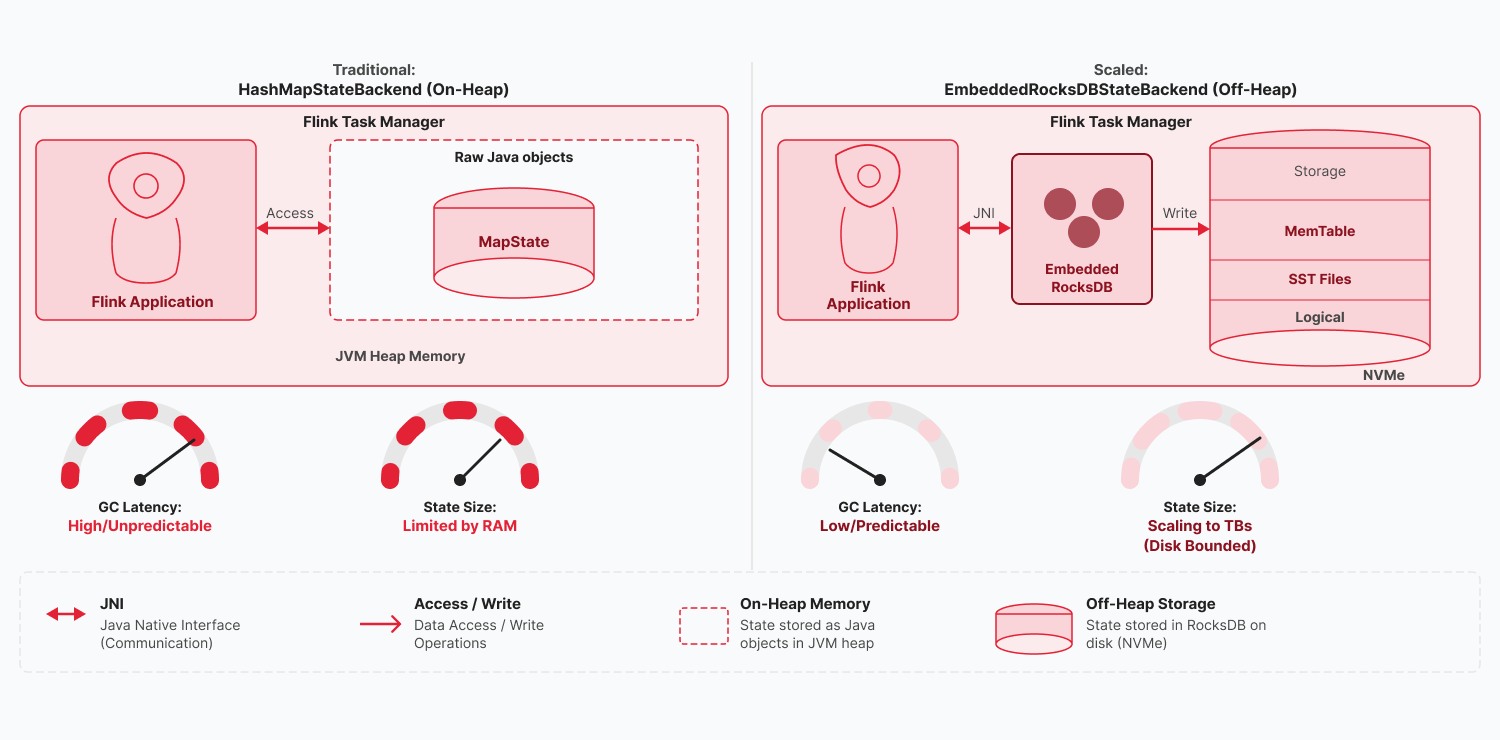
Figure 2: Architectural Comparison. LEFT: Heap Backend (State on JVM Heap, GC spikes, limited size). RIGHT: RocksDB Backend (Off-Heap JNI interaction, local NVMe storage, scaled capacity, low GC impact).
The Comparison Visualization: When you use Flink’s native MapState with RocksDB, each sub-key maps to an independent key-value entry in the LSM-tree. Flink communicates with the embedded C++ store via JNI on every read and write.
- Heap model. State lives as raw Java objects on the JVM heap. Access is fast, but size is hard-bounded by RAM, and GC pressure grows with every additional key until it becomes the dominant bottleneck.
- RocksDB model. State is serialised and moved off-heap into native memory and local NVMe storage. The JVM heap stays lean regardless of state volume, GC behaviour stays predictable, and capacity scales to the size of your disk rather than your RAM.
State Modelling and Configuration Best Practices
Getting the most out of RocksDB in production comes down to a handful of design decisions that are easy to get right upfront and expensive to fix later.
What to Do
- Leverage MapState over ValueState: When storing collection structures, always use MapState. It prevents Flink from having to serialize massive objects for minor updates, unlike the heap backend.
- Enable managed memory: Keep
state.backend.rocksdb.memory.managed: trueenabled. This allows Flink to control RocksDB’s block cache and write buffers using the TaskManager’s managed memory allocation, preventing native out-of-memory leaks. - Use State TTL (Time-To-Live): Always configure an expiration cleanup policy for continuous streams to prevent infinite, unbounded disk growth.
What to Avoid
- Ignoring the serialisation tax: Every RocksDB read and write crosses the JNI boundary and requires serialising keys and values to raw byte arrays. This overhead is acceptable for most workloads, but if your application targets sub-millisecond P99 latencies, you need to size and tune your block cache carefully to keep hot-path reads off disk entirely.
- Mutating retrieved state objects in place: RocksDB stores and reads serialised bytes, not object references. If you retrieve an object from state, modify a field on it, and move on without calling
.update()or.put(), the change is silently lost. The underlying store only reflects what you explicitly write back.
Stability at Scale: Incremental Checkpointing and Recovery
The final requirement for scaling state to terabytes is making sure you can back it up efficiently. The heap-based backend must perform a full snapshot of all objects every time. RocksDB uses an append-only architecture, which Flink leverages for incremental checkpointing.
Figure 3: Incremental Checkpoint and Recovery Path. TOP: During Checkpoint T2, only the ‘Delta’ (SST File C) is uploaded to Remote Storage. BOTTOM: Recovery is fast, with the new Task Manager downloading all required SST files.
The checkpoint lifecycle works in three stages:
- Baseline (T1): The Task Manager flushes the initial data (SST Files A and B) to remote storage (e.g., S3).
- Snapshot (T2): When the next checkpoint (T2) is triggered, RocksDB only needs to upload what has changed since T1 — just SST File C (the delta).
- Recovery: When a failure occurs, Flink re-assembles the state by instructing a new Task Manager to download the set of SST files (A+B+C). Since the baseline was already present, this recovery is fast, ensuring minimal downtime at scale.
The result: the checkpoint “diff” is extremely small, resulting in minimal network and CPU spikes, and recovery stays fast even at terabyte scale.
How Ksolves Can Help
Production-grade RocksDB configuration, managed memory sizing, block cache tuning, and incremental checkpoint pipelines at terabyte scale all require deep expertise with Apache Flink internals. That is exactly what Ksolves brings.
Our Big Data engineering team has designed and deployed large-scale Flink architectures across industries, helping organisations move from fragile heap-based pipelines to stable, RocksDB-backed streaming systems built for real-world throughput. Whether you are starting from scratch or migrating a job that has hit its memory ceiling, we can help you get it right.
Wrapping Up
EmbeddedRocksDBStateBackend is the preferred choice for enterprise Apache Flink deployments, delivering durable state management, predictable low latency, and efficient large-scale state handling. By reducing memory pressure and enabling incremental checkpointing, it improves performance while lowering infrastructure costs. For stateful streaming workloads with gigabytes or terabytes of data, it provides a scalable, resilient foundation for production environments.
Ready to Scale Your Flink State the Right Way?
Frequently Asked Questions
What is RocksDB state management in Apache Flink?
RocksDB state management in Apache Flink is the practice of using the embedded RocksDB key-value store, instead of the JVM heap, as the primary storage layer for operator state. State is serialized and written to local NVMe or SSD storage via RocksDB’s LSM-tree architecture, which lets state size scale with disk capacity rather than available RAM. Flink communicates with RocksDB through the Java Native Interface (JNI) on every state read and write.
What happens if Flink state grows too large for the heap?
When state exceeds the JVM heap allocated to a Flink TaskManager, the job typically fails with an OutOfMemoryError and crashes without graceful degradation. Before the crash, growing heap pressure usually triggers longer garbage collection pauses that can breach Flink’s heartbeat timeout and cause unnecessary failovers. Switching to RocksDB state management avoids this because state lives off-heap on local disk instead of in JVM memory.
How do I enable RocksDB as the state backend in Apache Flink?
You enable RocksDB by calling env.setStateBackend(new EmbeddedRocksDBStateBackend(true)) in your job’s execution environment, where the boolean argument turns on incremental checkpointing. No changes are needed to existing ValueState, MapState, or ListState descriptors, since Flink routes the same API calls to the new backend automatically. Ksolves also recommends enabling state.backend.rocksdb.memory.managed so RocksDB’s block cache and write buffers draw from Flink’s managed memory rather than allocating independently.
Is RocksDB or the heap-based state backend better for Flink?
HashMapStateBackend is faster for small state because it keeps objects directly in JVM memory with no serialization overhead, but it is capped by available RAM and prone to GC pauses as state grows. RocksDB trades a small per-access serialization cost for state capacity bounded by disk rather than memory, predictable latency, and incremental checkpoints. Most production teams choose RocksDB once state exceeds a few gigabytes per TaskManager or checkpoint times start climbing.
When should I switch a Flink job to RocksDB state management?
Teams typically switch to RocksDB once state size approaches the tens-of-gigabytes range per TaskManager, or when they start seeing OutOfMemoryError crashes, long garbage collection pauses, or checkpoint durations that grow with total state size rather than with the rate of change. Migrating early, before a production incident forces the change, avoids downtime. Ksolves generally recommends evaluating the switch as part of any capacity-planning review for stateful streaming jobs.
Who can help configure RocksDB for production Apache Flink workloads?
Ksolves’ data engineering team designs and deploys production-grade RocksDB configurations for Apache Flink, including managed memory sizing, block cache tuning, and incremental checkpoint pipelines at terabyte scale. This kind of tuning requires deep familiarity with Flink internals, since misconfigured memory allocation can cause the same native out-of-memory failures that RocksDB is meant to prevent. Teams migrating an existing heap-based job or starting a new large-state deployment can get hands-on support rather than working from documentation alone.
Does switching to RocksDB reduce Apache Flink infrastructure costs?
Yes, because RocksDB decouples state capacity from RAM, teams can scale local NVMe or SSD storage instead of provisioning expensive memory-optimised instances as state grows. Incremental checkpointing also cuts checkpoint network overhead by roughly 95 percent or more in most production workloads, since only changed SST files are uploaded rather than the full state. The main added cost is the serialization overhead on the JNI boundary, which is negligible for most workloads outside sub-millisecond latency targets.
Still have questions about RocksDB state management in Apache Flink? Contact our team.
 Anil Kushwaha
You add 50 servers to your Apache HBase cluster expecting it to run faster. Instead, everything slows down. You open […]
 Anil Kushwaha
For an enterprise, “real-time” has a specific, measurable bar: dashboards that update within seconds of an event happening, and queries […]






























Author
About the Author Editorial Team The Ksolves Editorial Team includes certified Salesforce experts, Big Data engineers, AI/ML specialists, Zoho consultants, and experienced technology writers focused on delivering clear, actionable insights for modern businesses. With hands-on experience across Salesforce, Big Data platforms, AI/ML solutions, application development, software testing, and Zoho ERP/CRM, the team publishes practical guides, real-world use cases, and industry updates that support smarter decisions and faster growth. Every article is created to solve business challenges, guide technology adoption, and keep organizations aligned with evolving digital ecosystems.
Share with