

 Apache Flink
 5 MIN READ


When building real-time data pipelines, data correctness is non-negotiable. A node crash, a network partition, or a transient upstream cloud blip should never result in a corrupted ledger, a duplicated billing charge, or an inventory count that is off by one. Yet in distributed streaming systems, these failure scenarios are not edge cases. They are routine operational realities that every production pipeline must be designed to survive. This is the problem that Exactly-Once Processing is built to solve.
The phrase gets used loosely across the data engineering industry. Vendors market it. Engineers assume it is a single toggle that, once enabled, makes a pipeline correct. In practice, the gap between claiming exactly-once support and actually delivering it is architectural, not cosmetic. Apache Flink closes that gap through two interlocking mechanisms: a distributed snapshot protocol based on the Chandy-Lamport algorithm, and a Two-Phase Commit sink interface that extends correctness guarantees all the way to your external systems.
What Is Exactly-Once Processing?
Dispelling the Myth: “Exactly-Once Delivery”
Before examining Flink’s internals, there is a misconception worth addressing head-on. Exactly-once processing does not mean an event is transmitted across the network exactly once.
This distinction matters more than it might appear. Over a distributed network, guaranteeing physical single-delivery during a failure is mathematically impossible. When a worker node crashes after receiving a message but before sending an acknowledgement, the upstream broker has no way to confirm delivery. Its only safe course of action is to retransmit. Duplicates at the transport layer are not a bug. They are an unavoidable property of how reliable distributed messaging works.
What Flink guarantees is something fundamentally different: exactly-once semantic processing of state. When a duplicate event arrives due to a retry or a replay, Flink’s internal tracking ensures the operator’s state store is updated exactly once. The duplicate is absorbed cleanly, without corrupting your counters, window buckets, or transactional database tables. Your business logic sees one logical event, regardless of how many times the network delivered it.
This distinction is the foundation of everything else in Flink’s exactly-once architecture.
The Engineering Trade-offs: Latency, Cost, and Consistency
Enforcing strict correctness across distributed state introduces real infrastructure costs. Understanding these trade-offs upfront prevents misconfiguration in production. If you have not yet committed to Flink, our comparison of Kafka Streams vs Spark Streaming is a useful starting point.
At-Least-Once: Optimise for Speed
If your pipeline tolerates minor inaccuracies, the at-least-once profile eliminates the overhead of global state synchronisation. Operators process events immediately without waiting for barrier alignment. Latency drops to sub-millisecond ranges.
The catch: during a worker failure, some events will be reprocessed and the state will reflect duplicates. For non-critical logging, search indexing, or real-time dashboards where approximation is acceptable, this is a reasonable trade.
Exactly-Once: Optimise for Correctness
For mission-critical pipelines, financial reconciliation, inventory control, and billing engines, exactly once is non-negotiable. Flink guarantees 100% correct state across infrastructure restarts.
The cost is an “infrastructure tax”: a minor latency increase tied to checkpoint barrier coordination, plus a requirement that your external sinks support either idempotent writes or transactional two-phase commit protocols.
Consistency Metrics Matrix
| Engineering Metric | At-Least-Once Configuration | Exactly-Once Configuration (End-to-End) |
|---|---|---|
| Data Correctness | Dupes are possible during failures. | 100% mathematically correct state. |
| End-to-End Latency | Ultra-low (sub-millisecond). | Higher. Linked to your checkpoint interval and transactional commit speeds. |
| Sink Storage Dependency | Any database/file system. | Requires idempotent targets or transactional systems (e.g., Kafka / PostgreSQL). |
| Operational Overheads | Low. Minimal tuning required. | Medium to high. Requires active state size management and transaction timeout configurations. |
Choosing the Right Profile for Your SLA
The right choice depends on your SLA and the downstream consequences of a duplicate event. Many production architectures use at-least-once for edge ingestion and cleansing zones, then enforce exactly-once at the core aggregation and reporting layer. This tiered approach captures most of the throughput benefit of at-least-once while ensuring correctness where it actually matters.
The Core Engine: Distributed Chandy-Lamport Checkpointing
Flink’s exactly-once guarantee at the state level is built on a variant of the Chandy-Lamport distributed snapshot algorithm. The key design principle: Flink never stops the pipeline to take a backup. Instead, it injects lightweight metadata markers called Checkpoint Barriers directly into the event stream.
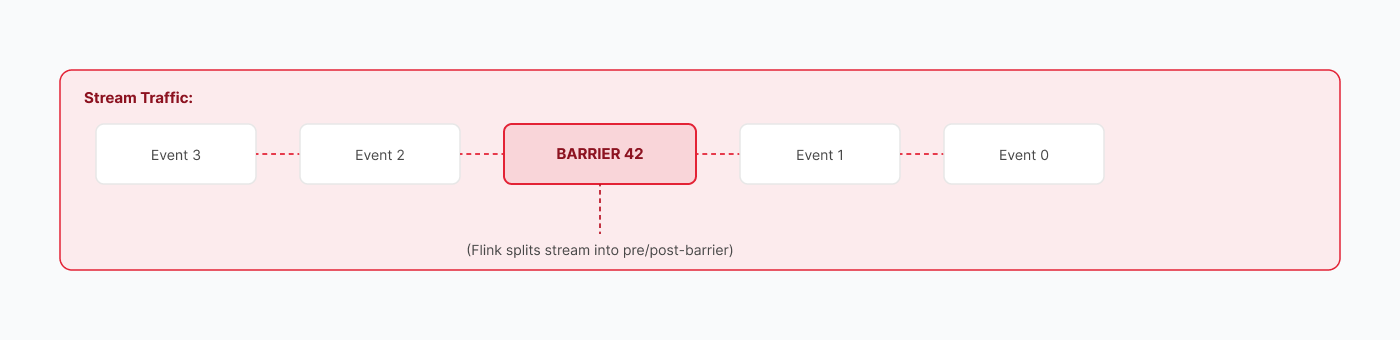
Figure : Flink Checkpoint Barrier Alignment. Operators receive data from multiple upstream channels. When a checkpoint barrier arrives on one channel, the operator pauses consumption on that channel and waits for the matching barrier from other channels (Alignment). This ensures the snapshot captures state exactly at the barrier boundary before flushing data off-heap.
Inside Checkpoint Barrier Alignment: A Step-by-Step Breakdown
- Barrier Injection. The JobManager’s Checkpoint Coordinator injects a lightweight barrier marker into every parallel input stream at scheduled intervals. The barrier travels downstream alongside live data records, invisible to business logic but visible to every operator in the execution graph.
- Asynchronous Alignment. When a downstream operator receives a barrier on one of its input channels, it pauses consumption on that channel and waits for the matching barrier to arrive from all other parallel input channels. This alignment step is the correctness guarantee: it creates a clean boundary that prevents pre-barrier events from mixing with post-barrier state updates, which would otherwise corrupt the snapshot.
- Off-Heap Snapshotting. Once all barriers align, the operator serialises its current state into a local copy and ships it asynchronously to durable remote storage such as Amazon S3 or HDFS. The snapshot captures state at the exact barrier boundary, nothing before it and nothing after.
- Resuming Processing. The operator resumes live event processing immediately after triggering the snapshot upload. It does not block on the remote write. Persistence happens in the background, keeping pipeline latency low while durability is guaranteed in parallel.
Achieving End-to-End Consistency: Two-Phase Commit (2PC)
Guaranteeing exactly-once state updates inside Flink solves only half the problem. If a failure occurs after Flink snapshots its internal state but before it finishes writing to an external sink, the destination database still ends up with duplicated rows. Internal correctness alone cannot prevent this.
To close that gap, external output sinks must participate directly in Flink’s checkpoint lifecycle through the TwoPhaseCommitSinkFunction. Data is held in an uncommitted transaction buffer and only atomically committed once Flink confirms a successful global checkpoint. If anything fails before that confirmation, the transaction rolls back cleanly. Without this integration, data leakage at the sink boundary is unavoidable.
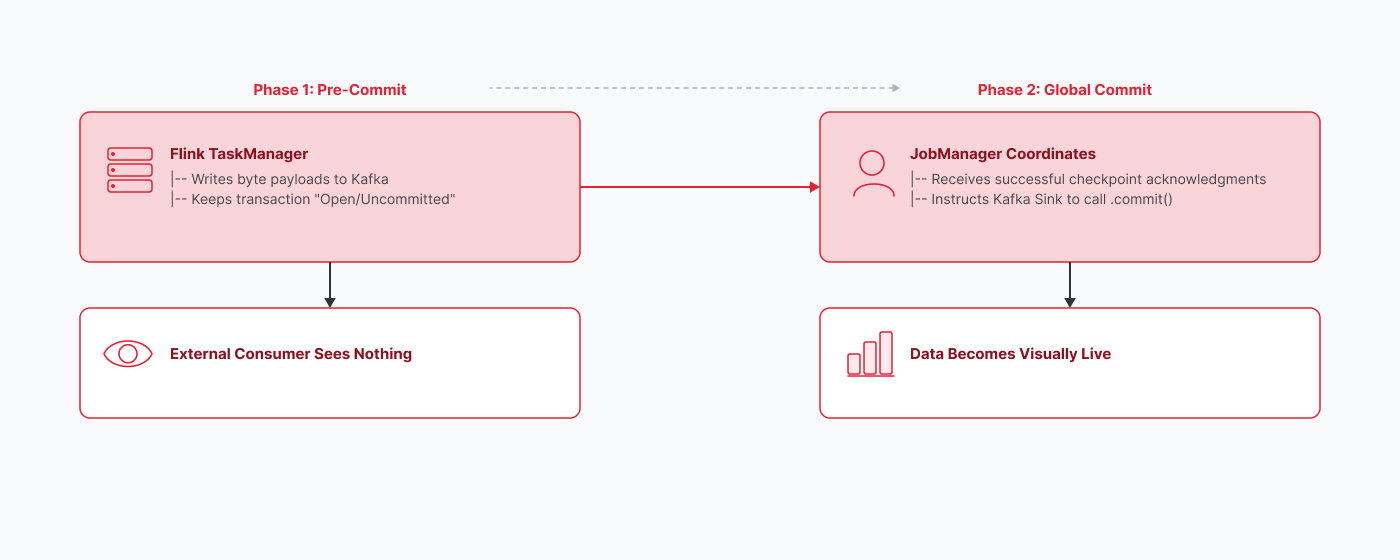
Production Blueprint: End-to-End Exactly-Once with Kafka
The following code configures a complete end-to-end exactly-once pipeline using Kafka as both source and sink.
import org.apache.flink.api.common.serialization.SimpleStringSchema;
import org.apache.flink.connector.kafka.sink.KafkaRecordSerializationSchema;
import org.apache.flink.connector.kafka.sink.KafkaSink;
import org.apache.flink.connector.kafka.sink.DeliverGuarantee;
import org.apache.flink.connector.kafka.source.KafkaSource;
import org.apache.flink.connector.kafka.source.enumerator.initializer.OffsetsInitializer;
import org.apache.flink.streaming.api.environment.StreamExecutionEnvironment;
import org.apache.flink.streaming.api.CheckpointingMode;

public class EndToEndExactlyOncePipeline {
    public static void main(String[] args) throws Exception {
        StreamExecutionEnvironment env = StreamExecutionEnvironment.getExecutionEnvironment();

        // 1. Enforce strict internal Exactly-Once Checkpointing
        env.getCheckpointConfig().setCheckpointingMode(CheckpointingMode.EXACTLY_ONCE);
        env.getCheckpointConfig().setCheckpointInterval(60000); // 60 seconds

        // 2. Build Exactly-Once Consumer Source
        KafkaSource<String> source = KafkaSource.<String>builder()
            .setBootstrapServers("localhost:9092")
            .setTopics("input-events")
            .setGroupId("flink-consistency-group")
            .setStartingOffsets(OffsetsInitializer.committedOffsets())
            .setValueOnlyDeserializer(new SimpleStringSchema())
            .build();

        // 3. Build Transactional Two-Phase Commit Sink
        KafkaSink<String> transactionalSink = KafkaSink.<String>builder()
            .setBootstrapServers("localhost:9092")
            .setRecordSerializer(
                KafkaRecordSerializationSchema.builder()
                    .setTopic("output-analytics")
                    .setValueSerializationSchema(new SimpleStringSchema())
                    .build()
            )
            .setDeliverGuarantee(DeliverGuarantee.EXACTLY_ONCE) // Activates Flink's 2PC Sink Engine
            .setTransactionalIdPrefix("flink-tx-sensor-metrics-")
            .build();

        // 4. Bind Pipeline Execution Graph
        env.fromSource(source, org.apache.flink.api.common.eventtime.WatermarkStrategy.noWatermarks(), "KafkaSource")
            .map(value -> value.toUpperCase()) // Stateless operational transformation
            .sinkTo(transactionalSink);

        env.execute("EndToEndExactlyOncePipeline");
    }
}
Three configuration decisions in this blueprint are doing the heavy lifting:
- CheckpointingMode.EXACTLY_ONCE activates barrier-based distributed snapshotting inside the Flink runtime.
- DeliverGuarantee.EXACTLY_ONCE on the Kafka sink activates the TwoPhaseCommitSinkFunction, wrapping all writes in Kafka transactions.
- setTransactionalIdPrefix gives each Flink task a stable transaction identity, allowing Kafka to identify and fence zombie transactions after a failure.
Best Practices and Pitfalls for Exactly-Once Configuration
Getting exactly-once processing right requires more than enabling the right flags. Missing even one of these configuration dependencies can cause silent data duplication or unexpected pipeline downtime.
What Should You Consider?
- Align transaction timeouts with checkpoint intervals. Your external broker’s transaction timeout must always exceed your Flink checkpoint interval. For Kafka, if transaction.max.timeout.ms defaults to 15 minutes; your checkpoint interval must stay comfortably within that window. Breaching it produces orphaned transactions that Kafka expires before Flink gets the chance to commit them. Teams running Kafka in production often lean on dedicated Kafka support to keep these broker and transaction settings correctly tuned.
- Set consumer isolation to read committed. Any downstream application consuming from a Flink Two-Phase Commit sink must configure isolation.level=read_committed in Kafka. Without this setting, consumers read uncommitted records that may still be rolled back on failure, quietly invalidating the guarantees your transactional pipeline was built to provide.
- Control checkpoint concurrency with a minimum pause. Guard against checkpoint overlap by setting env.getCheckpointConfig().setMinPauseBetweenCheckpoints(30000). This ensures one checkpoint fully completes before the next is triggered, preventing the system from stalling under heavy I/O workloads.
What You Should Avoid?
- Avoid non-transactional sinks on critical paths. Standard file systems and REST endpoints that lack rollback support cannot participate in the Two-Phase Commit protocol. Any partial write during a failover cannot be undone, silently reverting your pipeline to at-least-once behaviour regardless of how Flink is configured internally.
- Use unaligned checkpoints with care. Unaligned checkpoints (state.backend.changelog.enabled: true) reduce latency under backpressure but increase the network recovery footprint during a failover. Enable them only when low latency is the priority and the added recovery cost is fully understood.
Conclusion
Architecting reliable real-time pipelines requires choosing the right balance between processing speed and state correctness. For edge cleansing, filtering, and raw ingestion zones where throughput is the priority, at-least-once transformations are a practical and efficient choice. For core aggregation, stateful accounting, and transactional metrics reporting, Flink’s Chandy-Lamport checkpointing alongside transactional 2PC sinks is non-negotiable.
True end-to-end exactly-once processing is not a passive setting. It is an explicit architectural contract between your data source, Flink’s internal state engine, and your downstream output sinks. Getting it right eliminates the need for manual deduplication logic and builds a resilient foundation that holds up under real-world failure conditions.
This is exactly where Apache Flink enterprise support proves its value — the difference between a pipeline that works in a demo and one that survives production failure at scale. At Ksolves, we help engineering teams design and implement production-grade pipelines with exactly-once guarantees built in from the ground up. If you’re building a real-time data platform that cannot afford correctness gaps, our team is ready to help you get it right.


 Anil Kushwaha