



Top Challenges Businesses Face with Snowflake: How Support Services Help
Big Data
5 MIN READ
July 10, 2026

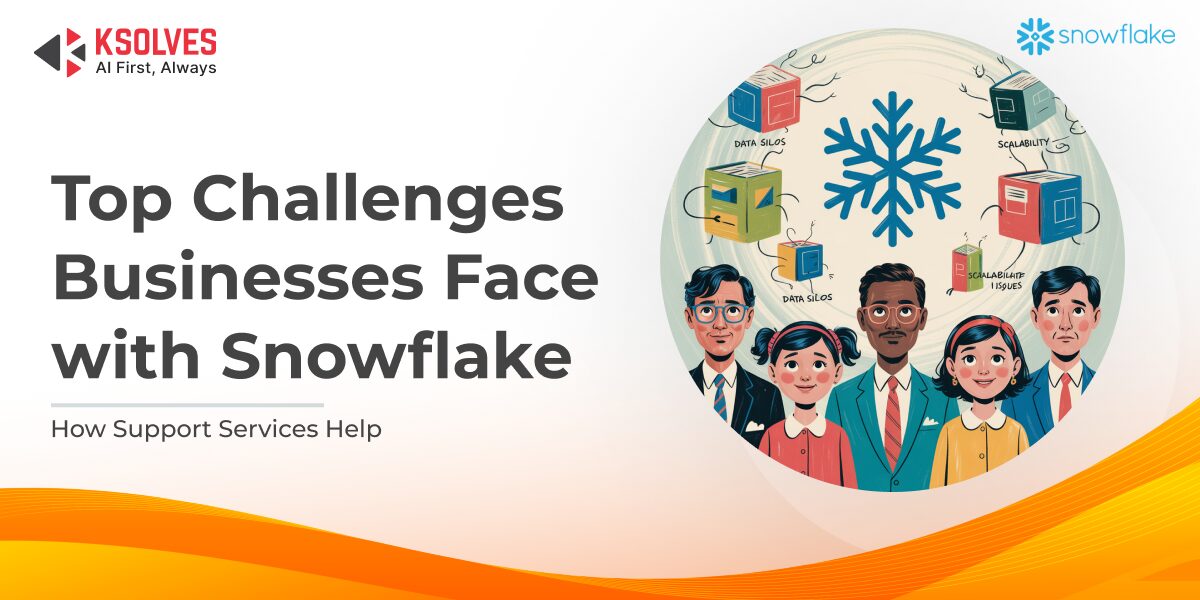
Managing data in Snowflake can feel overwhelming due to challenges like data quality, security, cost control, and performance optimization. This guide breaks down these common Snowflake issues and offers practical, step-by-step solutions.
From implementing strong data governance to choosing the right data pipeline approach (ETL vs. ELT) and integrating with other platforms, you’ll learn how to build a secure, efficient, and future-ready Snowflake environment.
Key Takeaways
- Snowflake offers scale and speed but comes with challenges in data quality, governance, cost, and complexity.
- Use validation, automation, and governance tools to ensure clean, secure data.
- Optimize costs with smart scaling, usage monitoring, and the right pricing model.
- ETL offers control; ELT leverages Snowflake’s processing power.
What is Snowflake?
Snowflake is a fully managed, cloud-based data platform that enables businesses to consolidate structured and semi-structured data for advanced analytics. Built on a multi-cluster shared data architecture, Snowflake provides near-infinite scalability, secure data sharing, and simplified data warehousing without the burden of infrastructure management.
Despite these advantages, many organizations run into challenges in Snowflake environments due to the platform’s flexibility, cost structure, and reliance on cloud-native processes.
Common Snowflake Challenges and How to Overcome Them
Snowflakes come with various challenges, but these can be resolved. Here are the key Snowflake challenges to know about.
Poor Data Quality
Poor data quality is one of the most critical challenges in any data management platform, and Snowflake is no exception. If the data ingested into Snowflake is incomplete, duplicated, or incorrect, it undermines the reliability of analytics and reporting.
- Identify Data Sources: Always know the origin of your data to ensure its credibility.
- Data Validation Rules: Implement automated checks to validate inputs.
- Data Cleansing: Use transformation tools to eliminate inconsistencies.
- Monitoring & Auditing: Regularly audit datasets to detect and resolve errors.
Snowflake support services help by integrating advanced data quality tools and automating these processes to ensure clean and trustworthy data.
Lack of Flexibility in Data Pipelines
Many organizations struggle with rigid and hardcoded data workflows that can’t adapt to shifting business priorities or evolving technologies. A lack of flexibility slows innovation, delays insights, and often forces teams to rebuild entire pipelines when changes are needed.
- Adopt Agile Methodologies: Embrace iterative development practices that make it easier to roll out incremental improvements.
- Automate Manual Processes: Automation reduces human errors and accelerates data movement, allowing your team to focus on strategic work.
- Design for Modularity: Build pipelines with reusable components that can be quickly updated or reconfigured.
Expert support services help implement best practices for agility and integrate solutions that streamline pipeline adaptability.
Overly Complicated Systems
Overly complicated systems can lead to inefficiencies, high operational costs, and frustrated users. In Snowflake environments, this complexity often comes from sprawling architectures, redundant processes, or poorly documented workflows. As systems grow organically over time, they can become harder to maintain and scale.
- Simplify Architecture: Identify and eliminate redundant layers or processes. Opt for a clean, modular structure that prioritizes performance and ease of use.
- User-Centric Design: Design interfaces, queries, and workflows with end-users in mind. Simple, intuitive design reduces training needs and improves adoption.
- Centralized Documentation: Maintain up-to-date, accessible documentation for all processes and configurations. This helps reduce dependency on specific team members and improves troubleshooting.
- Evaluate Tools Regularly: Periodically assess your tech stack to ensure tools are still adding value and not creating unnecessary complexity.
With expert guidance, businesses can streamline Snowflake deployments and build scalable, maintainable systems that foster productivity and growth.
Overcome Snowflake Data Governance and Security Challenges
Snowflake is built with robust security features such as multi-factor authentication, end-to-end encryption, and secure data sharing zones. However, ensuring consistent governance and access control across complex data landscapes can still be a hurdle for many teams.
- Use Data Catalogs: Data catalogs help organize assets, define access rules, and track metadata changes, making it easier to audit and maintain compliance.
- Deploy Governance Tools: Tools like Collibra or Alation enable centralized metadata management, data lineage tracking, quality monitoring, and secure access control.
- Run Automated Data Tests: Automated testing ensures data consistency and accuracy across ETL/ELT workflows, helping maintain high data quality and reliable reporting.
Overcome Snowflake Challenges: Managing Costs
While Snowflake offers powerful scalability and performance, its costs can quickly add up if not properly managed. Fortunately, with the right strategies, you can optimize your Snowflake usage and significantly reduce expenses. Here are a few key ways to keep your costs in check.
- Select the Right Pricing Model: Snowflake offers two primary billing options: pay-as-you-go, ideal for unpredictable workloads, and pre-purchased capacity, which suits steady, long-term usage. Choosing the right model based on your needs can lead to significant savings.
- Monitor Usage Continuously: Regularly track compute and storage usage to identify unusual activity or unexpected spikes. This helps avoid billing surprises and supports better budgeting.
- Scale Responsibly: Only scale your virtual warehouses when necessary. Over-provisioning leads to higher costs without added value. Right-sizing compute resources is key to maintaining efficiency.
- Disable Idle Resources: Pause or shut down warehouses and pipelines when not in use. Snowflake charges based on active usage, so minimizing idle time can directly reduce your bill.
- Use Available Discounts: Explore Snowflake’s discount programs, such as volume-based pricing, usage-based credits, or committed spend options, to reduce overall expenditure.
Need Help Getting Your Snowflake Costs and Governance Under Control?
Choosing Between ETL and ELT in a Snowflake Environment
When working with Snowflake, one of the key decisions you’ll need to make is whether to use ETL (Extract, Transform, Load) or ELT (Extract, Load, Transform) for your data processing pipelines. Both approaches serve the same purpose — moving data from source systems into your Snowflake environment — but they differ in execution and are suited for different scenarios.
What is ETL?
ETL is a classic data integration method where data is first extracted from source systems, transformed externally (often using an ETL tool), and then loaded into the data warehouse. This approach gives you full control over the transformation logic before the data ever reaches Snowflake. It’s ideal for cases where data must be cleaned, enriched, or standardized before loading, especially in legacy environments or when transformation complexity is high.
What is ELT?
ELT, on the other hand, takes advantage of Snowflake’s cloud-native strengths — its scalability, parallel processing, and powerful SQL engine. With ELT, raw data is first loaded into Snowflake, and the transformation happens afterward within the platform. This makes it much faster and more efficient when dealing with large volumes of data, especially semi-structured formats like JSON or Avro.
| ETL | ELT |
|---|---|
| Strong control over transformation workflows | Faster data ingestion |
| Cleaner, structured data enters Snowflake | Utilizes Snowflake’s compute power for transformations |
| Useful for strict compliance or data cleansing needs before storage | Ideal for big data or cloud-native use cases |
Which One Should You Choose?
The right choice depends on how complex your data is, what performance you need, and how your data pipeline is structured. ETL is great when you need control before storage, while ELT is perfect for modern, scalable analytics workflows where speed and flexibility are critical.
Wrapping Up
Snowflake is a powerful platform that enables organizations to build scalable, high-performance data architectures. However, Snowflake challenges, such as data governance, cost management, security, and choosing the right data integration approach, can sometimes hinder its full potential.
By understanding the challenges in Snowflake, setting up proper governance frameworks, and using optimized processes, businesses can overcome most Snowflake issues with confidence.
To make this journey even smoother, Ksolves offers expert Snowflake consulting and support services. Our team helps organizations tackle common and complex Snowflake challenges, implement best practices, and maximize value from their Snowflake investments.
Ready to Build a Cleaner, Cost-Efficient Snowflake Environment?
































Author
About the Author Editorial Team The Ksolves Editorial Team includes certified Salesforce experts, Big Data engineers, AI/ML specialists, Zoho consultants, and experienced technology writers focused on delivering clear, actionable insights for modern businesses. With hands-on experience across Salesforce, Big Data platforms, AI/ML solutions, application development, software testing, and Zoho ERP/CRM, the team publishes practical guides, real-world use cases, and industry updates that support smarter decisions and faster growth. Every article is created to solve business challenges, guide technology adoption, and keep organizations aligned with evolving digital ecosystems.
Share with