



Apache NiFi vs IBM DataStage: Which Data Integration Tool is Right for You?
Big Data
5 MIN READ
March 26, 2026

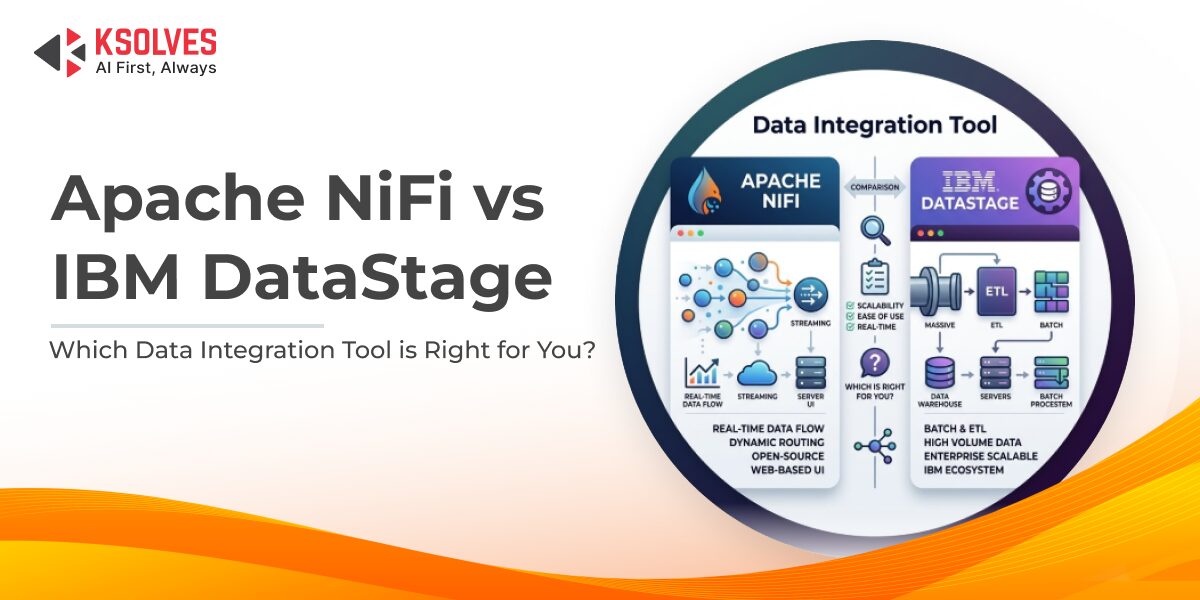
Imagine that your e-commerce platform is processing thousands of transactions per minute. You need to detect fraudulent activity as it happens, route orders in real time, and update customer dashboards instantly. Can your current data system keep up? Or maybe your organization runs complex nightly batch jobs, moving massive datasets into a central data warehouse for regulatory reporting and business intelligence. You need rock-solid accuracy, scalability, and end-to-end data governance.
This is where businesses often face a critical decision. Do you need the speed and flexibility of real-time data pipelines like Apache NiFi, or the power and governance of batch-oriented enterprise tools like IBM DataStage?
Both are excellent at what they do, but they solve very different problems.
In this blog, we’ll explore the strengths, trade-offs, and ideal use cases for each platform so you can choose the right tool to power your data strategy.
What is Apache NiFi?
Apache NiFi is a powerful, open-source data integration and flow automation tool that simplifies how data moves between systems. Its standout feature is an intuitive, drag-and-drop interface that allows even non-technical users to quickly design, build, and manage complex data pipelines with ease. What sets NiFi apart is its ability to handle real-time data ingestion and processing. It’s built to collect, transform, and route data instantly as it flows through the system, making it an ideal solution for businesses that need fast, reliable, and flexible data movement across diverse platforms.
NiFi Features
-
User-Friendly Visual Interface
Apache NiFi is built with simplicity in mind. Its drag-and-drop, flow-based interface allows users to easily create, manage, and modify data pipelines without writing complex code. This makes NiFi highly accessible,even for users who don’t have deep programming skills,while still providing the flexibility needed for advanced configurations.
-
Real-Time Data Processing
One of NiFi’s biggest strengths is its ability to process data streams in real time. As data flows through the system, NiFi can instantly ingest, transform, and deliver it to the right destination with minimal delay. This is particularly valuable for applications that rely on immediate data, such as live dashboards, fraud detection systems, or real-time alerts.
-
Extensive Connector Support
NiFi comes with a rich library of pre-built connectors and processors, enabling seamless integration with various data sources and destinations. Whether you’re connecting to relational databases, cloud storage platforms, messaging queues, APIs, or file systems, NiFi makes it easy to move data between them without custom coding.
-
Dynamic Data Routing
Data rarely follows a straight path. NiFi’s intelligent flow management allows you to dynamically route data based on its content, format, or metadata. This means you can automatically send different types of data to different systems or apply specific processing rules, all in real time.
-
Real-Time Visual Monitoring
With NiFi, you don’t have to guess what’s happening inside your data flows. Its built-in, real-time visual monitoring tools let you track data as it moves through each step. You can easily spot bottlenecks, failures, or unexpected behavior and take immediate corrective action, saving valuable time and reducing downtime.
-
High Scalability
Whether you’re handling small datasets or enterprise-level data volumes, NiFi can scale to meet your needs. You can start with a single-node deployment and expand to a clustered, multi-node setup as your data workloads grow. This scalability ensures that NiFi can continue supporting your operations as your business evolves. Teams currently on an older version can explore a NiFi 1.x to 2.0 upgrade to unlock Kubernetes-native deployment and Python processor support.
Challenges of Using Apache NiFi
-
High Resource Usage
Processing large volumes of data in real-time requires significant memory and CPU.
-
Complexity for Advanced Use Cases
Basic flows are easy to set up, but complex scenarios may require expert knowledge.
-
Security Requires Manual Configuration
NiFi has good security features, but they need to be carefully set up and regularly maintained.
-
Limited Community Compared to Enterprise Tools
Being open-source, its community is smaller than IBM’s.
What is IBM DataStage?
IBM DataStage is a powerful, enterprise-level ETL (Extract, Transform, Load) platform designed for managing large-scale, complex data integration processes. Unlike real-time tools like Apache NiFi, DataStage specializes in high-performance batch processing, making it ideal for businesses that need to process massive datasets on a scheduled basis. It is widely used in industries such as banking, healthcare, and retail, where accuracy, scalability, and reliability are critical. Understanding the difference between ETL vs ELT approaches helps clarify why DataStage and NiFi serve such different architectural roles.
DataStage seamlessly integrates with various databases, cloud platforms, and IBM’s broader technology ecosystem. With advanced metadata management and strong governance features, DataStage is a trusted solution for mission-critical data pipelines and large enterprise environments.
Key Features of IBM DataStage
-
Enterprise-Grade Scalability
IBM DataStage is built to handle massive datasets with ease. Thanks to its parallel processing architecture, DataStage can split large tasks across multiple servers or cores, significantly speeding up data processing and reducing time to delivery. This scalability makes it a reliable choice for businesses dealing with complex, high-volume data workloads.
-
Robust Integration Capabilities
DataStage seamlessly connects to a wide range of data sources and platforms, whether on-premises, cloud-based, or hybrid environments. It integrates smoothly with databases, cloud storage solutions, ERP systems, and other enterprise applications, allowing businesses to build cohesive and streamlined data pipelines without compatibility issues.
-
User-Friendly Graphical Interface
Like Apache NiFi, DataStage offers a visual, drag-and-drop interface that simplifies the design and management of ETL jobs. This intuitive environment makes it easier for both technical and non-technical users to create, modify, and monitor complex workflows with greater visibility and control.
-
High-Performance Data Processing
DataStage is engineered for fast, efficient batch processing. It intelligently balances workloads and optimizes resource usage to ensure large volumes of data are processed quickly and accurately, which is essential for enterprise reporting, analytics, and regulatory compliance.
-
Advanced Metadata Management
One of DataStage’s standout features is its comprehensive metadata management. It meticulously tracks the origin, movement, and transformation of data across the pipeline. This is especially valuable for businesses that need strong governance, data lineage tracking, and regulatory compliance, as it provides full visibility and control over the data lifecycle. This is especially valuable for businesses that need strong governance, data lineage tracking, and regulatory compliance – topics also addressed through careful Apache NiFi and regulatory compliance pipeline design.
Challenges of Using IBM DataStage
- High Licensing Costs: DataStage is not free. It’s an enterprise solution with significant costs for licensing and support.
- Complex Setup: Installing and configuring DataStage can take time and usually requires skilled professionals.
- Steep Learning Curve: Mastering the full power of DataStage may require dedicated training.
- High Resource Consumption: To run effectively, it needs powerful servers and can be hardware-intensive.
- Vendor Lock-In: Heavy reliance on IBM technologies may limit your ability to switch tools later without significant effort.
| Apache NiFi vs IBM DataStage | ||
| Feature | Apache NiFi | IBM DataStage |
| User Interface | Drag-and-drop, simple for beginners | Graphical, but advanced skills are needed |
| Processing Type | Real-time, continuous data flows | Batch-focused, high-performance |
| Scalability | Horizontal scaling via clustering | Enterprise-grade parallel processing |
| Integration | Extensive open-source connectors | Deep integration with IBM and others |
| Security Management | Requires manual setup and constant review | Built-in enterprise security |
| Performance Focus | Real-time ingestion and routing | Fast, reliable batch processing |
| Community Support | Growing open-source community | Large enterprise user base |
| Cost | Free (open-source); paid enterprise add-ons | Expensive licensing and maintenance |
When Should You Choose Apache NiFi?
Choose NiFi if:
- You need to process data in real-time.
- You prefer a low-code, visual development environment.
- Your organization values open-source and cost-effective solutions.
- You are handling moderately complex data pipelines.
- You need flexible routing of streaming data across multiple systems.
Best For:
Startups, medium-sized businesses, and companies need flexible, real-time data pipelines without heavy licensing costs.
If you’re also evaluating workflow orchestration tools, our breakdown of Apache NiFi vs Airflow covers how these two tools compare for scheduling and pipeline automation.
When Should You Choose IBM DataStage?
Choose DataStage if:
- You need enterprise-grade scalability for huge datasets.
- Your organization already uses other IBM tools.
- You prioritize batch processing over real-time ingestion.
- You require advanced metadata management for governance and compliance.
- You have the budget and team to handle a large, complex system.
Best For:
Large enterprises, regulated industries, and businesses processing massive data volumes in structured environments.
Wrapping Up
Choosing between Apache NiFi and IBM DataStage isn’t about which is better; it’s about what suits your business. NiFi is best for real-time processing, flexible data flows, and open-source agility, while DataStage excels in batch processing, enterprise scalability, and strict governance. The right choice depends on your data speed, compliance needs, and system complexity.
At Ksolves, we offer expert consulting, implementation, and support for Apache NiFi. Whether you need to build real-time streaming pipelines or set up enterprise-grade batch processing, our certified professionals can guide you from strategy to execution. Connect with us today to design the right data solution for your business!
Frequently Asked Questions
What is the main difference between Apache NiFi and IBM DataStage?
What are the risks of using IBM DataStage for real-time data needs?
How do I migrate from IBM DataStage to Apache NiFi?
Is Apache NiFi a good alternative to IBM DataStage for enterprises?
When does it make sense to use NiFi and DataStage together?
Which companies provide Apache NiFi consulting as an alternative to IBM DataStage?
How much does it cost to replace IBM DataStage with Apache NiFi?
Have more questions? Contact our team for a free consultation.































Author
About the Author Editorial Team The Ksolves Editorial Team includes certified Salesforce experts, Big Data engineers, AI/ML specialists, Zoho consultants, and experienced technology writers focused on delivering clear, actionable insights for modern businesses. With hands-on experience across Salesforce, Big Data platforms, AI/ML solutions, application development, software testing, and Zoho ERP/CRM, the team publishes practical guides, real-world use cases, and industry updates that support smarter decisions and faster growth. Every article is created to solve business challenges, guide technology adoption, and keep organizations aligned with evolving digital ecosystems.
Share with