Project Name
Multi-Site CDR Data Platform for a Telecom Operator in the Middle East and Africa


A growing telecom operator in the Middle East and Africa region manages a distributed network with a central data site and four remote locations, each generating high-volume call detail records around the clock. With no unified data architecture to consolidate these streams, real-time billing reconciliation, network analytics, and operational reporting were entirely manual and error-prone. As subscriber volumes grew, the absence of a scalable pipeline became a direct liability to revenue assurance and regulatory compliance.
The operator needed a modern, distributed data platform capable of ingesting CDR streams from all five sites, processing them in real time, and surfacing actionable insights through live dashboards for billing, network, and operations teams. The operator partnered with Ksolves, an AI-First Company, to design and deliver a multi-site Big Data platform using a modern open-source stack, transforming fragmented, siloed data into a single unified analytics layer.
The challenges faced by the client are as follows:
- Distributed Data Silos Across 5 Sites: Each remote location generated CDR data independently with no standardized ingestion path. Reconciling records across sites required manual intervention, leading to consistent billing delays.
- No Real-Time Billing Analytics: Revenue assurance teams could not monitor billing accuracy in real time, increasing the risk of undetected revenue leakage and delayed dispute resolution.
- Network Optimization Blind Spots: Without unified telemetry across all sites, network operations teams lacked the data needed to proactively identify congestion, outages, or capacity issues.
- Scalability Constraints: Legacy data handling processes could not scale to meet projected subscriber and traffic growth. The architecture needed to support multiples of the current data volumes without requiring a full redesign.
- Multi-Technology Integration Complexity: The operator's environment required seamless integration across NiFi, Kafka, Spark, Druid, MinIO, Superset, Hive, and PostgreSQL, all coordinated into a single coherent pipeline.
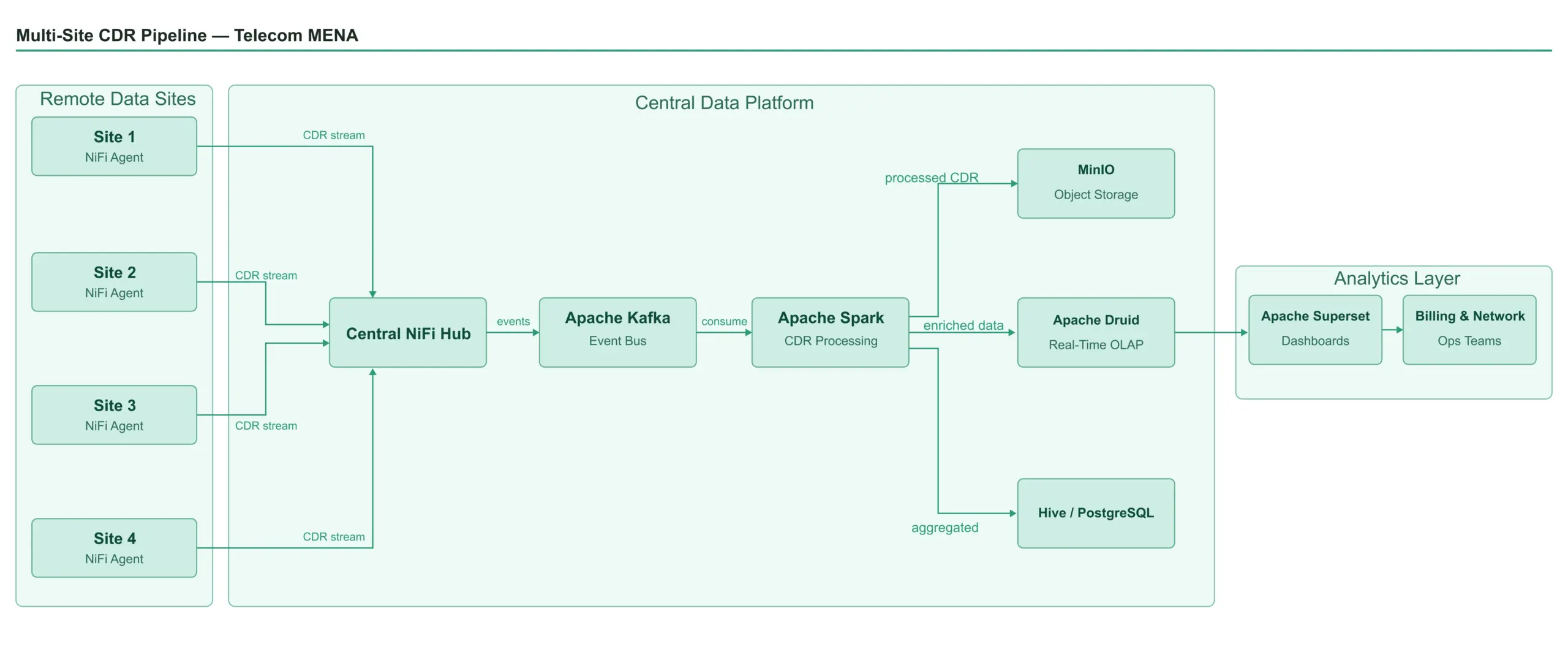
Ksolves, an AI-First Company, designed a distributed, multi-site Big Data platform using a modern open-source stack, enabling real-time CDR ingestion from all locations into a unified analytics layer. The architecture was built for operational resilience, horizontal scalability, and low-latency query performance across billing, network, and operations dashboards.
- Apache NiFi for Multi-Site Ingestion: NiFi agents were deployed at each of the 4 remote sites and the central hub, providing reliable, monitored CDR ingestion with guaranteed delivery and backpressure handling.
- Apache Kafka for Distributed Streaming: Kafka served as the central event bus, decoupling ingestion from processing and enabling sub-minute data availability for downstream analytics and billing systems.
- Apache Spark for CDR Processing: Spark jobs handled enrichment, aggregation, and quality validation of CDR records at scale, processing billing-relevant fields and flagging anomalies for revenue assurance review.
- Apache Druid for Real-Time OLAP: Druid provided sub-second query performance on CDR time-series data, enabling real-time operational dashboards and on-demand analytics for billing and network teams.
- Apache Superset for Analytics Dashboards: Superset dashboards surfaced billing accuracy KPIs, CDR volume trends, and site-level network performance, giving leadership and operations teams a unified, real-time operational view.
Technology Stack
| Layer | Technology |
|---|---|
| Ingestion | Apache NiFi |
| Streaming | Apache Kafka |
| Processing | Apache Spark |
| Analytics | Apache Druid |
| Storage | MinIO |
| Visualisation | Apache Superset |
- Real-Time CDR Visibility Across All 4 Sites: CDR data from remote sites was previously consolidated manually, leaving billing and network teams with no real-time cross-site view. A unified CDR pipeline now delivers sub-minute data availability across all 5 sites, enabling billing teams to continuously monitor revenue metrics in real time.
- Billing Accuracy Significantly Improved: Manual reconciliation processes led to billing disputes going undetected for days, increasing the risk of revenue leakage. Automated CDR enrichment and anomaly flagging via Spark have significantly reduced billing-discrepancy resolution time, with a target of same-day detection for all anomalies.
- Analytics Query Performance Accelerated: Operational reports previously required manual data pulls and took hours to produce, with no real-time dashboard capability. Druid-powered dashboards now deliver sub-second query response on CDR time-series data, giving operations teams live KPI visibility at all times.
- Platform Scalability Established: Legacy data handling processes could not support projected subscriber growth and required redesign with each traffic increase. The horizontally scalable Kafka, Spark, and Druid architecture can now handle multiples of the current CDR volumes without re-engineering.
Ksolves transformed a fragmented, multi-site CDR environment into a unified, real-time Big Data platform that delivers live billing analytics, network KPIs, and operational dashboards across all locations. The operator moved from manual billing reconciliation and siloed data streams to a single platform with sub-minute CDR availability, sub-second query response, and same-day billing anomaly detection.
The platform’s horizontally scalable architecture supports network growth, regulatory reporting, and future AI/ML analytics without architectural rework. With the CDR pipeline operational, the operator is now positioned to build predictive churn models, network optimization tools, and fraud detection use cases directly on the unified data layer.
For telecom operators and ISPs still reconciling CDR data manually across distributed sites, our Big Data Support Services deliver the scalability, real-time visibility, and revenue assurance required for modern network operations.
Is Your Telecom Still Reconciling CDR Data Manually Across Distributed Sites?