Project Name
ML Model Deployment Cut From 3 Weeks to 30 Minutes on OCI


The client is a retail analytics company operating a machine learning-first platform that delivers business intelligence across retail operations and consumer behaviour modelling. Running on OCI GPU Clusters and OCI Kubernetes Engine, their data science organisation trains high-value predictive models informing pricing, inventory, and promotional decisions at scale.
The path from a validated experiment to a deployed production endpoint was a 2 to 3-week handoff process involving a separate MLOps team, manual pipeline configuration, and no standardised model versioning, making time-to-insight commercially uncompetitive.
With every new model requiring bespoke engineering work before it could serve production traffic, the MLOps team had become a permanent bottleneck to business impact. Leadership engaged Ksolves to build a self-service golden path that gives data scientists end-to-end control from experiment to production without waiting for a dedicated MLOps queue.
A data science organisation producing high-quality models at pace, and an MLOps process that ensured none of them reached production in less than three weeks.
- 2–3 Week Model Deployment Cycles: Every validated model required manual MLOps handoffs and pipeline setup, delaying production deployment by weeks.
- No Standardized Path to Production: Each deployment followed a different process, with no reusable templates or validation framework.
- Ad-Hoc Model Versioning: Models, datasets, and training configurations were tracked inconsistently, limiting reproducibility and traceability.
- Manual GPU Provisioning Delays: GPU clusters were provisioned through manual requests, slowing experiment execution and model training.
- No Automated Pre-Deployment Validation: Models reached production without automated benchmarking, performance checks, or canary testing.
- Limited Visibility Into Model Health: No centralized monitoring for model versions, inference performance, or production health metrics.
Ksolves, an AI-first DevOps consulting services company, built a self-service MLOps platform using Backstage Scaffolder and Dagger pipelines, enabling data scientists to move models from OCI Data Science training to OKE production endpoints without MLOps team involvement. Automated validation, benchmarking, and canary deployment gates ensured only verified models reached production, while a custom Backstage plugin provided centralized visibility into model versions, A/B testing metrics, and inference performance.
- Self-Service MLOps Platform: Ksolves built a self-service MLOps platform using Backstage and Dagger, enabling data scientists to deploy models from training to production without MLOps team intervention.
- Backstage MLOps Golden Path Templates: Standardized Backstage templates automate training job provisioning and OKE inference deployment through a simple form-driven workflow.
- Dagger ML Lifecycle Automation: Dagger orchestrates validation, benchmarking, containerization, registry publishing, and canary deployment in a single automated pipeline.
- Self-Service OCI GPU Provisioning: Data scientists can provision OCI GPU training environments directly from Backstage, eliminating infrastructure request delays.
- Automated Model Deployment & Canary Releases: Models are deployed with automated canary rollouts, performance monitoring, and rollback safeguards.
- Custom Backstage MLOps Plugin: A centralized dashboard provides visibility into model versions, training status, A/B testing results, and inference performance.
Technology Stack
| Category | Technology |
|---|---|
| AI/ML | OCI Data Science + OCI GPU Clusters |
| Platform | Backstage (MLOps Golden Path Plugin) |
| CI/CD Portability | Dagger (TypeScript SDK) |
| Container Platform | OCI Kubernetes Engine (OKE) |
| Object Storage / Registry | OCI Object Storage + OCIR |
| Database | Oracle Feature Store |
From a 2 to 3-week MLOps handoff queue to a 30-minute self-service pipeline, data scientists now own the full journey from validated experiment to live production endpoint.
- Model Deployment Time Reduced to 30 Minutes: Automated pipelines cut deployment time from 2–3 weeks to under 30 minutes.
- GPU Provisioning in Minutes: Self-service OCI GPU cluster provisioning eliminates multi-day infrastructure request delays.
- 100% Pre-Production Model Validation: Every deployment passes automated benchmarking and canary validation before go-live.
- Complete Model Version Traceability: All model artefacts, parameters, and performance metrics are centrally tracked and versioned.
- MLOps Handoffs Eliminated: Data scientists deploy independently, allowing MLOps teams to focus on platform innovation.
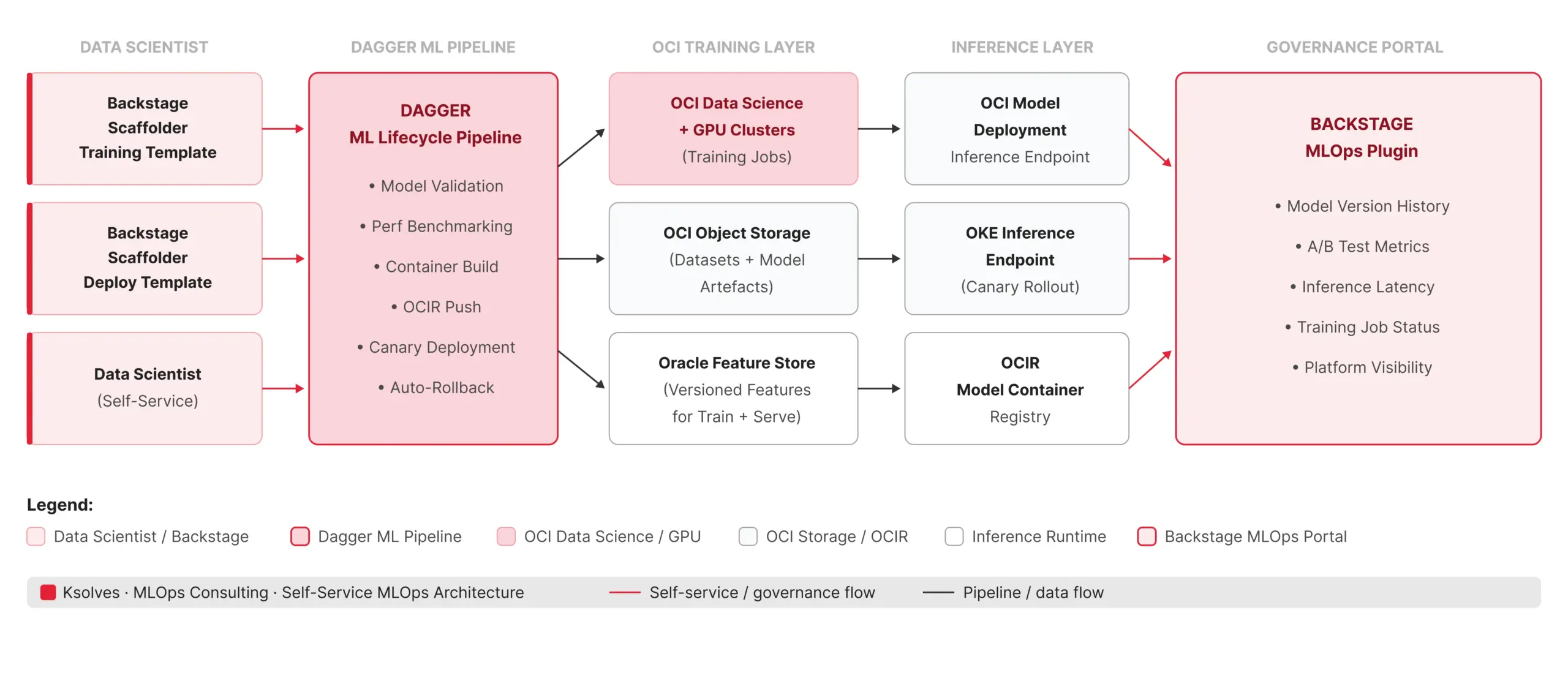
A strong data science team can only create business value when models reach production quickly and reliably. Ksolves eliminated deployment bottlenecks by introducing a self-service MLOps platform that automates the entire path from training to production. Models can now be validated, benchmarked, and deployed in minutes, with full traceability and governance built in. The result is faster innovation, reduced operational overhead, and an MLOps team focused on platform advancement rather than deployment queues.
Is Your ML Deployment Pipeline Measured in Weeks Rather than Minutes?