Project Name
Cut ERP Disaster Recovery Time by 85% With Automated Azure Failover


Our client operates a multi-module Odoo ERP deployment on Azure, serving finance, inventory, manufacturing, and CRM functions across multiple business units in India. The platform runs as a Dockerised stack with PostgreSQL as the primary database, handling hundreds of concurrent users during peak business hours. As the organisation scaled, the gap between their business continuity expectations and their actual DR capability became a critical risk, one that needed to be closed before the next outage, not after.
A single zone incident exposed every gap in the recovery model, all at once, all requiring human intervention.
- Manual Failover Procedures: Disaster recovery relied on a step-by-step runbook that required an engineer to manually spin up resources, restore database snapshots, and reconfigure networking, a process taking hours under ideal conditions and significantly longer under pressure.
- No Automated Health Monitoring for DR Readiness: There was no continuous check to confirm that replication was current and the standby environment was actually recoverable. The team only discovered replication drift during actual incidents, when it was already too late.
- Database Consistency Risk During Failover: PostgreSQL backups were taken periodically but not continuously replicated. A zone outage could result in hours of lost transactions, with no automated consistency validation at recovery time.
- DNS and Networking Cutover Delays: Redirecting traffic from primary to secondary required manual DNS changes and security group updates, adding significant unplanned minutes to every recovery attempt at the worst possible moment.
- Untested Recovery Plans: DR drills were never performed because executing a test failover risked impacting the production environment. The team had no way to validate their recovery capability without taking on production risk.
- Extended RTO Threatening Business Operations: Manual steps, untested procedures, and sequential dependencies combined to push the effective Recovery Time Objective well beyond what a revenue-critical ERP platform could tolerate.
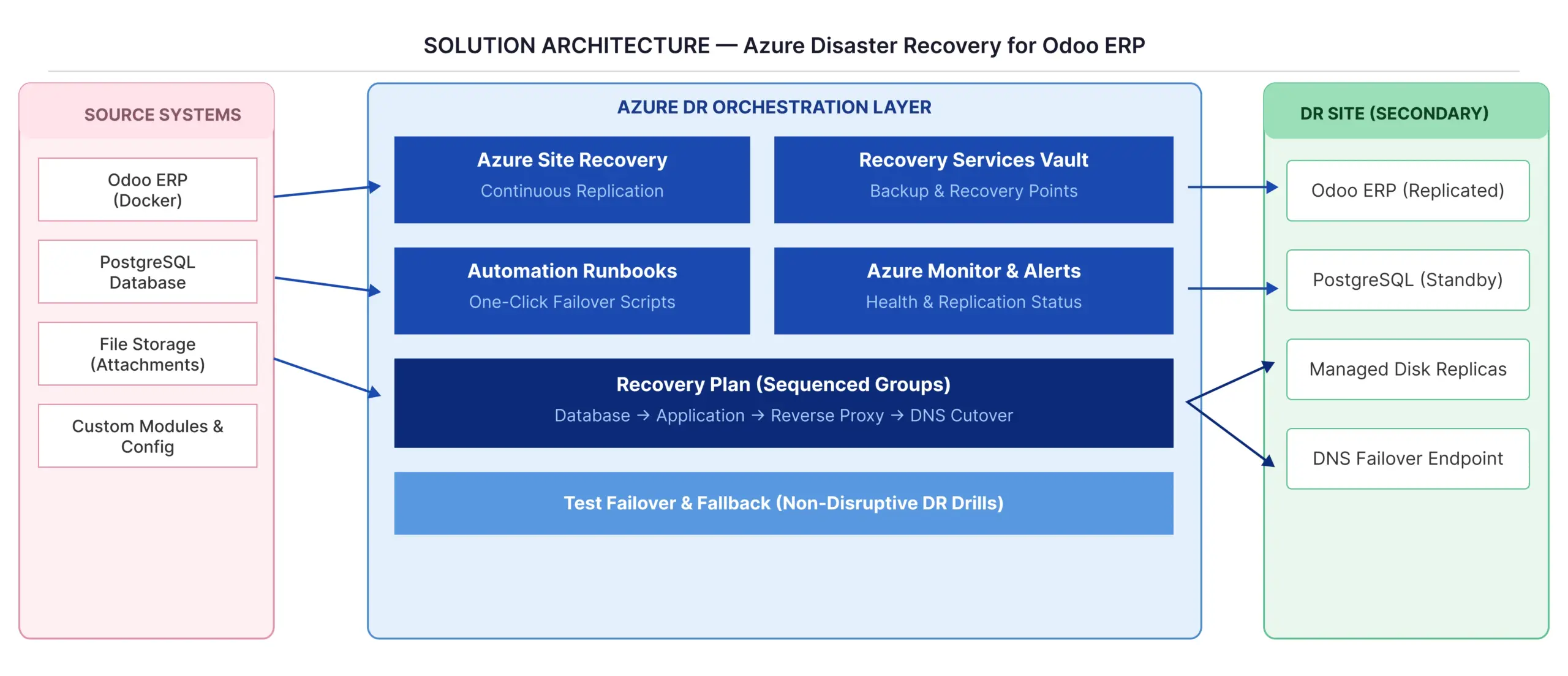
Ksolves designed and deployed a fully automated disaster recovery architecture on Azure, purpose-built for Dockerised Odoo ERP workloads. The governing principle was zero-manual-intervention failover: every step from replication monitoring to DNS cutover had to execute without human action. Azure Site Recovery served as the replication backbone, with custom Automation Runbooks orchestrating the sequenced recovery of database, application, and networking layers in the correct order, every time.
- Azure Site Recovery: Configured ASR to continuously replicate all Odoo VM disks, including Docker volumes, PostgreSQL data directories, and custom module storage, from the primary Azure region to a secondary region, with both crash-consistent and application-consistent recovery points maintained at all times.
- Automation Runbooks for One-Click Failover: Built Azure Automation Runbooks that execute the full failover sequence automatically: stop primary, promote replicated disks, start PostgreSQL with consistency validation, launch Odoo Docker containers, and update load balancer endpoints, triggered by a single action or automated alert.
- Recovery Plan with Sequenced Groups: Defined a multi-step Recovery Plan in Azure Site Recovery, enforcing the correct startup order: database tier first, application tier second, reverse proxy and networking third, DNS cutover last, eliminating the dependency failures that manual runbooks were prone to.
- Azure Monitor and Alerting Integration: Deployed Azure Monitor with custom alert rules tracking replication health, replication lag, and recovery point age, triggering both notifications and automated remediation if replication drifts beyond acceptable thresholds before an incident occurs.
- Non-Disruptive Test Failover: Enabled isolated test failover capability that spins up the entire DR environment in a sandboxed network, allowing the team to validate end-to-end recovery quarterly without impacting production or consuming live IP addresses.
Technology Stack
| Category | Technology |
|---|---|
| Infrastructure | Azure Site Recovery |
| Infrastructure | Recovery Services Vault |
| DevSecOps | Azure Automation Runbooks |
| Platform | Odoo ERP (Docker) |
| Database | PostgreSQL |
| Infrastructure | Azure Monitor & Alerts |
From a manual, untested, multi-hour scramble to a single-click recovery, validated, repeatable, and production-safe.
- Recovery Time Reduced by 85% (target): Automated one-click failover now completes full Odoo ERP recovery in under 45 minutes, including database consistency validation and DNS cutover, down from a 4 to 6 hour manual process with no guaranteed outcome.
- Data Loss Window Collapsed From Hours to Minutes (target): Continuous disk-level replication with application-consistent recovery points reduces potential data loss to under 15 minutes RPO, replacing periodic backups that left up to 6 hours of transactions exposed during a zone outage.
- DR Drill Frequency: From Zero to Quarterly: Non-disruptive test failover capability now enables quarterly DR drills in an isolated network with zero production impact, replacing a model where recovery plans were never tested because testing was too risky.
- Manual Intervention Steps Eliminated Entirely: All 12-plus manual failover steps across VM provisioning, database restore, Docker restart, and DNS update are now sequenced in a single Recovery Plan with Automation Runbooks, zero human intervention required.
- Replication Health Visibility: From None to Real-Time: Azure Monitor dashboards and automated alerts provide continuous visibility into replication lag, recovery point age, and VM health, replacing a model where replication drift was only discovered during live incidents.
Before this engagement, disaster recovery for this Odoo ERP platform was a manual, untested, multi-hour process that depended entirely on an engineer executing a runbook correctly under pressure, with no guarantee of the outcome. Replication drift went undetected, recovery plans went untested, and the business had no honest answer to how long recovery would actually take. Ksolves replaced that uncertainty with a single automated action. Failover now completes in under 45 minutes, data loss is bounded to under 15 minutes, and the team runs quarterly DR drills in an isolated environment without touching production. The organisation now has a disaster recovery posture it can defend to leadership, satisfy auditors with, and build on, with a direct path to ISO 22301 business continuity certification.
Is Your Erp Platform One Outage Away From a Manual Recovery Scramble?