



How Ksolves Is Using AI to Solve Accessibility Compliance Faster Than Traditional Audits Ever Could
AI
5 MIN READ
April 22, 2026

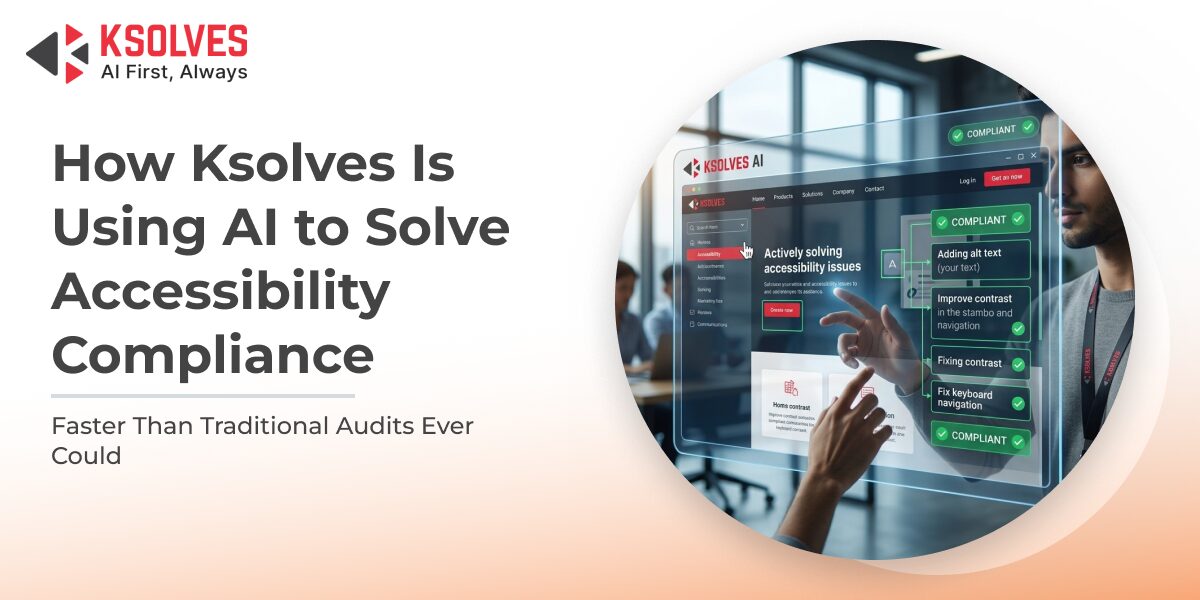
Most software teams do not discover accessibility compliance gaps until it is too late. The application is built, the launch date is set, and then the legal reality hits. Without meeting accessibility standards, the product simply cannot go live in the US market.
The traditional response has always been the same: assign a team, start reviewing the codebase manually, and brace for weeks of slow, uncertain work. But AI is changing that response entirely. Today, what once took weeks can be mapped, analyzed, and actioned in a fraction of the time. Hence, this blog explores how AI-powered accessibility audits work, why manual approaches fall short, and what it actually looks like when an AI-first company like Ksolves steps in to solve this problem fast.
The Accessibility Compliance Problem Is Bigger Than Most Teams Realize
According to the World Health Organization, 16% of the global population, approximately 1.3 billion people, experience significant disability. In the US, the Americans with Disabilities Act (ADA) and WCAG guidelines make digital accessibility a legal requirement rather than a preference. Non-compliant applications risk lawsuits, rejection from enterprise procurement, and blocked market entry.
Yet accessibility is still one of the most overlooked aspects of software development. It is often treated as a final checklist item rather than a design principle, which means many applications reach completion with deep compliance gaps baked into the codebase.
Why Manual Accessibility Audits Take So Long
When a codebase is handed off for a compliance audit, the challenge is not just fixing issues but ensuring the new team understands the context. The real difficulty lies in finding them all.
A typical manual audit involves:
- Reviewing every UI component for missing ARIA labels
- Checking all interactive elements for keyboard navigability
- Testing dynamic content for screen reader announcements
- Validating color contrast across every view
- Verifying form fields, error messages, and modals for compliance
When the codebase is large, unfamiliar, or undocumented, this process becomes exponentially slower. Teams frequently discover new issues mid-remediation, which unpredictably extend timelines. The result is a process that is both slow and incomplete.
How AI Changes the Audit Phase Entirely
The most significant shift AI brings to accessibility compliance is not in the fixing. It is in the finding.
Instead of combing through the codebase manually, an AI model can analyze the entire codebase at once, identify every non-compliant element, and produce a structured, prioritized map of issues before remediation begins. This changes the shape of the entire project.
What an AI-powered audit covers:
- Missing or incorrect ARIA labels across all components
- Elements that screen readers cannot interpret
- Absent focus management and keyboard interaction support
- Dynamic content with no announcements for assistive technologies
- Non-compliant form structures and error handling patterns
The output is not a vague list of concerns. It is a precise, complete inventory of every issue in the codebase, which means the development team walks in with full visibility from day one.
From Launch Blocker to US Market: How Ksolves Turned an Accessibility Crisis Around with AI
As an AI-first company, Ksolves has helped businesses tackle some of the most time-sensitive compliance challenges using the power of artificial intelligence. One such engagement stands out as a clear example of how AI-first expertise can turn a launch-blocking crisis into a fast, structured, and certain fix.
Ksolves worked with a software client who had built a complete application but could not launch it in the US due to accessibility issues. The application had no screen reader support, missing labels throughout, and components that assistive technologies simply could not interpret.
The codebase had not been built by Ksolves, so the team had no prior familiarity with its structure. A manual audit would have taken weeks. Instead, the Ksolves AI-first team ran the codebase through an AI model, which flagged every non-compliant element, identified every missing label, and produced a complete map of what needed to change before a single fix was made.
The impact was immediate:
- The audit phase that would have taken weeks was completed in a fraction of the time
- The development team had a complete, prioritized remediation checklist from day one
- No issues were discovered mid-fix, which kept the timeline predictable
- The client achieved certification and launched in the US market on schedule
This is the core value of an AI-first approach to compliance: not just speed, but certainty.
As an AI and ML consulting company, Ksolves brings this same AI-first rigor to every engagement, whether it is accessibility, performance optimization, or full-scale product development.
Conclusion
Accessibility compliance does not have to be a weeks-long crisis. With AI, teams can map every gap in a codebase before writing a single fix, turning an unpredictable audit into a structured, fast-moving process. The result is faster launches, lower risk, and products that meet the standards they need to reach the markets they are targeting.
If your application is facing compliance challenges or you are planning a US market launch, Ksolves can help you move faster and with greater confidence. Talk to our experts today or send us your query at [email protected].































AUTHOR
AI
Share with