Project Name
Ksolves Eliminates Counting Downtime Across 3+ Device Fleets via AWS Amplify Offline

A large-scale retail and logistics operation runs inventory cycles across multiple regional sites, relying on mobile-first workflows to keep stock accurate across sprawling warehouse and store estates. When warehouse staff lost connectivity mid-count, the session simply stalled, forcing a restart and risking reconciliation delays that cascaded across the supply chain. Ksolves’ mobile app development work re-architected the mobile layer around a store-and-forward offline model, making offline the default behavior rather than an edge case to work around. Device provisioning time dropped by roughly 80%, and scan data loss during network outages has been eliminated entirely.
- Counting Halts on Connectivity Loss: Any network interruption during an active count session caused progress to stall, forcing staff to restart from scratch and invalidating all prior work.
- No Store-and-Forward Safety Net: The mobile app had no way to buffer completed scan payloads locally, so data captured during an outage was silently discarded before it ever reached the backend.
- Fragile Direct-Write Sync Model: Scan results pushed directly to the backend with no queue buffer meant any transient failure caused permanent data loss instead of a retriable delivery attempt.
- Unsafe Logout Risk: Workers could exit the app before syncing incomplete area counts, leaving silent data gaps that only surfaced during reconciliation hours or days later.
- Slow and Friction-Heavy Device Onboarding: Provisioning a new device required manual credential entry and time-consuming configuration, slowing fleet expansion and replacement cycles.
- Fragmented Device Fleet Compatibility: The existing app was never validated across the full range of hardware in use, causing intermittent failures on ruggedised scanners like Zebra, Urovo, and Point Mobile, plus older Android versions.
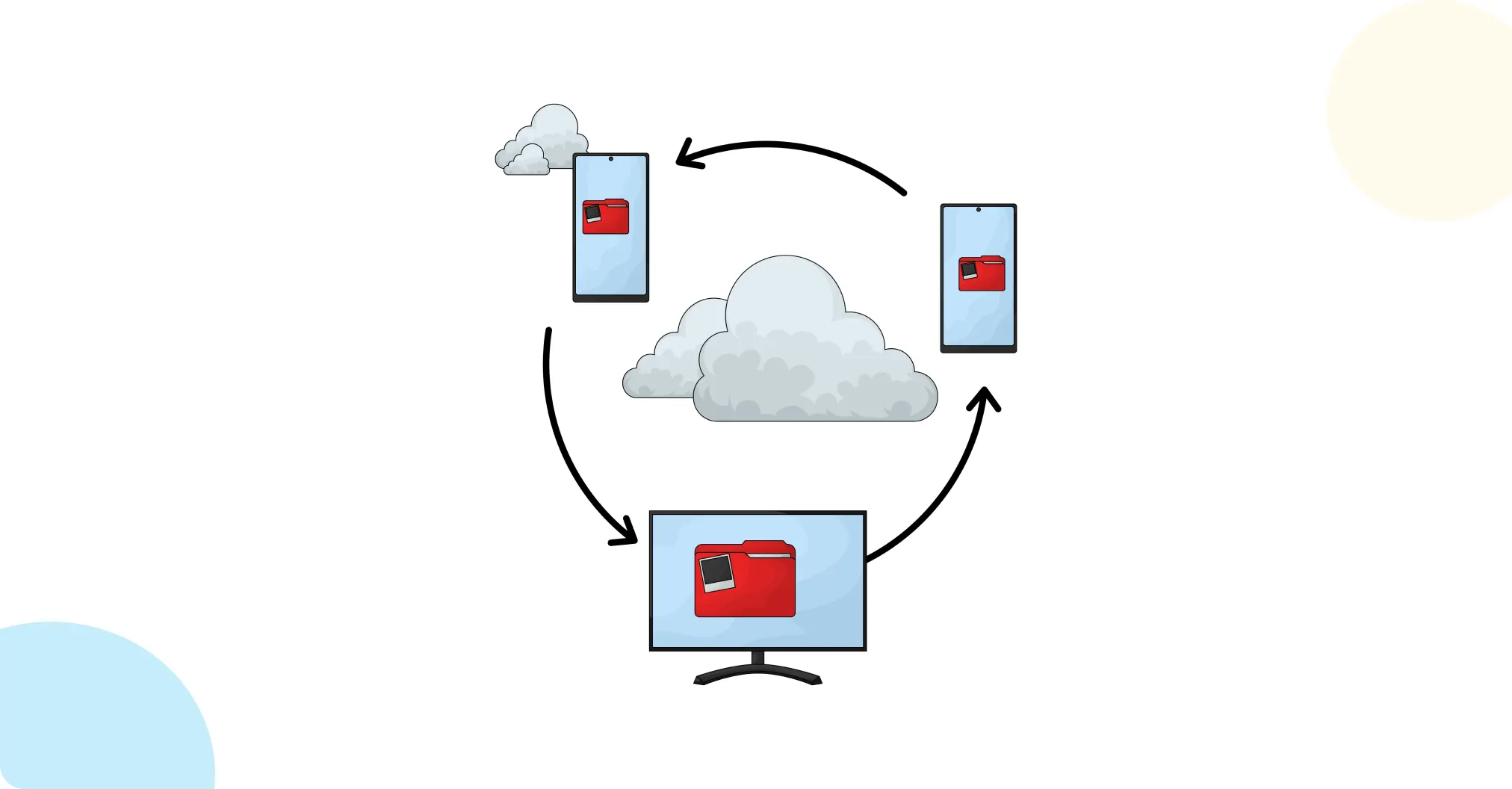
Ksolves redesigned the mobile inventory platform around a store-and-forward offline model as the governing principle: every scan buffers on-device and dispatches asynchronously, so the app behaves identically whether or not the network is present.
- Local Store-and-Forward Buffer: Completed scan payloads hold in an on-device buffer and dispatch to Amazon SQS the moment connectivity is available, removing any dependency on a live connection during active counting.
- SQS-to-MySQL Async Sync Pipeline: A dedicated ECS task continuously polls the SQS message queue and inserts validated scan records into MySQL, ensuring reliable, ordered persistence without any direct mobile-to-database writes.
- AWS AppSync Area Tag Monitoring: AppSync subscriptions track backend events for area tag configuration changes, automatically reflecting structural updates to the count plan on connected devices with no manual refresh needed.
- Remaining Areas Indicator and Logout Guard: An in-app progress panel surfaces all outstanding area counts in real time, and an enforced logout safeguard blocks session termination while unsynced data still sits in the local buffer.
- QR-Based Device Onboarding via Amplify Auth: A QR login flow through Amplify Auth replaces manual credential entry, provisioning a new device in seconds instead of minutes.
- Certified Multi-Device and OS Coverage: The iOS and Android app is validated and performance-tuned across Apple iOS, Android 7 and above, and key ruggedised handhelds including Zebra, Urovo, and Point Mobile, ensuring uniform behavior fleet-wide.
Technology Stack
| Category | Technology |
|---|---|
| Platform | AWS Amplify + Amazon S3 |
| Integration | AWS AppSync |
| Messaging | Amazon SQS |
| Processing | Amazon ECS Task |
| Database | MySQL |
| Frontend | Mobile App (iOS / Android) |
- Counting Continuity Achieved Across All Sessions: Scans now buffer on-device and queue to SQS on reconnection, so counting continues uninterrupted regardless of network state instead of halting and restarting.
- Zero Scan Data Loss via SQS Durability: SQS message durability paired with the ECS consumer guarantees every scan payload delivers and persists into MySQL, eliminating the silent data loss that used to happen during outages.
- Device Provisioning Time Reduced by 80%: QR-based onboarding through Amplify Auth now provisions a device in under 3 minutes, down from the 15-20 minutes manual credential entry used to take.
- Full Fleet Coverage Across 5+ Device Families: Certified support across Zebra, Urovo, Point Mobile, and Android 7+ now delivers uniform performance fleet-wide, replacing the intermittent failures that used to disrupt high-volume count cycles.
- Unsafe Logout Incidents Eliminated: The logout guard with its remaining-areas indicator now blocks unsafe exits until every pending payload has queued to SQS, closing the invisible reconciliation gaps that used to appear hours or days later.

“Our counting teams no longer stop when the network goes down, the app just keeps going. Onboarding new devices used to take the better part of a morning, now it takes minutes.”
– Senior Operations Leader, Logistics and Supply Chain (name withheld per NDA)
Inventory counting on this platform used to be entirely connectivity-dependent: a network drop halted a session outright, scan data vanished with no retry path, and a worker could log out mid-session leaving a reconciliation gap nobody would see until much later. Ksolves’ mobile app development work replaced that with a store-and-forward architecture that buffers every scan on-device, routes it through SQS, and persists it reliably to MySQL through a dedicated ECS task.
Device provisioning time dropped by roughly 80%, scan data loss is eliminated entirely, and the app now performs uniformly across more than five device families instead of failing intermittently on ruggedised hardware. Counting simply never stops now, regardless of what the network is doing.
The same offline-first architecture is built to extend into other field operations, order picking, receiving, stocktakes, without requiring further infrastructure investment to get there.
Is Your Mobile Workforce Losing Data Every Time the Network Drops?