 AI
 5 MIN READ


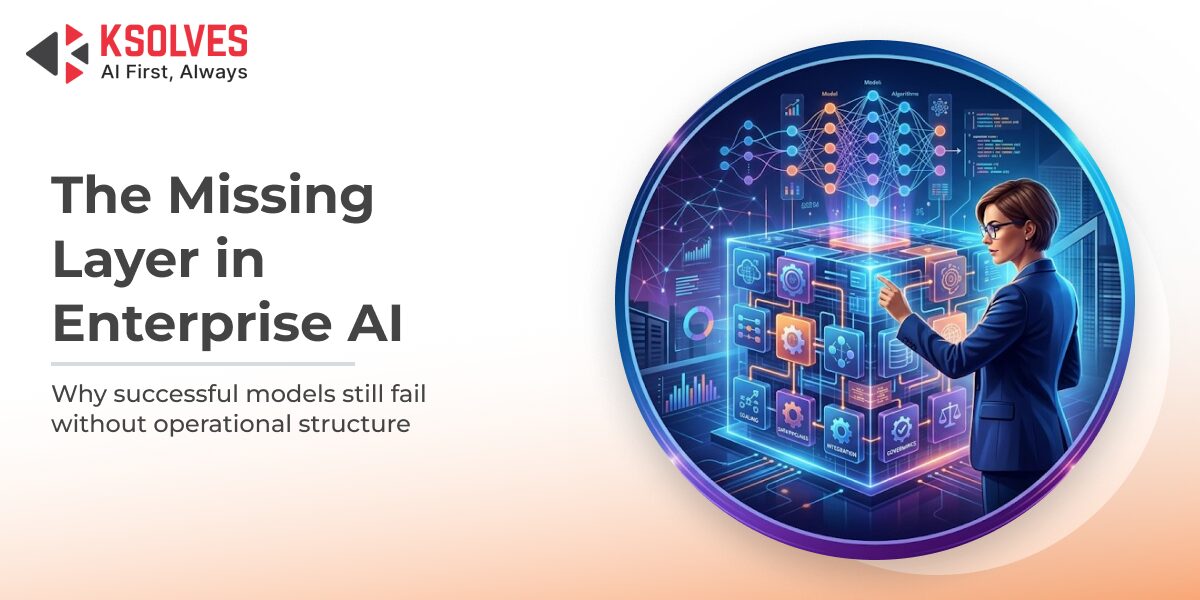
Machine learning models are only as valuable as their ability to run reliably in the real world. Building a model that performs well in a notebook is one thing. Keeping it accurate, governed, and scalable across an enterprise is an entirely different challenge. That gap is exactly what MLOps is designed to close.
MLOps, short for Machine Learning Operations, brings the discipline of DevOps into the machine learning lifecycle. It covers everything from data pipelines and model versioning to automated deployment, performance monitoring, and compliance governance. For enterprise AI teams, it is the difference between a proof-of-concept that never ships and an AI system that delivers measurable business value.
This blog unpacks what MLOps actually means, why enterprise teams cannot afford to ignore it, and what a mature MLOps practice looks like in production.
The Harsh Reality Behind AI Deployments
Enterprise AI enthusiasm has rarely translated into enterprise AI success. According to a survey of over 1,000 enterprises across North America and Europe, 42% of companies abandoned most of their AI initiatives in 2025, a dramatic rise from just 17% in 2024. On average, organizations scrapped 46% of AI proofs-of-concept before they ever reached production. Another analysis confirms that over 80% of AI projects fail, a rate twice that of non-AI technology projects.
Without MLOps, models degrade silently, teams work in silos, and governance is an afterthought. MLOps provides the operational backbone that prevents these failure modes before they occur.
What Is MLOps, Exactly?
MLOps is a set of practices that automate and standardize the machine learning lifecycle, from data preparation and model training to deployment, monitoring, and retraining. It applies DevOps principles such as continuous integration, continuous delivery (CI/CD), version control, and automated testing to ML systems.
A standard MLOps workflow covers these core stages:
| Stage | What It Involves |
|---|---|
| Data Management | Versioning datasets and feature pipelines using tools like DVC or Feast, so experiments are reproducible and auditable. |
| Model Training and Experimentation | Tracking experiments with tools like MLflow or Weights & Biases, ensuring teams can compare runs and reproduce results. |
| CI/CD for ML | Automating model validation, testing, and deployment through pipelines similar to those used in software engineering. |
| Model Serving and Deployment | Using platforms like AWS SageMaker, Azure ML, or Google Vertex AI to push models into production with canary rollouts and safe rollback. |
| Monitoring and Drift Detection | Continuously watching model performance in production, detecting data drift or concept drift before it harms business outcomes. |
| Governance and Compliance | Maintaining audit trails, data lineage, and explainability documentation to meet regulatory requirements. |
Why MLOps Matters for Enterprise AI Teams
1. Models Degrade in Production
A model trained on last year’s data is not the same model next year. Customer behavior shifts, market conditions change, and input distributions evolve. Without a systematic monitoring-and-retraining loop, enterprises are flying blind. MLOps operationalizes drift-detection and retraining pipelines, ensuring models remain accurate without manual intervention from data scientists.
2. Siloed Teams Kill AI Velocity
In most enterprises, data scientists build models, ML engineers deploy them, and IT operations run them, often using different tools and without shared visibility. The result is misaligned goals, delayed handoffs, and deployment failures. MLOps introduces shared platforms, standardized workflows, and automated handovers that eliminate these silos.
Netflix, for example, uses Metaflow as a shared MLOps layer to align experimentation, engineering, and operations across teams.
3. Scaling AI Is Not Just a Technical Problem
Deploying one model is manageable. Managing 50 models across different business units, with different data sources, compliance requirements, and update cadences, is an entirely different challenge. According to a study, 70% of enterprises will operationalize AI architectures using MLOps as the primary mechanism for managing model portfolios at scale. Without standardized pipelines, each model becomes a one-off project, and technical debt compounds rapidly.
4. Governance and Compliance Are Non-Negotiable
Regulated industries such as banking, healthcare, and insurance cannot deploy AI without auditability. Regulators want to know what data trained a model, how decisions are being made, and who approved the deployment. MLOps builds governance into the pipeline, not as an afterthought.
Barclays, for instance, has adapted its MLOps infrastructure specifically to incorporate vector databases, regulatory compliance checkpoints, and monitoring metrics designed for both traditional ML and generative AI workloads.
5. The Cost of Fragmented Tooling Is Real
Enterprises with fragmented AI tool stacks often struggle with excessive maintenance overhead, which limits their ability to focus on model improvement and innovation. Managing multiple disconnected tools increases complexity, slows down workflows, and creates operational inefficiencies across teams. It can also lead to developer fatigue and reduced productivity.
MLOps addresses these challenges by creating a unified, integrated ecosystem that enables teams to streamline workflows, reduce maintenance effort, and focus on delivering high-impact AI solutions.
The MLOps Maturity Model
Not every organization needs a fully automated, event-driven MLOps pipeline from day one. Maturity tends to progress through three stages:
Stage 1: Manual Workflows
Models are trained and deployed manually. There is minimal automation, no versioning, and reactive monitoring. This is where most teams begin, and where many stay too long.
Stage 2: Automated Pipelines
CI/CD pipelines are introduced for model training and deployment. Experiment tracking is in place. Monitoring triggers alerts when performance degrades. Teams move faster and catch issues earlier.
Stage 3: Full MLOps
End-to-end automation includes event-driven retraining triggered by drift detection, governance workflows with human-in-the-loop approvals for regulated use cases, and full lineage tracking across data, models, and deployments. This is the operational standard for enterprise AI teams running AI in mission-critical systems.
Key Tools in the MLOps Ecosystem
The MLOps tooling landscape has matured significantly. Organizations typically build their stacks around these categories:
| Category | Popular Tools |
|---|---|
| Experiment Tracking | MLflow, Weights & Biases, Neptune.ai |
| Data Versioning | DVC, Delta Lake, Feast |
| Pipeline Orchestration | Apache Airflow, Kubeflow, Prefect |
| Model Serving | Seldon Core, KServe, BentoML |
| Cloud Platforms | AWS SageMaker, Azure ML, Google Vertex AI |
| Monitoring | Evidently AI, Arize, Fiddler |
The trend in 2026 is toward consolidation. Rather than assembling point solutions, enterprise teams are gravitating toward unified platforms that handle the full ML lifecycle in a single environment, reducing integration overhead and the hidden costs of sprawl.
How Ksolves Helps Enterprise Teams Build Production-Ready MLOps Practices
Deploying AI at enterprise scale requires more than the right tools. It requires an architectural strategy aligned with your business objectives, compliance environment, and team structure. Ksolves brings deep expertise in AI services with MLOps consulting, helping enterprise teams design and operationalize end-to-end ML pipelines that are scalable, governed, and built for production.
Whether you are beginning your MLOps journey or looking to mature fragmented workflows into a unified, automated practice, Ksolves can accelerate your path from experimentation to measurable business impact. Our approach is tailored to your existing infrastructure, industry requirements, and team capabilities, so you are not adopting a generic framework but building something that fits.
Conclusion
MLOps is not just a nice-to-have for enterprise AI. It is the infrastructure that makes reliable, scalable AI possible. Without it, even the best models stagnate in development, degrade in production, or fail under the weight of compliance requirements and operational complexity. With it, enterprise teams can ship AI faster, monitor it intelligently, and keep it trustworthy over time.
If your organization is serious about extracting long-term value from machine learning, building a mature MLOps practice is the most important investment you can make.