


Sizing PowerCenter to IDMC Migrations With Effort Ranges, Risks and Payback
We built a five-step assessment that sizes a PowerCenter repository, lists its risks, and turns the effort into business case inputs, before any conversion work begins.
600 → 450
mappings left to migrate after clean-up
14%
of mappings carrying 46% of the conversion effort
4,600–9,200
hours in the full effort range

O V E R V I E W
Leaders asked to approve a migration without knowing its size, time, or payback
Standard support for PowerCenter 10.5 ended on 31 March 2026, and paid extended support runs only to 31 March 2027. Before leaders can approve a move, they need three numbers: how much work it is, how long it takes, and whether it pays back. A guess is not enough, because most of the real effort hides in a small share of the repository, and estates built over 10 to 20 years are rarely well understood by the people now running them.
Ksolves built a repeatable assessment method that answers all three. A repository goes through five steps: inventory, clean-up, grouping by complexity, effort estimate, and a risk register. The output is an effort range, a timeline, a risk list, and the inputs for a business case. This case study applies the method to a worked sample repository of 600 mappings. The method is the real one, and the numbers are replaced with measured values when we assess a client’s own repository.
C H A L L E N G E
01
Nobody Knows What Is in the Repository PowerCenter estates grow for 10 to 20 years, and the people who built them have often moved on. Mappings, workflows, mapplets, and connections depend on each other in ways nobody has written down.02
Counting Everything as Work Old jobs that no longer run still sit in the repository. Informatica’s own move started with about 2,000 mappings, and retiring unused ones removed roughly 800. An estimate based on the first number would have been far too high.03
Treating All Mappings Alike An average hours-per-mapping figure hides the truth: ten simple mappings and ten full of custom code are not the same work, and a few complex mappings take most of the time.04
Trusting the Automation Figure Informatica reports converting more than 90% of its own mappings, sessions and SQL automatically. That is a vendor result on one estate, and the remainder still needs manual work.05
Forgetting the Work Around the Conversion Parallel running, business testing, and cutover take real time. Informatica itself kept PowerCenter running for about a month after validation.06
One Number and No Business Case A single estimate is either padded or wrong, and hours alone do not show payback or fit against the support deadline. Leaders approve money, not hours.S O L U T I O N
One assessment that sizes the work, exposes the risk and builds the business case
Ksolves, an AI-first Big Data services company, built a five-step assessment method for PowerCenter to Informatica IDMC migrations. It starts from the repository metadata, taken through Informatica’s Migration Factory assessment tool or from the repository itself. Inventory feeds clean-up, clean-up feeds complexity grouping, and grouping feeds the effort estimate, risk register and business case. Every effort figure is set as a planning assumption first, then replaced with measured values from a pilot. Each fix below answers the challenge with the same number.
- 01 Full Inventory First Every mapping, session, workflow, worklet, mapplet and connection is listed with its type, settings and dependencies. The sample holds 600 mappings, 210 workflows that become taskflows, 35 mapplets that must be handled before the mappings using them, and 18 connections to recreate and test in IDMC.
- 02 Clean Up Before Sizing Run history and ownership show which mappings are unused or duplicated. The sample retires a deliberately cautious 25% (150 of 600, against about 40% in Informatica’s own estate), leaving 450 to migrate. Owners confirm each one before it is dropped.
- 03 Three Groups, Three Estimates Mappings are sorted by what is inside them: 250 simple (56%), 135 medium with lookups, joiners, routers and parameter files (30%), and 65 complex with custom or Java transformations, stored procedures, command tasks and dynamic SQL (14%). Each group gets its own effort range, which shows the 14% carrying 46% of the conversion effort.
- 04 Planned Effort for What Does Not Convert The hours per mapping (3 to 6 simple, 8 to 16 medium, 24 to 48 complex) include rework of what the converter misses, unit testing and data comparison. Custom code, stored procedures, and command tasks are flagged early and assigned to senior developers.
- 05 Separate Lines for Parallel Run and Contingency Conversion comes to 3,390 to 6,780 hours. On top of that, 20% is added for parallel run, validation and cutover, and 15% for programme management and contingency, giving a total of about 4,600 to 9,200 hours.
- 06 A Range Turned Into a Business Case The effort feeds the one-time cost. Support, licence, server and administration costs feed the cost of staying. IDMC subscription, usage and Secure Agent hosts feed the cost after the move. Two formulas tie them together: annual saving equals cost of staying minus cost after the move, and payback in months equals one-time cost divided by monthly saving. Both are run for the low, middle (about 6,900 hours) and high cases.
- 07 Assessment-Specific Handling From our own IDMC work, the risk register flags conversion traps that pass validation but fail on real data. Parameter syntax differs from PowerCenter, mapping task parameter bindings do not refresh, and router null checks can misroute rows without an error. Hence, testing uses real data and a conversion checklist. The timeline also aligns with the support dates. A 6- to 11-month programme starting in late 2026 ends after extended support closes, so the business case includes a bridge option, either renewed extended support or the narrower sustaining support, with terms confirmed with Informatica.
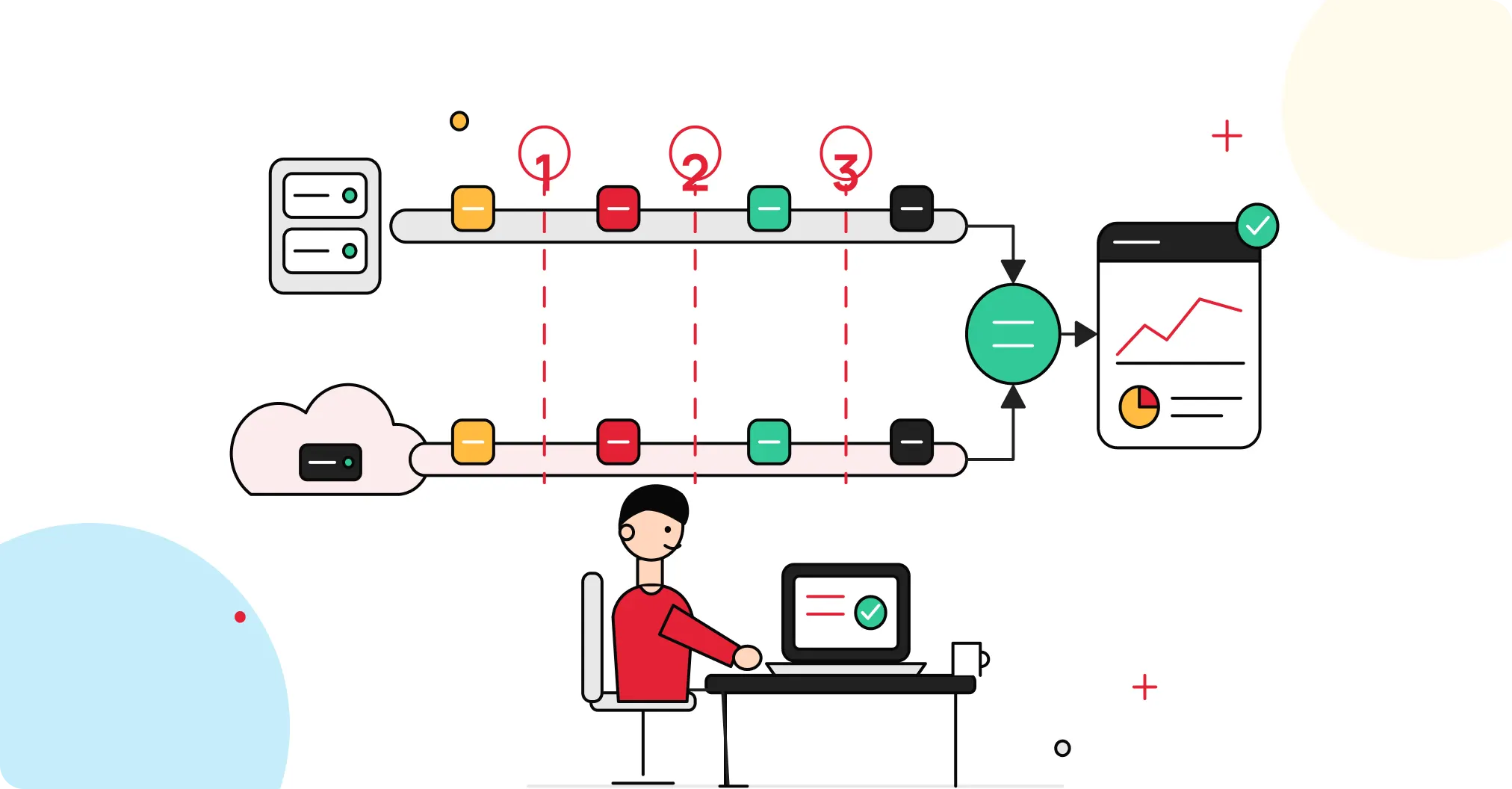
Data Flow Daigram

Technology Stack
| Category | Technology |
|---|---|
| Source Platform | Informatica PowerCenter 10.5 |
| Target Platform | Informatica IDMC |
| Assessment | Informatica Migration Factory assessment tool, PowerCenter repository metadata export |
| Integration | Cloud Data Integration (CDI) Mappings |
| Orchestration | IDMC Taskflows (from 210 PowerCenter workflows) |
| Runtime | Informatica Secure Agent hosts |
| Architecture | Inventory → Clean-Up → Complexity Groups → Effort Range → Risk Register → Business Case |
D E L I V E R Y
How one repository moves from 600 mappings to a decision-ready business case
Ksolves delivered a repeatable assessment that turns a PowerCenter repository into six outputs: scope, effort range, timeline, risk register, business case inputs, and a recommendation. In the sample, 600 mappings are inventoried, 150 unused ones are retired, and the remaining 450 are grouped by complexity and sized at 4,600 to 9,200 hours.
At 140 productive hours per person-month, that comes to 33 to 65 person-months, or roughly 6 to 11 months for a team of six. The risk register gives each hidden problem an owner and an action, covering custom code, scripts around workflows, external schedulers, business testing windows, skills, cloud running cost and the period of running two platforms. The plan then starts with a small pilot, which replaces the sample assumptions with measured values.
R E S U L T S
From a guess to a number leaders can take to a steering committee
Leaders no longer approve a migration on a single headline figure. They see the scope, an effort range with its assumptions, the risks with owners, and how the timeline fits against the support deadline. Ksolves replaced the single padded-or-wrong estimate with an assessment that shows where the work and the risk really sit. Leaders get a number they can take to a steering committee and a plan that starts with a pilot instead of a leap. The same method works for a repository of 100 mappings or 2,000.
- 600 → 450 Mappings to Migrate Retiring 150 unused or duplicate mappings cuts 25% of the scope before any work starts.
- 14% → 46% Complex Mappings Exposed Complex mappings are 14% of the count but 46% of the conversion effort, so they are visible before they can move the plan.
- 4,600–9,200 Hours Effort Range Low and high cases by complexity group, with every assumption written down.
- 6–11 Months Timeline for a Team of Six Calendar time is checked against the support dates, showing a bridge is needed past 31 March 2027.
- 3 Business Case Blocks Ready One-time cost, cost of staying and cost after the move, with payback run for three effort cases.
T E A M
Meet the Engineers on Your Project
Every engagement is staffed by senior engineers from our Informatica Migration and Integration team, who will assess your repository, size the move, and build your business case with you.


READY TO BUILD YOURS?
Know What Your PowerCenter Migration Will Cost, and When It Pays Back
Tell us how your PowerCenter repository looks today. The team that built this method will walk you through what an inventory, effort range, risk register, and business case could look like for your mappings, team and support deadline.
Other Success Stories