



AI in Healthcare: Benefits, Technologies, and Real World Impact
AI
5 MIN READ
September 1, 2026

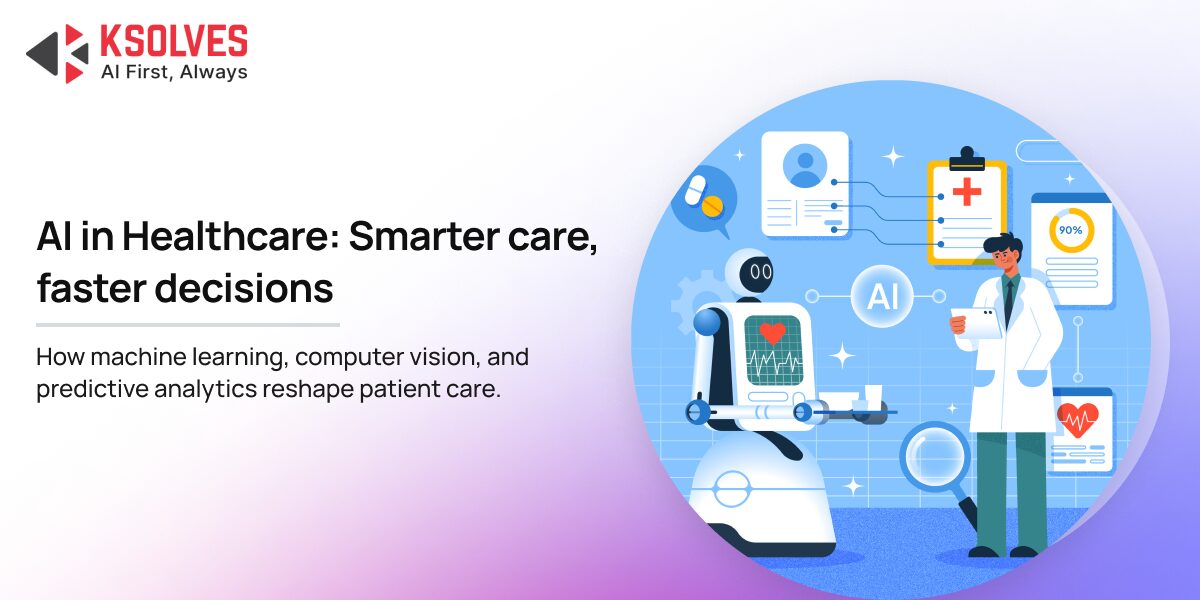
Healthcare systems worldwide are facing increasing pressure from data overload, rising operational costs, and clinician burnout. Doctors and medical staff spend a large portion of their time on documentation, billing, and administrative work instead of patient care. At the same time, the volume of healthcare data, including medical imaging, lab results, patient histories, and genomics, is growing rapidly.
To address these challenges, AI in healthcare has emerged as a critical enabler of future-ready healthcare systems. It helps organizations improve efficiency, enhance decision-making, and deliver better patient outcomes. Hence, this blog explores how AI is transforming healthcare through key benefits, real-world use cases, and long-term impact.
What Does AI in Healthcare Really Mean?
AI in healthcare refers to the use of intelligent algorithms and data-driven models to analyze medical data, recognize patterns, and support clinical and operational decision-making.
Key Technologies Involved
| Technology | What It Does |
|---|---|
| Machine Learning | Learns from historical data to improve predictions and outcomes |
| Natural Language Processing | Extracts insights from clinical notes, discharge summaries, and medical literature |
| Computer Vision | Interprets medical images such as X-rays, CT scans, and MRIs |
| Predictive Analytics | Forecasts disease risk, patient outcomes, and resource needs |
Unlike traditional healthcare IT systems that mainly store and retrieve data, AI and ML services actively analyze information and provide actionable insights in real time.
Key Benefits of AI in Healthcare
AI delivers tangible value to healthcare organizations by combining different technologies discussed above. Together, these technologies enable faster diagnosis, better care decisions, and more efficient operations.
3.1 Improved Diagnostic Accuracy and Early Detection
Computer Vision plays a crucial role in improving diagnostic accuracy. It interprets medical images such as X-rays, CT scans, and MRIs to detect abnormalities that may be difficult for the human eye to identify. Research also shows that AI systems significantly improve diagnostic precision over traditional methods. For instance, in a comprehensive multi-site study of chest X-ray interpretation, an AI model achieved up to 98% precision and 95%+ recall across multiple pathologies, offering reliable support for clinical decision-making.
At the same time, Machine Learning models learn from historical diagnostic data and previous patient outcomes. As more data is processed, these models continuously improve their accuracy, helping healthcare providers reduce misdiagnosis and support timely intervention.
3.2 Personalized and Predictive Patient Care
Machine Learning in healthcare enables personalized care by analyzing patient history, lab results, genetics, and lifestyle data. Based on these insights, treatment plans can be tailored to individual patients rather than relying on one-size-fits-all approaches.
Predictive Analytics further enhances this capability by forecasting disease progression and potential complications. Healthcare providers can anticipate health risks, adjust treatment plans proactively, and improve long-term patient outcomes.
3.3 Enhanced Clinical Decision Support
Natural Language Processing extracts valuable insights from unstructured data such as clinical notes, discharge summaries, prescriptions, and medical research. This allows AI systems to surface relevant patient information and evidence-based recommendations during clinical decision-making.
Combined with Machine Learning, these systems learn from previous decisions and outcomes to continuously refine their guidance. This helps clinicians make faster, more informed decisions while reducing cognitive load and documentation effort.
3.4 Operational Efficiency and Cost Reduction
AI in healthcare also supports hospital operations by forecasting patient inflow, staffing needs, and resource utilization. This enables better planning and reduces inefficiencies across departments. AI algorithms now detect diabetic retinopathy with 96.3% accuracy, outperforming traditional screening.
Meanwhile, Natural Language Processing automates administrative tasks such as medical coding, documentation, and claims processing. By reducing manual effort and errors, healthcare organizations can lower operational costs and allow staff to focus more on patient care.
3.5 Expanded Access Through Remote Care and Telehealth
AI-powered remote care solutions rely heavily on Machine Learning and Predictive Analytics to monitor patient data from wearable devices and connected health systems. These technologies detect early warning signs and alert providers before conditions escalate.
In addition, Natural Language Processing enables AI-driven virtual assistants and chatbots that support patients with symptom checks, appointment scheduling, and follow-up care. This expands access to healthcare services, especially for patients in remote or underserved areas.
Ready to Bring AI Into Your Healthcare Operations?
4. Ksolves: Shaping the Future of Healthcare With AI
At Ksolves, we help healthcare providers harness the power of AI in healthcare and advanced AI and ML services to turn complex data into actionable intelligence. Our solutions are designed to improve patient outcomes, enhance clinical decision-making, and streamline healthcare operations through applied artificial intelligence.
We work closely with healthcare organizations to build scalable AI systems that support predictive analytics, clinical intelligence, and data-driven care delivery. From model development to cloud deployment, our experts ensure every solution aligns with real-world healthcare needs.
Case Study Highlight: Turning Patient Data Into Predictive Care Intelligence
- Problem: The healthcare organization struggled to derive actionable insights from large volumes of patient data, limiting its ability to predict medical outcomes and support timely clinical decisions.
- Solution: Ksolves implemented an ML-powered predictive analytics solution on AWS Cloud, leveraging Python and TensorFlow to build machine learning models that structure data and enable real-time outcome predictions.
- Outcome: Clinicians gained accurate, data-driven insights to forecast patient outcomes, improve decision-making, and establish a scalable foundation for future AI-driven healthcare initiatives.
Ready to transform your healthcare operations with AI? Contact Ksolves today to explore how our AI and ML services can accelerate your journey toward smarter, data-driven patient care.
Long-Term Impact of AI on the Healthcare Ecosystem
AI will extend healthcare capacity to meet rising demands. Systems that use AI for continuous learning will improve in accuracy and adaptability over time, effectively transforming disease prediction, preventive care, and personalized medicine. Integration of wearable data and genomics promises a future where healthcare is proactive, not reactive.
Conclusion
AI is redefining how healthcare organizations deliver care, manage operations, and improve outcomes. From early diagnosis and predictive care to clinical decision support and operational efficiency, AI in healthcare is enabling smarter and more proactive services. As adoption grows, success will depend on responsible implementation, strong data foundations, and trusted AI and ML services. Organizations that invest in AI today will be better prepared to deliver scalable, patient-centric, and future-ready healthcare solutions.
Frequently Asked Questions
1. What is AI in healthcare?
AI in healthcare refers to the use of technologies such as Machine Learning, Natural Language Processing, Computer Vision, and predictive analytics to analyze medical data, support clinical decisions, and improve patient care outcomes.
2. How does AI improve patient outcomes in healthcare?
AI improves patient outcomes by enabling early disease detection, personalized treatment planning, predictive risk assessment, and faster clinical decision-making based on data-driven insights.
3. Is AI in healthcare safe and compliant with regulations?
Yes, when implemented correctly. AI solutions must follow strict data privacy, security, and regulatory standards. Ethical AI practices and secure cloud infrastructure play a critical role in ensuring compliance and patient trust.
4. What are the most common use cases of AI in healthcare?
Common AI healthcare use cases include medical imaging analysis, disease prediction, drug discovery, hospital workflow automation, and AI-powered patient engagement solutions.
5. How can healthcare organizations get started with AI adoption?
Healthcare organizations can start by identifying high-impact use cases, building strong data foundations, and partnering with experienced providers offering AI and ML services to ensure scalable and responsible implementation.































Author
About the Author Editorial Team The Ksolves Editorial Team includes certified Salesforce experts, Big Data engineers, AI/ML specialists, Zoho consultants, and experienced technology writers focused on delivering clear, actionable insights for modern businesses. With hands-on experience across Salesforce, Big Data platforms, AI/ML solutions, application development, software testing, and Zoho ERP/CRM, the team publishes practical guides, real-world use cases, and industry updates that support smarter decisions and faster growth. Every article is created to solve business challenges, guide technology adoption, and keep organizations aligned with evolving digital ecosystems.
Share with