



Hive to Apache Hudi Migration: A Complete Guide to Incremental Processing at Scale
Apache Hudi
5 MIN READ
September 9, 2026

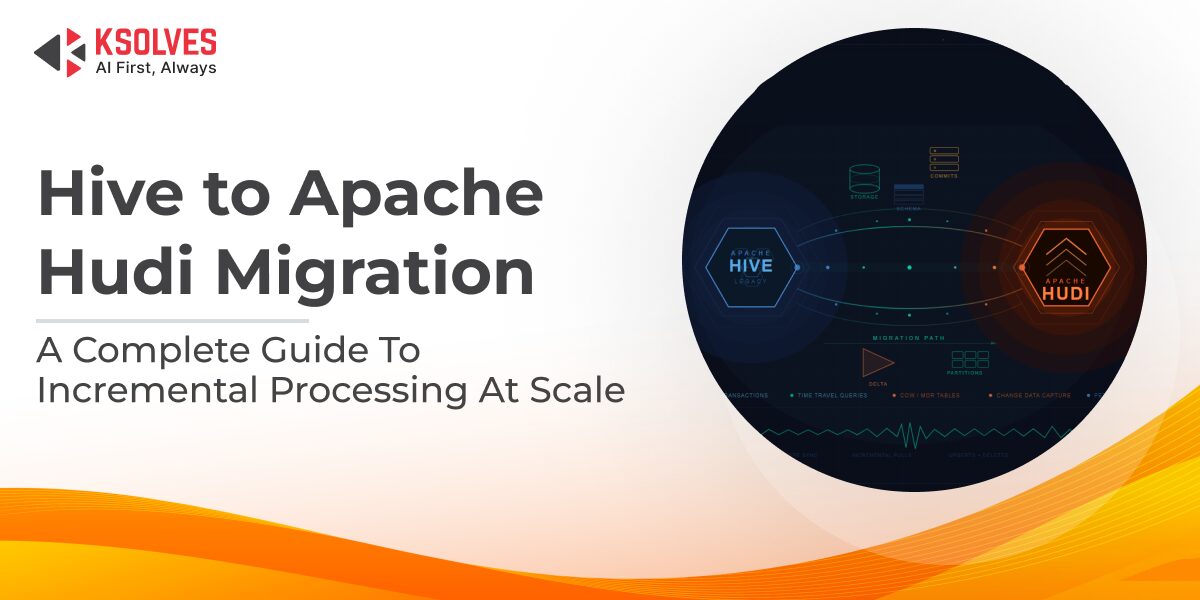
Apache Hudi has emerged as one of the most effective data lake tools for enterprises that need to move beyond the limitations of static, batch-only architectures. Apache Hive has served as the foundation of enterprise data lakes for well over a decade, delivering reliable SQL-based querying on top of HDFS. However, Hive was designed for batch analytics on immutable datasets, and that design assumption becomes a real constraint the moment your business requires data freshness measured in minutes rather than hours.
When engineers need to process updates, deletions, or late-arriving records in a Hive-based lake, they often resort to full partition rewrites, which consume significant compute resources and introduce unacceptable pipeline latency. Apache Hudi solves this problem directly, transforming a static data lake migration target into a transactional, low-latency platform that supports both batch and near-real-time analytical workloads simultaneously.
Why Hive Alone Falls Short for Modern Data Engineering
Hive performs well for scheduled batch workloads where the underlying data does not change between queries. The challenge arises as soon as engineers need to handle change data capture streams, GDPR deletion requests, or late-arriving records from upstream systems.
A standard Hive workflow for handling updates involves reading an entire partition, merging the changed records in memory or via a temporary table, and rewriting the full partition back to HDFS. On a table with hundreds of gigabytes per partition, this process is slow, resource-intensive, and introduces a significant window of inconsistency between the old and new data states.
Hive and Hadoop-based architectures (see end-to-end data management with Apache Hadoop) were built around the assumption that writes are infrequent and reads dominate. The rise of streaming ingestion via Apache Kafka, real-time CDC pipelines, and machine learning feature stores has fundamentally shifted that assumption. Modern data engineering teams need a storage layer that supports both high-frequency writes and analytical read performance, without forcing a choice between them.
What Is Apache Hudi and How Does It Work
Understanding what is Apache Hudi starts with its full name: Hadoop Upserts Deletes and Incrementals. Apache Hudi is an open-source data lake tools framework originally developed at Uber and contributed to the Apache Software Foundation. It adds a transactional layer on top of distributed storage systems including HDFS, Amazon S3, Azure ADLS, and Google Cloud Storage, enabling record-level insert, update, and delete operations on large datasets while maintaining full compatibility with query engines including Apache Spark, Hive, Presto, Trino, and Amazon Athena.
The core mechanism that makes Apache Hudi different from a standard Hive Metastore-backed table is its timeline. Every write operation in a Hudi table is recorded in an ordered timeline of commits. This timeline enables incremental queries: instead of scanning an entire table to find changed records, downstream consumers can query only the records that changed since a specific commit timestamp.
Apache Hudi Table Types: COW vs MOR
Selecting the correct table type is one of the most consequential decisions in a data lake migration. Apache Hudi offers two primary table types, and choosing between them depends on the read and write patterns of each specific dataset.
Copy-On-Write (COW) Tables
Copy-On-Write (COW) tables rewrite the underlying Parquet base files on every write operation. This means reads are always fast because there are no merge operations at query time. The key trade-off is write amplification: COW rewrites the entire affected file even when only a small percentage of records change, so write cost scales with file size rather than change volume. COW tables are well-suited for datasets queried frequently where updates per batch represent a relatively small share of the total dataset, such as dimension tables or append-heavy analytical datasets.
Merge-On-Read (MOR) Tables
Merge-On-Read (MOR) tables store incoming writes in row-based Avro delta log files by default (configurable to Parquet or HFile format) alongside existing columnar Parquet base files. Reads require a merge between the base files and the delta logs at query time, which adds some overhead. However, writes are significantly faster because Hudi does not rewrite large Parquet files on every update.
MOR tables are the right choice for high-frequency streaming ingestion scenarios, particularly when powered by Apache Kafka or Apache Spark Structured Streaming. Compaction, which merges Avro delta log files back into Parquet base files, runs as a scheduled background operation and can be configured inline or asynchronously.
For most enterprise migrations from Hive, a mixed approach works well: COW for dimension tables and slow-changing analytical datasets, MOR for event tables, CDC targets, and near-real-time feeds. Understanding Apache Spark with Hadoop and HBase integration is essential when configuring Spark-based Hudi writers for either table type.
Planning the Migration: Key Steps
A successful data lake migration from Hive to Apache Hudi requires careful planning across five structured steps.
Step 1: Audit Existing Hive Tables
Before writing a single line of migration code, catalog every Hive table in scope. Classify each table by update pattern (append-only, periodic overwrites, CDC-driven), partition strategy, data volume, and downstream consumer dependencies. Tables that are truly append-only may not benefit significantly from Hudi and can remain in Hive format. Focus migration effort on tables that require upsert support or incremental query capabilities.
Step 2: Define the Record Key and Precombine Field
Every Apache Hudi table requires a record key that uniquely identifies each row globally across the table, and a precombine field that Hudi uses to resolve duplicate records during ingestion. For a customer transactions table, the record key might be a transaction ID and the precombine field might be a last-updated timestamp.
Step 3: Bootstrap Existing Hive Data into Hudi
Hudi provides a bootstrapping mechanism that links existing Parquet files in HDFS to a new Hudi table without physically copying the data. Two bootstrap modes are available: METADATA_ONLY, which generates skeleton base files with keys and footers, and FULL_RECORD, which performs a complete rewrite of the data. After bootstrapping, incremental writes proceed normally using the Hudi HoodieStreamer (formerly DeltaStreamer, renamed in Hudi 1.x) or Spark DataSource API. Partition metadata in the Hive Metastore is updated automatically by Hudi’s sync utilities, preserving compatibility with existing Hive queries during the transition.
Step 4: Configure the Hive Metastore Sync
Hudi writes table and partition metadata back to the Hive Metastore automatically when hoodie.datasource.hive_sync.enabled is set to true. Note: In Hudi 1.x the correct property name is hoodie.datasource.hive_sync.enabled (with trailing “d”). The HoodieStreamer --enable-hive-sync flag is the recommended approach for new deployments. For MOR tables, Hudi creates two representations in the Hive Metastore: a read-optimised table backed by base Parquet files only, and a real-time table suffixed with _rt that merges Avro delta logs at query time. Teams should verify that downstream consumers are pointed at the correct representation for their latency requirements.
Step 5: Validate Data Integrity Post-Migration
Run a parallel validation phase where both the Hive source table and the migrated Apache Hudi table are queried with identical filters. Compare record counts, key distributions, and aggregate metrics across multiple partition ranges. Automate this validation as a pipeline step so it runs continuously during the cutover window. Do not decommission the original Hive table until validation passes consistently for at least two full business cycle periods.
Planning a Hive to Apache Hudi Migration?
Performance Considerations at Scale
Apache Hudi delivers significant performance improvements over Hive-based approaches for update-heavy workloads, but realising those improvements in production requires careful tuning.
Compaction scheduling is the most operationally significant consideration for MOR tables. If compaction does not run frequently enough, Avro delta log files accumulate and query-time merge costs increase. Most production deployments run compaction as an asynchronous Spark job on a schedule calibrated to write frequency: every few hours for high-volume CDC tables, daily for moderate update patterns.
File size management also matters substantially. The default target file size in Apache Hudi is 128MB per Parquet file (hoodie.parquet.max.file.size default value), confirmed by the official Hudi documentation. Hudi’s automatic small-file handling merges smaller files up to the configured target, but this process requires available cluster resources during write operations.
| Query Engine | Recommended Target File Size |
|---|---|
| Spark / Presto | 128MB – 256MB |
| Trino / Athena (larger clusters) | 512MB – 1GB |
Partition design decisions made in Hive carry over to Apache Hudi and cannot be changed without a full table migration. Teams should take the opportunity during migration to evaluate whether existing Hive partition columns remain the right choice, including reviewing how to maintain scalability with Hadoop support as part of the overall architecture review.
Apache Hudi vs Iceberg: Choosing the Right Format
A question that frequently arises during data lake migration planning is the Hudi vs. Iceberg choice. Both are open-source data lakehouse formats with ACID transaction support and compatibility with Spark, Flink, and Presto.
| Format | Best Suited For |
|---|---|
| Apache Hudi | High-frequency upserts and CDC ingestion; record-level indexing and MOR table type purpose-built for this pattern |
| Apache Iceberg | Query-heavy analytical workloads with less frequent updates; superior partition evolution and broader engine neutrality |
For teams already deep in the Hadoop ecosystem with active CDC pipelines, Apache Hudi is typically the lower-friction migration path from Hive.
Get Expert Help With Your Apache Hudi Migration
How Ksolves Supports Hive to Apache Hudi Migrations
Ksolves brings over 12 years of production experience across scalable Hadoop and big data architectures to every Apache Hudi engagement. Our data engineering team has executed data lake migration projects across financial services, healthcare, and telecom clients, covering both greenfield implementations and complex migrations from existing Hive-based data lakes.
Our migration methodology includes a structured table audit and classification phase, record key and precombine field validation, bootstrapping strategy using both METADATA_ONLY and FULL_RECORD modes, Hive Metastore sync configuration, and a parallel validation framework that runs automatically during the cutover window. We also implement compaction scheduling, file size tuning calibrated to your specific query engine, and cluster resource configuration aligned to write frequency and query patterns.
Using AI-assisted code review and intelligent workflow automation, the Ksolves team accelerates Hudi migration timelines while maintaining the architectural precision that production data platforms require. Every engagement concludes with full knowledge transfer so your internal team can manage, tune, and extend the Apache Hudi platform independently.
Whether you are running Spark-based pipelines on HDFS, migrating to cloud object storage on AWS, Azure, or Google Cloud, or evaluating the right table type strategy for a high-frequency CDC workload, Ksolves provides the expertise to execute the migration correctly the first time. Contact the Ksolves big data team to start your Apache Hudi migration assessment.
Conclusion
Migrating from Apache Hive to Apache Hudi is one of the highest-impact modernisation investments a data engineering team can make. It replaces a batch-only, partition-rewrite model with a transactional, incremental data processing architecture that supports near-real-time upserts, efficient CDC ingestion, and dramatically lower compute costs for update-heavy workloads.
The migration requires careful planning: globally unique record key design, appropriate table type selection, bootstrapping using Hudi HoodieStreamer or the Spark DataSource API, correct Hive Metastore sync configuration using hoodie.datasource.hive_sync.enabled, and thorough parallel validation before cutover.
Ksolves has the production expertise, the structured methodology, and the AI-accelerated delivery model to help your organisation realise these outcomes reliably and on schedule. Reach out to the Ksolves big data team to begin your migration assessment.
Frequently Asked Questions
Q1. What is Apache Hudi and how is it different from Apache Hive?
Apache Hudi is an open-source data lake tools framework that adds transactional capabilities including record-level upserts and deletes to distributed storage systems. Apache Hive is a query engine designed for batch analytics on immutable datasets. Hudi adds the ability to process incremental changes efficiently, which Hive cannot do natively without full partition rewrites.
Q2. What are the two Apache Hudi table types?
Apache Hudi offers Copy-On-Write (COW) and Merge-On-Read (MOR) tables. COW rewrites Parquet base files on every write with high write amplification but delivers fast reads. MOR stores row-based Avro delta log files by default alongside Parquet base files for faster ingestion, merging them at query time or during compaction.
Q3. Do Hudi tables work with the existing Hive Metastore?
Yes. Hudi’s Hive Metastore sync utilities automatically register Hudi table partitions, allowing existing Hive queries, Spark SQL, and connected BI tools to read Hudi tables without modification. For MOR tables, Hudi registers both a read-optimised view and a real-time view (_rt suffix).
Q4. How long does a Hive to Apache Hudi migration take?
A focused data lake migration typically runs 6 to 12 weeks depending on the number of tables, data volumes, and downstream consumer dependencies. The METADATA_ONLY bootstrapping approach avoids full data rewrites and significantly reduces migration time.
Q5. What is the difference between HoodieStreamer and DeltaStreamer?
HoodieStreamer is the current name of the Hudi streaming ingestion utility, introduced in Hudi 1.x. DeltaStreamer is the legacy name from versions prior to 1.x. The original classes remain in the deprecated package for backward compatibility. For all new implementations, use HoodieStreamer.
Q6. Can Ksolves help with Apache Hudi migration on cloud platforms?
Yes. Ksolves supports Apache Hudi migrations on AWS EMR with S3, Azure HDInsight or Databricks with ADLS, and Google Cloud Dataproc with GCS, with platform-specific configuration tuning applied for each target environment.

 Anil Kushwaha
You add 50 servers to your Apache HBase cluster expecting it to run faster. Instead, everything slows down. You open […]






























Author
About the Author Editorial Team The Ksolves Editorial Team includes certified Salesforce experts, Big Data engineers, AI/ML specialists, Zoho consultants, and experienced technology writers focused on delivering clear, actionable insights for modern businesses. With hands-on experience across Salesforce, Big Data platforms, AI/ML solutions, application development, software testing, and Zoho ERP/CRM, the team publishes practical guides, real-world use cases, and industry updates that support smarter decisions and faster growth. Every article is created to solve business challenges, guide technology adoption, and keep organizations aligned with evolving digital ecosystems.
Share with