


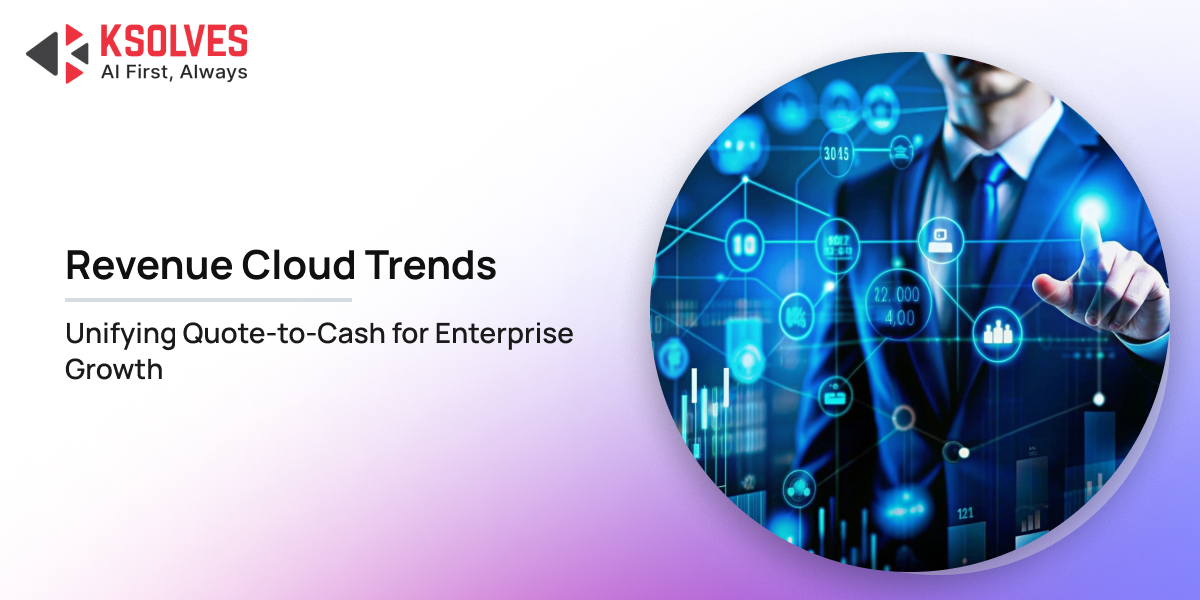
Revenue Cloud Trends: Unifying Quote-to-Cash for Enterprise Growth
Salesforce
5 MIN READ
October 22, 2026

How long does it take your sales team to move a complex quote from an initial prospect conversation to an executed contract? If your answer is measured in days, or worse, weeks, you are not alone.
In a major strategic pivot for modern enterprise sales tech, Salesforce officially retired new sales of legacy Salesforce CPQ in March 2025, redirecting all new implementations directly to their unified quote-to-cash engine, Salesforce Revenue Cloud.
Over 60% of B2B companies lose revenue due to disconnected quoting tools, manual pricing approvals, and fragmented billing systems. While sales teams push hard to close deals, finance teams struggle to reconcile complex revenue recognition rules. The gap between closing a sale and recognizing revenue is where margin quietly slips away.
To address this friction, modern enterprises are migrating away from standalone CPQ modules toward complete revenue operations platforms. Understanding this transition requires understanding top revenue cloud trends, how unified quote-to-cash frameworks function, and how to choose the right strategy for your business.
Unifying Sales, Billing, and ERP: The End of Siloed Quoting
Historically, B2B organizations operated in distinct departmental silos:
- Sales worked in the CRM to manage leads and opportunities.
- Operations managed product catalogs and discounting rules in standalone CPQ tools.
- Finance lived inside ERP systems to generate invoices and track revenue.
This architecture creates significant operational bottlenecks. When a deal closes, rep-keyed data introduces pricing errors, delayed invoices, and inaccurate revenue recognition.
The current trend prioritizes unified architecture. Rather than stitching together separate software packages with custom middleware, companies are shifting toward a single model where quoting, contract management, billing, and revenue recognition exist on one platform.
Executing a successful Salesforce revenue cloud implementation allows teams to unify these functions directly within core CRM workflows, protecting margins from day one.
Enterprise Use Case: Streamlining Multi-Product Subscriptions
Consider a growing software-as-a-service (SaaS) provider offering tiered subscriptions, usage-based consumption API fees, and professional implementation services.
Under a legacy system, sales reps build three distinct proposals across different spreadsheets or isolated software instances. Billing must manually calculate usage metrics at the end of each month, leading to billing disputes and high customer churn.
By moving to a unified framework via tailored Salesforce revenue cloud solutions, the rep creates a single quote containing fixed subscriptions, variable consumption metrics, and professional services.
Once signed, the platform automatically generates recurring billing schedules, triggers milestone-based invoices for professional services, and routes usage data into finance, without manual intervention.
Dynamic Pricing Strategies and AI-Driven Monetization Models
B2B buying behaviors have changed rapidly. Buyers expect flexible purchasing options, including usage-based pricing, seat-based subscriptions, auto-renewals, and hybrid pay-as-you-go models. Managing these models manually creates operational friction.
Modern enterprise revenue strategies rely heavily on artificial intelligence and predictive analytics to automate pricing governance:
- Real-Time Discount Guardrails: AI evaluates historical win rates, customer lifetime value, and deal size to recommend optimal discount thresholds directly inside the quoting interface.
- Automated Consumption Tracking: Usage data feeds continuously from product platforms into the billing engine, automatically invoicing customers as consumption thresholds are met.
- Intelligent Churn Prevention: Predictive algorithms analyze usage drops during contract lifecycles, alerting account teams to intervene before an auto-renewal fails.
To roll out these monetization strategies efficiently, enterprise companies collaborate with an experienced Salesforce revenue cloud partner to configure complex pricing rules, dynamic product catalogs, and automated approval matrices tailored to their specific market.
Key Revenue Operations Trends Transforming Enterprise Quoting
Companies optimizing their quote-to-cash pipeline should track four distinct operational shifts:
Shifting from Standalone CPQ to Unified Revenue Architecture
Standalone CPQ software solves initial quoting complexity, but it rarely solves billing or revenue recognition issues downstream. Organizations are upgrading to comprehensive revenue platforms that bridge the gap between sales reps and accounting teams.
Automating Contract Lifecycles and Renewal Workflows
Manually tracking subscription expiration dates leads to missed revenue. Modern architectures automate the creation of renewal opportunities before expiration, pre-populating current pricing, index-adjusted increases, and usage history.
Streamlining Revenue Recognition for ASC 606 and IFRS 15 Compliance
Complying with accounting standards like ASC 606 and IFRS 15 requires precise tracking of performance obligations. Modern revenue engines automatically map billing events to revenue schedules, eliminating spreadsheets and simplifying audit preparation.
Extending Quote-to-Cash Capabilities to Self-Service Portals
B2B buyers increasingly expect consumer-grade digital purchasing options. Extending quote-to-cash capabilities directly to customer portals allows clients to reorder products, modify subscription tiers, and pay invoices independently.
Comparing Enterprise Revenue Operations Models
Choosing the right path to modernize your lead-to-revenue stack depends on your organization’s technical maturity, business complexity, and existing software investments.
|
Dimension |
Legacy Siloed Systems | Custom Middleware & Standalone CPQ | Unified Revenue Cloud Architecture |
| Data Flow | Manual re-keying between CRM, CPQ, and ERP | Batch API syncs between disparate systems |
Single platform data model across quote-to-cash |
|
Quote Turnaround |
Slow (Days to weeks due to manual approvals) | Moderate (Faster quotes, slow billing handoff) | Rapid (Real-time approvals and automated billing) |
| Monetization Support | Simple flat-rate or simple seat pricing | Basic subscription support |
Multi-tier, usage-based, and hybrid models |
|
Maintenance Burden |
High administrative overhead | High developer cost to maintain custom code | Low code / native configuration updates |
| Audit & Compliance | High risk of manual accounting errors | Moderate risk during data translation |
Native compliance automation (ASC 606/IFRS 15) |
Strategic Implementation Blueprint for Revenue Cloud Success
Deploying an enterprise-grade revenue architecture is a strategic transformation, not just an IT upgrade. Organizations that succeed follow a structured, multi-phase execution strategy.
-
Process Assessment and Bottleneck Mapping
Before configuring software, map your existing lead-to-revenue workflow end-to-end. Identify:
- Where do quotes get stuck waiting for managerial approvals?
- How often do billing discrepancies require credit memos or invoice revisions?
- Which custom integrations frequently break during system updates?
-
Choosing Specialized Implementation Leadership
Because revenue processes directly impact financial records, execution precision is non-negotiable. Many organizations engage dedicated Salesforce revenue cloud implementation services to evaluate system dependencies, design robust data models, and prevent revenue leakage during migration.
A qualified or certified revenue cloud implementation partner brings pre-built industry templates and proven data-migration frameworks that reduce deployment risk and accelerate time-to-value.
-
Architectural System Integration and ERP Connection
Modernizing revenue processes requires connecting your core CRM with backend finance engines:
- Catalog Alignment: Rationalize duplicate SKUs and complex discount structures.
- Rule Engine Configuration: Build dynamic pricing and discount validation logic.
- ERP Integration: Establish bi-directional data synchronization between the revenue engine and financial systems (such as SAP, NetSuite, or Workday).
Working closely with specialized Salesforce revenue cloud consulting experts helps ensure your system architecture supports scalable growth without creating technical debt.
4. Change Management and User Enablement Protocols
A revenue system is only as effective as user adoption rates. Focus on:
- Sales Rep Experience: Simplify the quoting user interface so reps can generate error-free quotes quickly.
- Cross-Functional Training: Train sales, deal desk, legal, and billing teams on shared workflows to ensure smooth operational handoffs.
- Continuous Optimization: Leverage analytics post-deployment to refine pricing rules, streamline approvals, and eliminate newly identified operational friction.
Key Metrics for Decision-Makers Measuring Revenue Cloud ROI
Investing in an enterprise revenue transformation requires clear financial justification. Decision-makers should evaluate returns across four key operational areas:
- Quote-to-Order Speed: Tracking the reduction in sales cycle duration from initial quote generation to signed agreement.
- Margin Protection: Quantifying the reduction in unauthorized discounting through automated approval thresholds.
- Billing Accuracy: Measuring the decrease in invoice error rates, customer billing inquiries, and manual credit adjustments.
- Days Sales Outstanding (DSO): Accelerating cash collection by automating immediate, accurate invoice generation upon product or service delivery.
Leveraging specialized Salesforce revenue cloud development service teams enables businesses to configure custom analytics dashboards, giving executives real-time visibility into pipeline velocity, renewal health, and revenue realization.
Modernizing Your Revenue Operations Foundation
As business models shift toward recurring, usage-based, and multi-tier offerings, relying on legacy quoting spreadsheets and fragmented billing tools introduces unsustainable operational risk.
Modern enterprise growth requires aligning sales, deal desk, operations, and finance teams under a unified revenue engine.
Organizations that invest in comprehensive Salesforce implementation services build an agile, scalable foundation designed to protect profit margins, accelerate deal velocity, and adapt quickly to shifting market demands.
By engaging trusted Salesforce revenue cloud services and strategic implementation experts, decision-makers can turn complex, error-prone quote-to-cash workflows into a streamlined driver of predictable, long-term growth.
Ready to eliminate revenue leakage and accelerate your quote-to-cash pipeline? Partner with Ksolves, a certified Salesforce implementation partner specializing in end-to-end Revenue Cloud transformations. Contact us to schedule your dedicated revenue architecture assessment and discover how our certified experts can help streamline your operations.
Frequently Asked Questions
What is Salesforce Revenue Cloud, and how does it differ from traditional CPQ?
Salesforce Revenue Cloud brings together CPQ (Configure, Price, Quote), Billing, Subscription Management, and Partner Relationship Management into a single native platform. Unlike standalone CPQ, which focuses only on generating quotes, Revenue Cloud manages the complete lifecycle from initial buyer engagement all the way through billing, invoicing, and revenue recognition compliant with ASC 606 standards.
Why is Salesforce moving away from legacy CPQ to Revenue Cloud?
Legacy CPQ systems often operate in silos, requiring custom integrations with billing software and ERP engines. Salesforce retired new sales of legacy CPQ in March 2025 to offer an end-to-end, unified quote-to-cash solution natively built into the platform. Revenue Cloud reduces integration friction, natively supports complex recurring or usage-based monetization models, and automates downstream revenue operations.
How long does a Salesforce Revenue Cloud implementation typically take?
Implementation timelines vary based on catalog complexity, pricing models, and ERP integration requirements. A standard Enterprise deployment usually ranges from 12 to 24 weeks. Working with an experienced certified partner like Ksolves accelerates time-to-market through pre-built templates, automated migration frameworks, and structured phase deployments.
Can Salesforce Revenue Cloud integrate with backend ERP systems like SAP or NetSuite?
Yes. Revenue Cloud features robust, bi-directional API architecture designed to seamlessly integrate with enterprise ERP systems such as NetSuite, SAP, Oracle, and Workday. This ensures synchronized product catalogs, real-time inventory checks, and automated billing handoffs without manual re-keying of data.
How does Salesforce Revenue Cloud support usage-based and subscription pricing models?
Revenue Cloud includes native engine support for multi-attribute pricing, tiered subscriptions, consumption-based rating, and hybrid monetization models. It automates consumption tracking, aggregates API or service usage data, and applies automated billing schedules so reps can combine fixed, recurring, and usage services into a single unified quote.




























AUTHOR
Salesforce
Rakesh Kumar is a Salesforce Practice Lead and Application Architect at Ksolves India Limited, with over 11 years of experience in Salesforce development and enterprise solution architecture. He specializes in Salesforce Financial Services Cloud, Consumer Goods Cloud, Sales Cloud, Service Cloud, Commerce Cloud, Revenue Cloud, Data Cloud, and Agentforce. His expertise includes designing multi-cloud CRM solutions, integrating enterprise systems, developing reusable Salesforce accelerators, and implementing AI-driven workflows. A 12-time Salesforce-certified professional, Rakesh focuses on enterprise architecture, secure AI agent deployment, and transforming complex business processes into scalable, production-ready Salesforce solutions.
Share with