Project Name
Ksolves Simplifies Network Maintenance with CI/CD Automation Using Jenkins


The client is one of the leading broadband providers in the American region and leverages the concept of network maintenance, which plays a key role in helping cable operators identify any impairments in their cable plants. This technology is revolutionary in the industry and has proved to be a cost-effective solution in terms of overall maintenance without compromising the subscriber’s quality of experience.
- In the context of the client, many processes in the application deployment lifecycle required manual efforts - from packing and building the artifacts to deploying them manually across the staging and production estates.
- We helped the client identify key areas of DevOps practices, including a continuous deployment life cycle with scope for automation, which would cut down tremendous manual efforts.
- Following this discussion, the client wanted us to develop a one-stop solution for streamlining their entire software development/deployment lifecycle using automation.
- They were typically looking for an automated approach for - packaging, integrating, and containerizing their application along with a powerful container orchestration solution - that would help achieve better flexibility in terms of autoscaling, auto-healing in the event of failures, zero or very low downtimes - all this along with reasonable cost-effectiveness.
We proposed the use of the following open-source technologies:
- Gitlab: as a tool to manage the source code for the development and DevOps teams.
-
Jenkins: To create and automate builds. The build pipeline helped them achieve the following in an automated fashion.
- Compile the source code.
- Package the application using tools like Maven/Gradle and create artifacts.
- Deploy these build artifacts (images) to the client’s private docker registry.
- Docker: Running the application as an isolated container on any operating system specified by the client.
- Ansible: Automate the application deployment process.
- Source code Repository: Developers work on code and store it in a version control system, i.e., Gitlab.
- Build triggers: Whenever a developer commits code to the repository, Jenkins triggers the build process via a range of options like - Webhooks, SCM polling, scheduled builds, build post other builds, etc, that the client chooses, thus providing more flexibility that caters to the actual use case of the client.
- Build process: Jenkins fetches the latest code from the repository and compiles/builds it into an executable artifact. We also have an integrated plugin for Sonarqube that automates the code analysis.
- Automated Tests: Jenkins runs automated tests (unit tests, integration tests, etc.) on the built artifact to ensure it meets quality standards.
- Reporting: Test results and other metrics are generated and made available by QA teams for developers to review.
- Staging Environment: After the code passes all tests, it is deployed to a staging environment that closely resembles the production environment.
- Additional Tests: In the staging environment, the QA team performs additional tests, such as sanity testing, unit testing, performance testing, and user acceptance testing.
- Manual Review: For a critical application, in some areas, manual approval is required to ensure essential changes are thoroughly reviewed before deployment to production.
- Production Deployment: The code will be deployed to the production environment once approved.
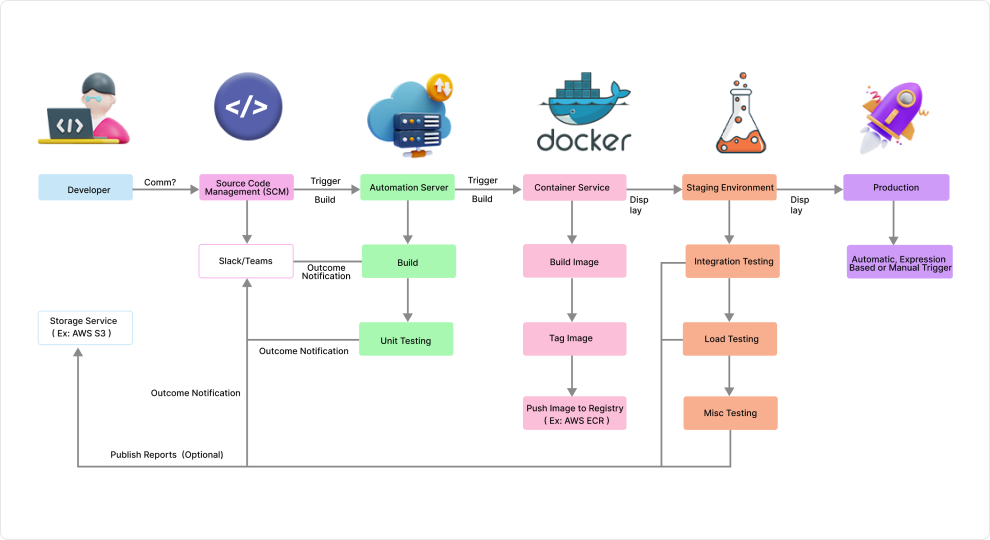
Thus, we have leveraged a cutting-edge DevOps tool like Jenkins to automate the builds for the client via a pipeline architecture and helped extensively cut down on manual efforts. This CI/CD automation implementation also ensures significantly less or zero downtime deployment, which is crucial for the client’s use case as the application requires high availability. This automation pipeline is usually a one-time activity that continues to run the way it’s defined until we make any customizations.
Get Zero Downtime Deployment and Reduced Manual Effort with Jenkins!