Project Name
Kubernetes Cluster Setup From Hours to Under 10 Minutes With Kubeadm Automation

The internal DevOps and infrastructure management division of a mid-sized global technology services company based in India, supporting cloud-native delivery across multiple client engagements. The team manages container orchestration environments for development, staging, and production workloads across diverse industries.
With a growing portfolio of Kubernetes-dependent projects, the division needed to eliminate provisioning bottlenecks that were consuming engineering hours and introducing environment inconsistencies across every engagement.
The goal was a repeatable, self-service cluster provisioning capability that any engineer could execute without deep Kubernetes expertise, and that produced the same result every time.
Half a day of manual setup per cluster, across multiple simultaneous engagements, with no guarantee that any two clusters were configured the same way.
- Time-Consuming Manual Provisioning: Setting up a Kubernetes cluster from scratch using kubeadm required engineers to execute 30-plus sequential steps manually across control plane and worker nodes, consuming 2 to 4 hours per cluster before a single line of client workload could be deployed.
- Inconsistent Environments Across Projects: Each engineer followed slightly different steps or skipped optional hardening configurations, resulting in clusters with different CNI plugins, different RBAC settings, and different runtime versions, making cross-project support and troubleshooting significantly harder than it needed to be.
- No Support for Mixed Network Topologies: Some environments used public IPs for node communication, while others required private networking. The manual process had no standardised way to handle both, leading to ad-hoc workarounds and frequent networking failures discovered only after setup was completed.
- Single-Node and Multi-Node Divergence: Development and PoC environments needed single-node clusters, while staging and production required multi-node setups. Engineers maintained two completely separate runbooks for what should have been a single parameterised workflow.
- Error-Prone Pre-flight Validation: Critical pre-requisites, such as swap disabled, required ports open, and container runtime installed, were frequently overlooked during manual setup, causing cluster initialisation failures that took additional hours to diagnose and resolve.
- No Reusable Provisioning Asset: Every new project required starting cluster setup from scratch. There was no internal accelerator, template, or automation script that could be reused across engagements, resulting in duplicated effort across the entire team on every kickoff.
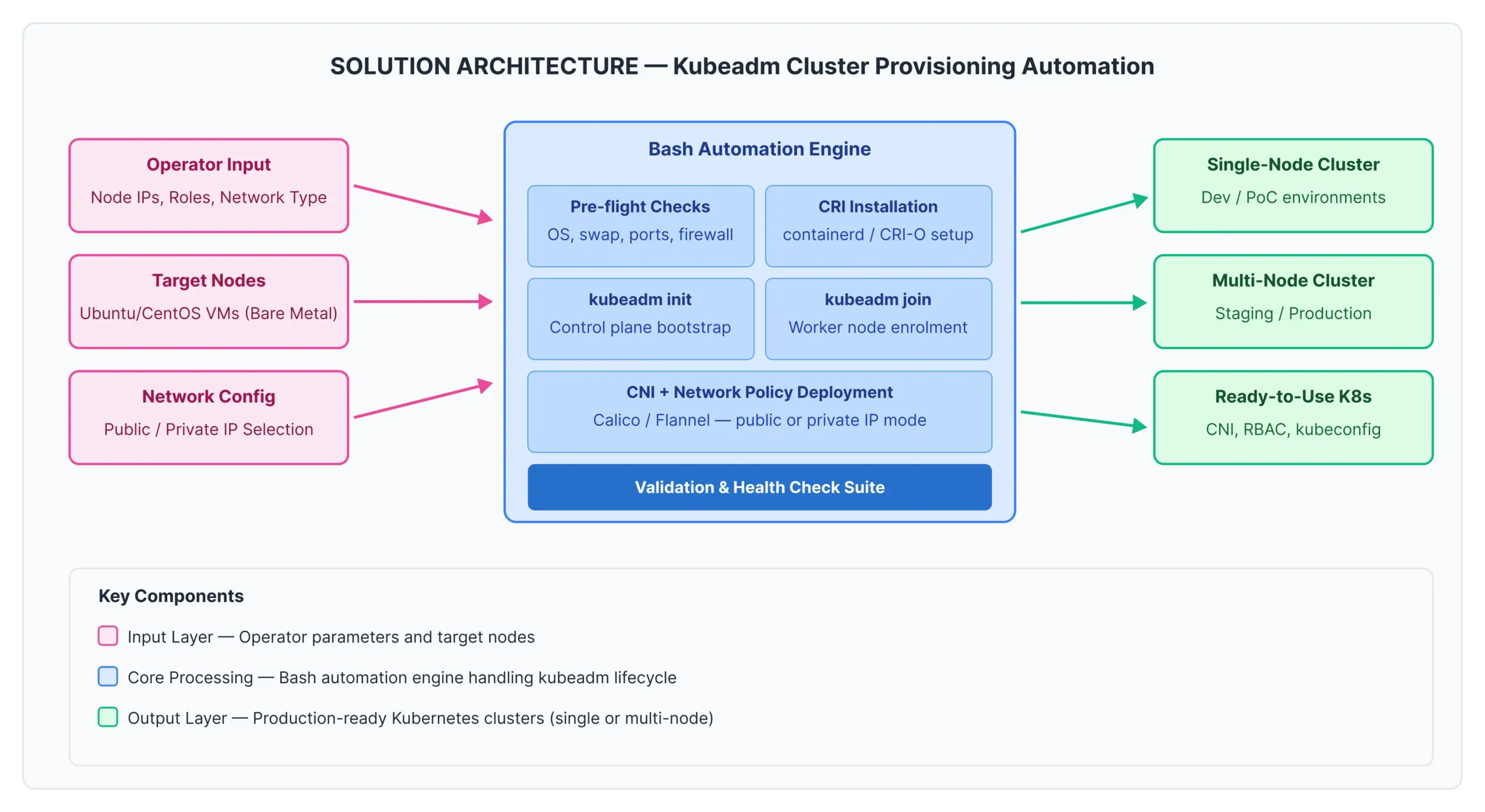
Ksolves, an AI-first DevOps consulting company, built a fully automated Bash-based provisioning engine that abstracts the entire kubeadm lifecycle, from pre-flight checks through CNI deployment and post-setup validation, into a single parameterised execution. The governing principle was one command, one outcome: every cluster provisioned by the automation meets the same specification regardless of the engineer running it, the network topology in use, or whether the target is a single-node development environment or a multi-node production setup.
- Parameterised Bash Automation Engine: A modular Bash script suite that accepts node IPs, roles, and network type as input parameters, then orchestrates the full kubeadm init and join lifecycle without manual intervention, reducing a 30-plus step manual process to a single command execution.
- Automated Pre-flight Validation Suite: Built-in pre-flight checks that verify swap is disabled, required ports are open, containerd is installed and running, and kernel modules are loaded, catching every misconfiguration that previously caused cluster initialisation failures before a single kubeadm command is issued.
- Unified Single-Node and Multi-Node Workflow: A single entry point that detects whether the target is a single-node dev cluster or a multi-node production setup and adjusts kubeadm configuration, taint policies, and join token distribution accordingly, eliminating the two-runbook divergence entirely.
- Dynamic CNI and Network Configuration: Automatic deployment of the appropriate CNI plugin, Calico for network policy enforcement, or Flannel for lightweight overlay, with IP range and interface binding configured based on whether nodes communicate over public or private addresses.
- Post-Setup Health Check and Kubeconfig Distribution: After cluster initialisation, the automation runs a full health check covering node readiness, pod DNS resolution, and CoreDNS availability, then distributes kubeconfig files to all nodes, ensuring every cluster is validated and immediately usable upon completion.
Technology Stack
| Category | Technology |
|---|---|
| Platform | Kubeadm |
| Processing | Bash Automation |
| Infrastructure | containerd |
| Architecture | Calico / Flannel |
| Platform | Kubernetes |
One command, one outcome, under 10 minutes, replacing half a day of manual steps and a different result every time.
- Cluster Provisioning Time Reduced by ~90%: Automated provisioning completes a fully validated cluster in under 10 minutes, replacing a manual process that consumed 2 to 4 hours of engineering time per cluster across 30-plus sequential steps.
- Environment Consistency Raised to 100%: Every cluster is now provisioned to an identical specification, same CNI configuration, same runtime version, same RBAC policies, eliminating the configuration drift that made cross-project support and troubleshooting unnecessarily complex.
- Pre-flight Failure Rate Eliminated: Automated pre-flight checks catch and resolve all prerequisites before initialisation begins, replacing a model where roughly one in three manual setups failed during kubeadm init due to missed swap, port, or kernel module requirements.
- 8 to 12 Engineering Hours Recovered Per Sprint: Provisioning is now a single-command operation, recovering an estimated 8 to 12 hours per sprint previously consumed by manual cluster setup across active engagements, redirected entirely to delivery work.
- Reusable Accelerator Standardised Across All Engagements: The automation script is now the standard internal provisioning accelerator used across all new Kubernetes engagements, replacing a model where every project started cluster setup from scratch with no reusable asset.
Manual Kubernetes provisioning is one of those problems that looks manageable until you multiply it across every project, every sprint, and every engineer on the team, at which point it stops being an inconvenience and starts being a structural drag on delivery velocity. This team was spending half a day per cluster, producing a different result every time, and starting from scratch on every new engagement. Ksolves reduced that to a single command. Clusters are now provisioned in under 10 minutes, every environment meets the same specification, and pre-flight failures are gone entirely. The engineering hours recovered go back into delivery, where they belong, and the automation is now the standard internal accelerator across every new Kubernetes engagement the team kicks off. Ksolves built a Bash-based kubeadm automation engine that provisions fully validated Kubernetes clusters in under 10 minutes, eliminating manual steps.
Still Provisioning Kubernetes Clusters Manually? Let Ksolves Automate Your Container Orchestration Pipeline.