Project Name
Agentforce Multi-Agent Architecture Delivered-Deterministic Control, Live Data, and Full Observability
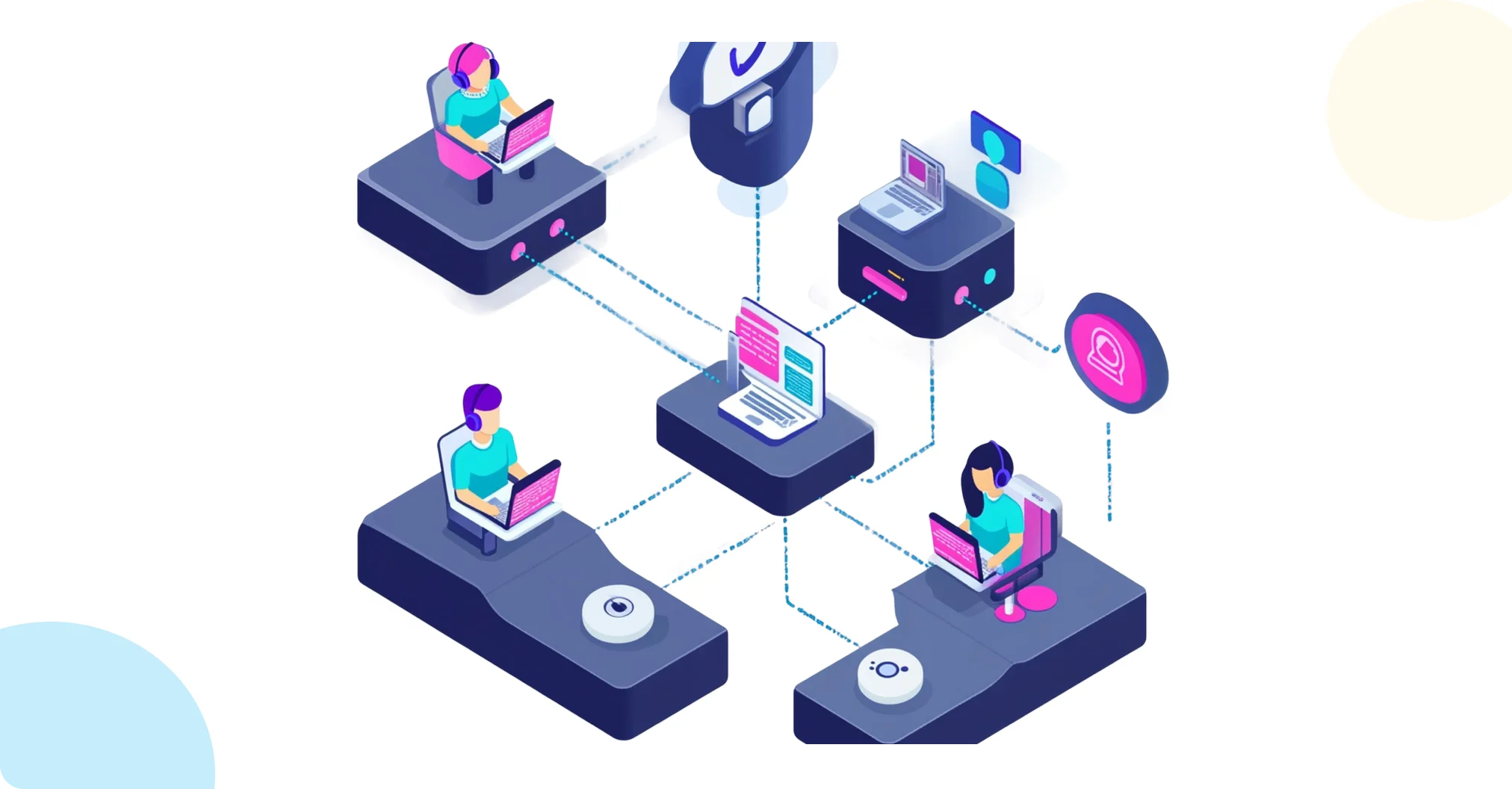

An enterprise Salesforce customer running high-volume sales and service operations had adopted early conversational AI agents that worked for simple single-turn questions but broke down on multi-step requests. Agents operated as isolated bots with no shared context. A billing question and a scheduling question needed two separate conversations. External data could not be reached safely and there was no way to trace why an agent had taken a particular action. Applying its AI-First approach, Ksolves designed and implemented a layered Agentforce architecture comprising Multi-Agent Orchestration, MCP-Grounded Data Access, and Agent Script with a Trust Gateway, backed by native session tracing for full observability.
- No Enforced Sequence for Consequential Actions: Compliance risk - agents could act before required checks such as identity verification were satisfied. No deterministic gate existed between intent and action execution.
- Single Monolithic Agent Handling Every Intent: Poor accuracy on complex requests with no clean way to test or scope individual capabilities independently.
- No Safe Way to Connect Agents to External Data: Agents produced approximate or hallucinated answers instead of grounded ones. No controlled mechanism existed to reach live external data sources or analytics tools.
- Platform Access Limited to the Salesforce UI: Agents could not act across Slack, external applications, or automated workflows.
- No Session-Level Tracing of Agent Decisions: Slow root-cause analysis and no reliable way to A/B test agent improvements across conversation turns.
Ksolves designed and implemented a layered Agentforce architecture comprising three interconnected capabilities: Multi-Agent Orchestration, MCP-Grounded Data Access, and Agent Script with a Trust Gateway. The governing principle: reasoning is flexible, execution is deterministic, and every action is grounded and auditable.
-
Multi-Agent Orchestration
A single front-door orchestrator agent maintains the customer conversation and shared context, delegating subtasks to specialized subagents so the customer is never passed around or asked to repeat themselves.- Front-door agent keeps one continuous session per customer regardless of how many subagents are invoked.
- Specialized subagents (billing, scheduling, technical support) are scoped, tested, and permissioned independently.
- Shared context store propagates conversation state and prior tool results across every handoff.
- Mid-conversation re-routing when the customer's intent shifts.
-
MCP-Grounded Data Access
Agents connect to external systems including Tableau's analytics engine through the Model Context Protocol, so responses are grounded in live business data rather than the model's best guess.- Trusted gateway model: administrators explicitly allow-list which MCP servers each agent can reach.
- Every tool call logged with a full audit trail to guard against tool-poisoning and prompt-injection attempts.
- Tableau MCP lets agents query live dashboards directly for grounded, current answers.
-
Agent Script and Trust Gateway
A human-readable, JSON-compiled expression language runs alongside the LLM to enforce explicit if/then control flow for consequential actions, while the model continues to handle open-ended reasoning.- Deterministic rule checks gate high-stakes actions such as identity verification before balance lookup.
- Model handles intent understanding. Agent Script enforces execution order.
- Open-sourced specification allows platform-specific dialects to extend the base language.
Technology Stack
| Layer | Technology / Feature |
|---|---|
| Core Platform | Agentforce 360 (Atlas Reasoning Engine) |
| Control Layer | Agent Script |
| Data Access | Model Context Protocol (MCP) + Trusted Gateway |
| Platform Access | Headless 360 (APIs / CLI) |
| Observability | Session Trace OTel API |
| Testing | Testing Center + A/B Testing API |
- Reliable, Auditable Execution Order: Consequential actions such as balance lookups only fire after required checks pass, closing the compliance gap. Every gate is deterministic and auditable via Agent Script.
- Reduced End-to-End Latency: Runtime optimisations across the reasoning pipeline cut response latency. Specialized subagents resolve faster than a single monolithic agent handling every intent.
- Grounded, Trustworthy Answers: Agents query live analytics via MCP instead of approximating, reducing hallucinated responses and giving customers answers they can trust.
- Full Session Observability: Every agent decision is traceable end-to-end via the Session Trace OTel API, cutting root-cause analysis time and enabling data-driven improvement cycles.
- Safer External Integrations: Allow-listed MCP gateway with audit trails closes off tool-poisoning attack vectors. No uncontrolled external connections from any agent.
- Scoped, Testable Agents: Specialized subagents tested and improved independently via the Testing Center and A/B Testing API instead of retraining one monolithic agent.

“The architecture Ksolves delivered is the first time our agent platform has felt production-ready. Every action is gated, every data source is controlled, and for the first time we can actually trace why an agent did what it did. We can now improve individual agents without touching the ones that are already working.”
– Head of AI / VP Salesforce Platform.
An enterprise Salesforce platform relying on isolated single-turn bots that broke on complex requests, produced hallucinated answers, and had no way to trace agent decisions was transformed through Ksolves Salesforce consulting services. Multi-Agent Orchestration, MCP-grounded data access, and Agent Script’s deterministic control delivered a platform where specialized subagents collaborate as a unified team, consequential actions are gated by auditable rules, and every decision is traceable end-to-end.
Are Your Agentforce Agents Still Operating as Isolated Bots With No Deterministic Control or Grounded Data?