



How F&B Companies Monitor Production Batches, Quality Control, and Inventory KPIs in Real Time
Odoo
5 MIN READ
July 1, 2026

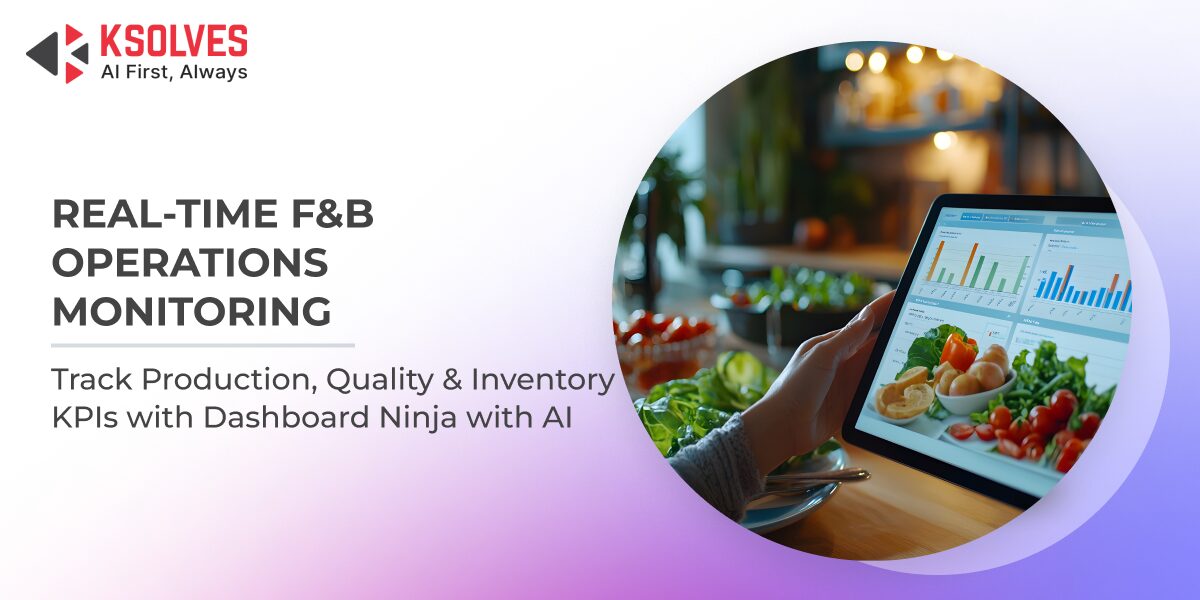
Food & Beverage manufacturing operates under constant pressure: tight shelf life, strict quality standards, and rapidly changing demand. In such an environment, even small delays in tracking production batches, quality checks, or inventory levels can lead to waste, compliance issues, and cost overruns.
The shift now is toward real-time visibility, where decisions are driven by live operational data instead of historical summaries.
AI-powered dashboards and unified analytics platforms are making this possible by connecting production, quality, and inventory data into a single, continuously updated view. Tools like Dashboard Ninja with AI are enabling F&B teams to act faster, reduce inefficiencies, and maintain tighter control across operations.
In this blog, we will explore how F&B companies monitor production batches, quality control, and inventory KPIs in real time, and how modern dashboards are reshaping operational decision-making.
Why Real-Time Visibility Has Become Critical in F&B
F&B operations move fast and leave little room for delay or guesswork. Every batch, ingredient, and quality check is time-sensitive due to:
- Short product shelf life and rapid expiry cycles.
- Strict food safety and compliance requirements.
- Complex, batch-driven production processes.
- Frequent demand fluctuations and seasonal variability.
Traditional reporting models, often based on daily or weekly summaries, create a visibility gap. By the time issues appear in reports, production inefficiencies or inventory losses have usually already occurred.
Real-time visibility closes this gap by enabling:
- Live tracking of production batches from start to finish.
- Immediate monitoring of quality checks and deviations.
- Continuous synchronization of inventory levels across systems.
- Fast detection and response to operational exceptions before they escalate.
Core Operational Challenges in F&B Manufacturing
F&B production environments are inherently complex, where multiple moving parts – materials, batches, quality checks, and demand signals – must stay perfectly aligned. In practice, this alignment is difficult to achieve due to fragmented systems and delayed visibility.
1. Fragmented Production Tracking
Many F&B plants still operate across disconnected tools such as ERPs, spreadsheets, and manual registers. This creates operational blind spots where production flow is not fully visible end-to-end.
As a result, companies often face:
- Gaps in batch status visibility between production, warehouse, and planning teams.
- Limited or no real-time insight into ongoing production progress.
- Delayed identification and escalation of bottlenecks on the shop floor.
This fragmentation slows down decision-making and reduces the ability to respond to disruptions as they happen.
2. Multi-Layered Quality Control Complexity
Quality control in F&B is not a single checkpoint, but it is a continuous process embedded at multiple stages of production:
- Raw material inspection before production begins.
- In-process sampling during manufacturing.
- Final product validation before packaging and dispatch.
Without real-time monitoring across these stages:
- Quality deviations are detected only after batch completion.
- Tracing the root cause becomes time-consuming and often incomplete.
- Compliance reporting becomes reactive, increasing audit and regulatory risk.
3. Inventory Volatility and Expiry Sensitivity
Inventory management in F&B is highly dynamic due to perishability and fluctuating demand patterns. Even small planning inaccuracies can quickly translate into financial loss or production disruption.
Common challenges include:
- Overstock situations leading to expiry-driven wastage.
- Understock scenarios causing production delays and missed demand fulfillment.
- Forecasting errors that create instability in procurement and planning cycles.
Without continuous visibility into consumption and stock movement, inventory decisions are often made reactively rather than strategically.
Key KPIs F&B Companies Track in Real Time
To maintain tight operational control, F&B leaders don’t just track data. They continuously monitor the right KPIs that reflect production efficiency, product quality, and inventory health in real time. These metrics act as early indicators of issues long before they escalate into losses or delays.
1. Production KPIs: Measuring Efficiency on the Shop Floor
Production KPIs provide immediate visibility into how efficiently batches are being executed and where operational delays may be forming.
Key metrics include:
- Batch completion rate to track production progress against plan.
- Cycle time per production run to identify slowdowns in manufacturing flow.
- Yield efficiency (input vs output ratio) to measure material utilization effectiveness.
- Machine downtime and utilization to assess equipment performance and idle time.
Together, these indicators help teams quickly detect bottlenecks, optimize resource usage, and maintain consistent production flow.
2. Quality KPIs: Ensuring Consistency and Compliance
Quality KPIs are essential for maintaining food safety standards and ensuring that every batch meets defined specifications without delay.
Key metrics include:
- First-pass yield rate to measure how many products pass QC without rework.
- Rejection and rework percentage to track production quality losses.
- Deviation frequency per batch to identify recurring quality issues.
- QC checkpoint compliance rate to ensure all inspection stages are completed correctly.
Real-time tracking of these KPIs allows immediate corrective action, reducing the risk of defective batches progressing further in the supply chain.
3. Inventory KPIs: Controlling Cost and Continuity
Inventory KPIs ensure that raw materials and finished goods are always available in the right quantity without overstocking or risking expiry.
Key metrics include:
- Stock turnover ratio to evaluate how efficiently inventory is being consumed and replenished.
- Expiry-risk stock levels to proactively identify items nearing spoilage.
- Raw material consumption rate to align procurement with actual production usage.
- Reorder cycle accuracy to ensure timely procurement and uninterrupted production.
These metrics directly influence cost efficiency, production continuity, and waste reduction across the supply chain.
Why Real-Time Monitoring Changes Everything
When F&B operations move from delayed reports to live KPI tracking, the entire decision-making model becomes faster, sharper, and far more controlled. Instead of reacting to issues after they occur, teams can intervene while processes are still in motion.
This shift enables:
- Early identification of production slowdowns before they impact downstream schedules.
- Immediate QC intervention to prevent defective batches from progressing further.
- Proactive control of inventory to minimize expiry losses and excess stock accumulation.
- Faster, data-driven decisions directly on the shop floor and management level.
- Stronger synchronization across procurement, production, and sales planning.
How Dashboard Ninja with AI Powers Real-Time F&B Intelligence
Dashboard Ninja with AI transforms fragmented operational data into a connected intelligence layer by combining real-time dashboards, AI-driven insights, and highly flexible visualization capabilities. It enables F&B companies to move from passive reporting to continuous operational awareness across production, quality, and inventory functions.
1. Unified Operational Visibility
Instead of relying on scattered reports across systems and teams, F&B companies get a single, consolidated view of operations.
- End-to-end visibility across production, QC, and inventory KPIs.
- Cross-functional dashboards tailored for different roles (plant, QA, procurement, management).
- Drill-down capability from plant overview to individual batch-level details.
- Centralized data view that eliminates departmental silos.
This ensures every stakeholder works from the same real-time operational truth.
2. AI-Driven Insights and Anomaly Detection
The AI layer continuously evaluates operational patterns to surface meaningful insights without manual effort.
- Detection of abnormal batch performance trends in real time.
- Early identification of production inefficiencies before escalation.
- Alerts on sudden spikes in raw material consumption or wastage.
- Automated performance summaries for daily or shift-level review.
- Trend-based insights to support continuous process improvement.
This reduces dependency on manual analysis and helps teams focus on corrective action instead of data interpretation.
3. Real-Time Data Synchronization with ERP Systems
Dashboard Ninja with AI integrates deeply with ERP systems like Odoo to ensure uninterrupted data flow.
- Continuous synchronization with production, quality, and inventory modules.
- Real-time updates on batch status changes and QC results.
- Instant reflection of stock movements and consumption data.
- Elimination of data lag between operational events and reporting dashboards.
This guarantees that decisions are always based on the latest operational state, not outdated snapshots.
4. Shopfloor Visibility with TV Dashboards
Large-screen, real-time dashboards improve transparency directly on the production floor.
- Live monitoring of production KPIs across lines and shifts.
- Real-time batch progress tracking for supervisors and operators.
- Immediate display of QC failures and operational alerts.
- Improved coordination between shift teams through shared visibility.
- Faster response to production disruptions.
This turns the shopfloor into a data-aware environment where everyone operates with the same live context.
5. Custom Dashboard Flexibility and Role-Based Design
Every F&B operation has unique workflows, and Dashboard Ninja with AI adapts to them.
- Fully customizable KPIs based on product lines or production units.
- Flexible visualization options including charts, tables, gauges, and heatmaps.
- Role-specific dashboards for production, quality, inventory, and leadership teams.
- Multi-plant and multi-location consolidated dashboards.
- Configurable filters for time, batch, product, or facility-level analysis.
This ensures relevance at every level of decision-making.
6. Advanced Alerting and Notification System
Beyond visualization, the system actively notifies stakeholders when action is required.
- Threshold-based alerts for production delays or QC failures.
- Inventory alerts for low stock or expiry risks.
- Real-time notifications for anomaly detection by AI models.
- Configurable escalation workflows for critical issues.
This helps teams respond instantly rather than discovering issues later in reports.
7. Historical Trend Analysis with Real-Time Context
Dashboard Ninja with AI does not just show current status, but it connects it with historical performance.
- Comparison of current batch performance with past trends.
- Identification of recurring operational inefficiencies.
- Seasonal demand and production pattern analysis.
- Continuous improvement tracking across cycles.
This bridges real-time monitoring with long-term operational optimization.
Final Words
In today’s fast-paced F&B industry, real-time visibility is essential for maintaining production efficiency, product quality, and inventory control. Delayed reporting often means delayed action, and missed opportunities to prevent issues before they impact operations.


































AUTHOR
Odoo
Neha Negi, Presales and Business Associate Head at Ksolves is a results-driven ERP consultant with over 8 years of expertise in designing and implementing tailored ERP solutions. She has a proven track record of leading successful projects from concept to completion, driving organizational efficiency and success.
Share with