


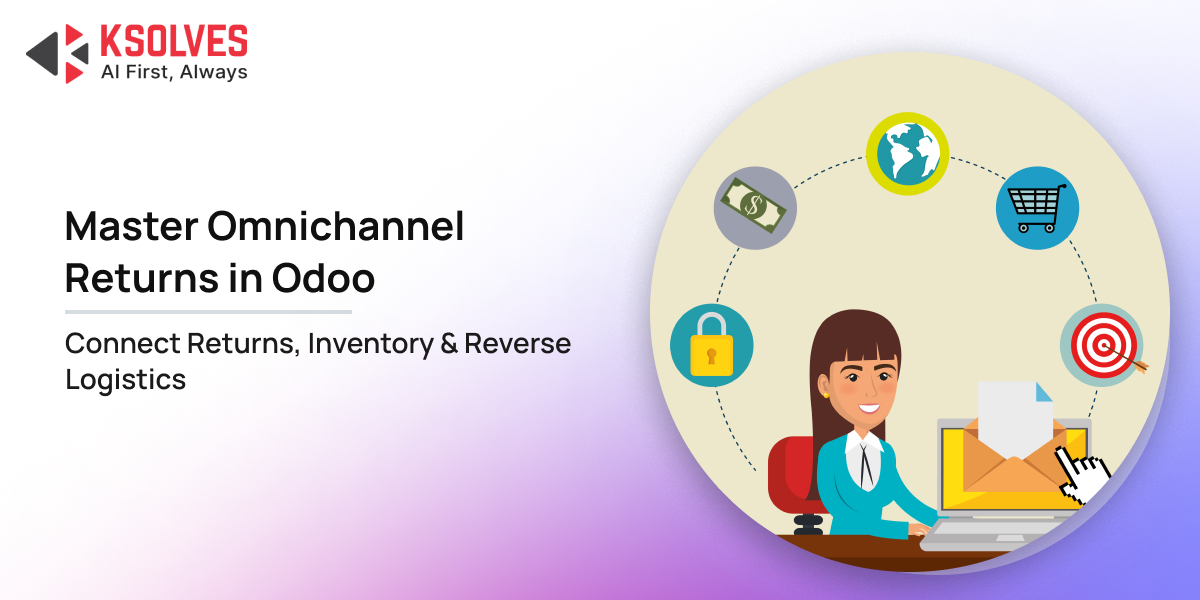
Mastering Omnichannel Returns: Managing Reverse Logistics in Odoo
Odoo
5 MIN READ
October 20, 2026

Returns are an unavoidable part of modern retail and eCommerce. Customers may purchase products through an online store, marketplace, mobile channel, or physical location. They expect the same flexibility when they want to return them.
An ERP such as Odoo can provide a connected foundation for managing sales, inventory, warehouse, accounting, and eCommerce operations. By structuring the Odoo return management process around the broader reverse-logistics lifecycle, retailers can create greater visibility and consistency across their return operations.
What is Reverse Logistics in Retail and eCommerce?
Traditional logistics focuses on moving products from the seller to the customer:
Order → Pick → Pack → Ship → Deliver
Reverse logistics works in the opposite direction. It manages the movement of products back from customers to the business and determines what happens to those products afterward:
Return Request → Approval → Pickup → Receipt → Inspection → Disposition → Refund/Replacement
In retail and eCommerce, reverse logistics can involve much more than simply accepting a returned product. Businesses need to coordinate customer service, sales, warehouse operations, inventory, finance, and sometimes suppliers or third-party logistics providers.
A structured reverse logistics management process helps businesses understand where a returned product is, why it was returned, whether it can be resold, and how the return affects inventory and finances.
Also Read: Top 10 Benefits of Odoo Customization for Retail Businesses
Why Omnichannel Returns Are Difficult to Manage
As businesses add more sales channels, managing returns becomes increasingly complex. A customer may purchase through an online store but return the product to a physical location, while another customer may purchase through a marketplace and follow a different return process.
Here are some common challenges associated with omnichannel returns management.
- Returns Coming From Multiple Sales Channels
Each channel may have different order information, return policies, fulfillment processes, and customer expectations.Without a centralized operational system, teams may need to switch between multiple platforms to understand the original transaction and process the return. - Disconnected Return and Order Data
A return should not be treated as an isolated transaction. Teams often need access to the original order, customer information, product details, quantities, fulfillment status, and payment information.When this information is spread across different systems, validating returns can become a manual process. - Manual Return Authorization
Email-based approvals, spreadsheets, and manual status updates can slow down the eCommerce return process.Businesses may also struggle to apply return eligibility rules consistently when different employees handle requests differently. - Inventory Visibility Gaps
A returned product may be:- In transit from the customer.
- Awaiting warehouse receipt.
- Under inspection.
- Ready for restocking.
- Sent for repair.
- Returned to a supplier.
- Marked as unsuitable for resale.
If these stages are not properly reflected in inventory operations, businesses can lose visibility into their actual stock position.
- Refund and Replacement Complexity
A return may result in a refund, replacement, exchange, store credit, or another resolution. Coordinating the commercial and inventory sides of these transactions can become complicated as return volumes increase. - Limited Visibility Into Return Reasons
A high return rate is only one part of the problem. Businesses also need to understand why products are being returned.Product defects, incorrect sizing, damaged shipments, inaccurate product descriptions, fulfillment errors, and changing customer preferences can all contribute to returns. Without structured return data, identifying these patterns becomes difficult.
How Odoo Can Streamline Omnichannel Returns
Odoo brings multiple business functions into a connected ERP environment. For businesses looking to improve Odoo returns management, this can provide a foundation for linking return-related activities with sales, inventory, warehouse, eCommerce, and accounting processes.
1. Centralize Return Information
Instead of maintaining separate records for sales, inventory, and returns, businesses can structure their operations around connected Odoo records and workflows.
This makes it easier for teams to trace a return back to the relevant customer and order information.
2. Connect Returns With Original Orders
A structured Odoo return workflow can connect the returned product with its original sales transaction. This provides context around:
- Customer
- Product
- Quantity
- Original order
- Delivery
- Return quantity
- Return reason
- Subsequent inventory action
This connection helps teams avoid treating returns as disconnected inventory movements.
3. Manage Returned Inventory
Once products reach the warehouse, businesses need to determine what happens next. Depending on the business process and product condition, returned goods may be:
- Returned to available inventory.
- Sent for inspection.
- Moved to another location.
- Repaired or refurbished.
- Returned to a vendor.
- Written off.
An ERP-based inventory return process can help connect these decisions with inventory operations.
4. Coordinate Warehouse Operations
Reverse logistics does not end when a customer submits a return request. The physical product still needs to reach the appropriate warehouse or location.
By incorporating returns into warehouse processes, businesses can create a more structured flow from return authorization through receiving and subsequent disposition.
5. Support Refund and Replacement Processes
Returns often require corresponding commercial actions. Once a return is validated, the business may need to process a refund or arrange a replacement.
Connecting return operations with the relevant sales and accounting processes can help reduce the need for duplicate data entry and manual reconciliation.
6. Create Visibility Across Channels
For businesses operating multiple sales channels, centralized ERP data can provide a broader operational view.
Instead of looking at returns independently for every channel, teams can analyze return activity across the business and identify patterns by product, customer, channel, or reason.
Also Read: How to Manage Your Retail Chain with Odoo: Tips & Tools You Need
Building an Omnichannel Return Workflow in Odoo
A well-designed Odoo return workflow should account for both the customer-facing and operational sides of the process. A typical workflow can be structured as follows.
Step 1: Customer Initiates a Return
The customer submits a return request through the relevant sales or customer-service channel. The business captures the order, product, quantity, and reason for the return.
Step 2: Return Request Is Validated
The return is checked against the applicable business rules. Depending on the business, validation may consider:
- Original order
- Delivery date
- Product
- Quantity
- Return eligibility
- Return reason
- Product condition
Step 3: Return Is Authorized
Once approved, the required return operation can be initiated according to the company’s process. This may involve customer pickup, shipment to a warehouse, or an in-store return.
Step 4: Product Reaches the Warehouse
The returned product is received and recorded through the appropriate inventory operation. At this stage, businesses need visibility into what was physically received versus what was originally authorized for return.
Step 5: Returned Product Is Inspected
The product can then be evaluated according to the organization’s inspection process. For example, the business may determine whether the item is:
- Unused and resalable
- Opened but resalable
- Damaged
- Defective
- Suitable for refurbishment
- Unsuitable for resale
Step 6: Product Is Assigned a Disposition
The business determines the next action for the returned item. The disposition could involve restocking, repair, refurbishment, vendor return, or write-off.
Step 7: Refund or Replacement Is Processed
Once the return meets the relevant conditions, the appropriate customer resolution can be completed. This may involve a refund or replacement, depending on the company’s return policy.
Step 8: Return Data Is Recorded for Analysis
The final step is turning operational data into business insight. Return information can be analyzed to identify frequently returned products, common reasons, high-return channels, and potential operational issues.
Managing Returns Across Different Retail Channels
The complexity of omnichannel return management comes from the fact that the same business may have very different return scenarios across its sales channels.
| Sales Channel | Common Return Challenge | How Odoo Helps |
|---|---|---|
| eCommerce | High volume of online return requests | Connect return activity with order and inventory records |
| Marketplace | Channel-specific processes | Centralize relevant operational information |
| Physical Store | In-store returns for online purchases | Coordinate sales and inventory workflows |
| Multiple Warehouses | Determining where returned products should go | Structure return routing and inventory operations |
| B2B | Larger quantities and complex approvals | Configure appropriate return and approval workflows |
Where Odoo May Need Customization for Complex Return Operations
Standard ERP workflows can provide a foundation, but not every business operates its returns in the same way.
A retailer with a simple online store may require a straightforward return process, while a large omnichannel organization may need customized workflows across multiple channels, warehouses, companies, and fulfillment partners.
Odoo customization may be relevant for scenarios such as:
- Complex return eligibility rules.
- Marketplace-specific return workflows.
- Custom approval processes.
- Automated customer notifications.
- Third-party logistics integrations.
- Payment and refund integrations.
- Multi-company return processing.
- Multi-warehouse return routing.
- Custom product disposition workflows.
- Advanced reverse-logistics reporting.
- Industry-specific return requirements.
Standard Odoo Not Enough for Your Return Process?
How Ksolves Helps Businesses Build Smarter Return Workflows in Odoo
Managing reverse logistics in Odoo is not just about configuring a return operation. For businesses with complex retail and eCommerce environments, the broader objective is to connect customer-facing return processes with sales, inventory, warehouse, accounting, and reporting workflows.
Ksolves, an AI-first Odoo development partner, helps businesses design and implement Odoo solutions around their operational requirements, including return workflow consulting, Odoo customization, integrations, inventory process optimization, and reporting.
Our approach can help businesses structure workflows for:
- Omnichannel return management.
- eCommerce returns.
- Return approvals and validations.
- Inventory and warehouse operations.
- Refund and replacement processes.
- Multi-warehouse return handling.
- Third-party integrations.
- Return analytics and reporting.
- Business-specific reverse-logistics requirements.
Whether the objective is to improve an existing Odoo return management process or build a more connected omnichannel workflow, the right implementation approach can help turn returns from a fragmented back-office process into a structured part of the overall retail operation.
Final Words
Returns are no longer just a customer service task – they directly impact inventory, warehouse operations, costs, and customer experience. With Odoo, businesses can connect return requests, inventory movements, refunds, and product disposition through a more structured reverse logistics workflow.
For businesses managing complex omnichannel returns, the right configuration and customization can make Odoo even more effective. Ksolves helps businesses build tailored Odoo return workflows that improve visibility, streamline operations, and support scalable retail and eCommerce growth.
Ready to Streamline Reverse Logistics With Odoo? Let Ksolves help you design an omnichannel return workflow built for your business.


























AUTHOR
Odoo
Neha Negi, Presales and Business Associate Head at Ksolves is a results-driven ERP consultant with over 8 years of expertise in designing and implementing tailored ERP solutions. She has a proven track record of leading successful projects from concept to completion, driving organizational efficiency and success.
Share with