



From Cost Center to Value Driver: How OpenShift Transforms IT Economics
OpenShift
5 MIN READ
September 25, 2026

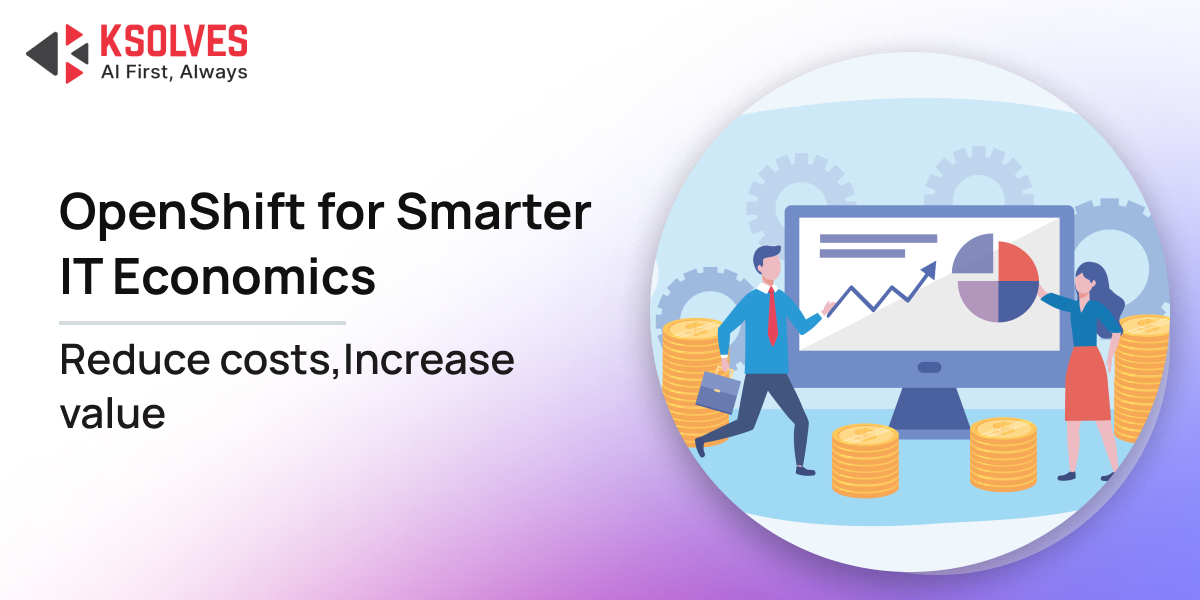
For years, IT has been viewed primarily as a cost center, an essential function that businesses must fund, maintain, and optimize. But in a digital-first economy, technology does far more than keep systems running. It drives innovation, accelerates product launches, improves customer experiences, and creates new business opportunities.
The challenge is that many enterprises still spend a significant share of their IT budget and talent simply managing complex infrastructure, maintaining legacy applications, and keeping disconnected systems operational.
“How can we generate more business value from our IT investments?”
OpenShift helps shift this equation. By bringing greater consistency, automation, and flexibility to application development and operations, it can help enterprises reduce complexity while improving productivity and accelerating innovation.
This blog explores how OpenShift can help transform IT from a cost center into a measurable driver of business value.
Why Traditional IT Economics Are Becoming Unsustainable
Enterprise IT environments have become increasingly complex.
Many organizations operate a combination of legacy applications, virtual machines, containers, private infrastructure, public cloud services, and multiple management tools. Each environment may require different processes, skills, security controls, and operational teams.
This fragmentation creates costs that are not always visible on an infrastructure budget.
1. Fragmented Infrastructure Creates Hidden Costs
When workloads are spread across disconnected platforms, organizations often deal with:
- Multiple infrastructure and management tools.
- Duplicated operational processes.
- Underutilized computing resources.
- Separate skills for different environments.
- Complex application deployment processes.
- Higher administrative overhead.
As infrastructure complexity grows, more time and resources are spent maintaining the technology environment rather than improving it.
2. Legacy Applications Increase the Cost of Change
Legacy systems often remain essential to business operations, but maintaining them can become increasingly expensive.
Organizations may struggle with:
- Slow application release cycles.
- Difficult scaling.
- Technical debt.
- Outdated development processes.
- Limited integration capabilities.
- High maintenance requirements.
The longer an organization remains dependent on rigid infrastructure and outdated application architectures, the more expensive it can become to respond to change.
3. Infrastructure Spending Does Not Always Create Business Value
A large percentage of IT spending is often directed toward keeping existing systems operational.
That leaves fewer resources available for:
- Application modernization.
- Product innovation.
- Customer experience improvements.
- Automation.
- Data and AI initiatives.
This creates a difficult cycle. IT teams remain busy maintaining existing environments, while the business expects them to deliver new capabilities faster.
Breaking that cycle requires a different approach to enterprise infrastructure.
How OpenShift Changes the IT Cost Equation
OpenShift should not be viewed simply as another infrastructure technology or a standalone Kubernetes deployment.
Its greater value lies in providing a consistent enterprise application platform that can support modern applications across different environments.
Instead of managing infrastructure as a collection of separate systems, organizations can move toward a more standardized operating model.
The shift looks like this:
| Traditional IT Model | OpenShift-Driven Model |
|---|---|
| Infrastructure management | Platform engineering |
| Separate environments | Consistent application platform |
| Manual operations | Automated workflows |
| Application silos | Standardized development and deployment |
| Reactive maintenance | Continuous optimization |
| Infrastructure-focused metrics | Business-value metrics |
This does not mean technology costs disappear. Rather, the economic model changes.
Organizations can spend less effort managing complexity and direct more resources toward application delivery, modernization, automation, and innovation.
Where OpenShift Creates Measurable Economic Value
The economic value of OpenShift extends beyond infrastructure savings.
Its impact can be evaluated across infrastructure, operations, developer productivity, application delivery, and modernization.
1. Infrastructure Consolidation and Better Resource Utilization
A fragmented IT estate often results in duplicated infrastructure and inconsistent resource utilization.
OpenShift can help organizations create a more consistent environment for workloads across their infrastructure landscape. With capabilities such as OpenShift Virtualization, enterprises can also run and manage virtual machines alongside containerized workloads.
This creates opportunities to:
- Consolidate workloads.
- Improve infrastructure utilization.
- Reduce platform sprawl.
- Simplify administration.
- Modernize workloads gradually.
For many enterprises, this is particularly important because modernization does not happen overnight.
A business may have hundreds or thousands of applications running on virtual machines. Rewriting every application as a cloud-native service would be expensive, disruptive, and often unnecessary.
A more practical approach is to create a platform where traditional and modern workloads can coexist while modernization happens at the right pace.
2. Lower Operational and Management Costs
Infrastructure becomes expensive when highly skilled teams spend significant time on repetitive operational tasks.
Provisioning environments, configuring systems, troubleshooting deployments, managing updates, and resolving configuration inconsistencies can consume valuable engineering capacity.
OpenShift can help standardize and automate many of these processes.
The potential benefits include:
- Reduced manual intervention.
- More consistent environments.
- Centralized management.
- Standardized operational workflows.
- Faster troubleshooting.
- Improved repeatability.
The economic value is not limited to reducing operational effort. It is also about enabling IT teams to spend more time on work that directly contributes to business outcomes.
3. Developer Productivity Is an Economic Multiplier
Developer productivity is one of the most important, and often underestimated, components of IT economics.
Highly skilled developers are expensive resources. Yet many developers still spend valuable time dealing with infrastructure-related challenges.
They may need to wait for environments, resolve deployment issues, manage inconsistent configurations, or coordinate with multiple teams before applications can move forward.
A platform-based approach can help reduce this friction.
With standardized development and deployment workflows, organizations can provide developers with a more consistent path from code to production.
This can support:
- Faster environment provisioning.
- Greater self-service capabilities.
- Standardized CI/CD workflows.
- Improved development consistency.
- Reduced deployment friction.
4. Faster Application Delivery Means Faster Business Value
The economic value of technology is closely connected to speed.
A new application, service, or feature does not create value while it remains in a development backlog.
It begins creating value when it reaches users.
OpenShift can support faster application delivery by helping organizations standardize application development, deployment, and operational processes.
This can enable businesses to:
- Release new features faster.
- Respond more quickly to customer needs.
- Test new ideas with less operational friction.
- Scale successful digital services.
- Reduce the time between development and production.
The connection to business value is straightforward.
A faster release cycle can mean faster customer improvements, quicker market responses, and earlier realization of revenue opportunities. This is why OpenShift should not be evaluated solely on infrastructure costs.
The cost of technology matters. But the speed at which technology enables the business can matter even more.
OpenShift and Application Modernization: Reducing the Cost of Legacy
Application modernization is often discussed as a technical initiative. In reality, it is also an economic strategy.
Legacy systems can become increasingly expensive because they require specialized skills, limit development speed, and create operational dependencies.
However, modernization does not always mean rewriting every application.
Also Read: Cost Benefits of OpenShift for Enterprises
1. Modernize Without Rewriting Everything
Different applications require different modernization strategies.
Depending on the workload and business requirements, organizations may choose to:
- Rehost applications with minimal changes.
- Replatform applications onto a modern environment.
- Refactor specific components.
- Rearchitect applications where greater transformation is justified.
The right decision should be based on business value.
An application that is stable and business-critical may not require immediate reengineering. Another application that limits innovation or creates high operational costs may be a stronger modernization candidate.
The goal is not to modernize everything. The goal is to modernize the right workloads at the right time.
2. Run Virtual Machines and Containers Side by Side
One of the challenges of enterprise modernization is the coexistence of old and new technologies.
OpenShift Virtualization supports a more gradual transition by allowing organizations to manage virtual machines and containerized applications within a consistent platform environment.
This can help enterprises avoid a disruptive, all-or-nothing migration strategy.
Instead, they can:
- Consolidate existing workloads.
- Standardize operations.
- Identify high-value modernization candidates.
- Modernize applications incrementally.
- Measure the business impact of each initiative.
This approach can reduce transformation risk while preserving existing technology investments.
Also Read: OpenShift Cluster Sprawl: How to Manage and Optimize at Scale
The Business Case for OpenShift: Looking Beyond Cost Savings
A strong OpenShift business case should not focus only on software or infrastructure costs.
The broader economic impact should include five major areas.
1. Direct Cost Optimization
Potential areas include:
- Infrastructure consolidation.
- Improved resource utilization.
- Reduced platform sprawl.
- Lower administrative overhead.
- More efficient operations.
2. Productivity Gains
Organizations can also evaluate:
- Developer productivity.
- Operations productivity.
- Reduced manual effort.
- Faster environment provisioning.
- Automation-driven efficiency.
3. Faster Time to Market
A platform that improves application delivery can help organizations:
- Launch digital products faster.
- Respond to market changes.
- Release customer improvements more frequently.
- Accelerate experimentation.
4. Revenue and Growth Enablement
Modern application platforms can support new business opportunities.
This may include:
- New digital services.
- Better customer experiences.
- Faster product launches.
- Scalable applications.
- Data and AI initiatives.
5. Risk Reduction
Standardization can also create economic value by helping reduce operational risk.
Organizations can benefit from:
- More consistent governance.
- Standardized security practices.
- Improved resilience.
- Reduced configuration inconsistencies.
- Better control across hybrid environments.
A more complete evaluation includes:
Total Cost of Ownership + Productivity + Time to Market + Business Enablement + Risk Reduction
How CIOs Should Measure OpenShift Value
Technology investments require measurable outcomes. For CIOs and technology leaders, the challenge is moving beyond purely technical metrics.
CPU utilization, server capacity, and container counts are useful operational indicators. But they do not fully explain the business value of the platform.
A stronger measurement framework includes both technical and business KPIs.
| KPI | What to Measure |
|---|---|
| Infrastructure TCO | Infrastructure, licensing, cloud, and operational costs |
| Resource Utilization | Utilization of compute, storage, and virtualized resources |
| Operational Efficiency | Manual effort and automation levels |
| Developer Productivity | Time spent on development versus operational tasks |
| Deployment Frequency | Application releases and delivery speed |
| Time to Market | Time from idea to production |
| Modernization Progress | Applications or workloads modernized |
| Availability | Downtime and business impact |
| Business Impact | Revenue or operational value enabled |
This creates a more meaningful conversation. Instead of asking: “How much does our infrastructure cost?”
Technology leaders can ask:
- How quickly can we launch a new application?
- How much developer time is lost to infrastructure friction?
- How efficiently are we using our existing resources?
- How quickly can we modernize critical workloads?
- How much does application downtime cost the business?
- How effectively does IT enable new revenue opportunities?
That is the shift from infrastructure metrics to business metrics.
Also Read: Top Mistakes When Running OpenShift Clusters
How Ksolves Helps Enterprises Turn OpenShift Into a Value Engine
Implementing OpenShift is only the beginning. The real value comes from aligning the platform with the organization’s applications, operating model, modernization strategy, and business objectives.
Ksolves, an AI-first OpenShift consulting services company, helps enterprises throughout their OpenShift transformation journey with services that can include:
- OpenShift consulting and strategy
- Architecture and implementation
- Application modernization
- VM and workload migration
- Kubernetes and OpenShift deployment
- CI/CD and DevSecOps enablement
- Automation
- Hybrid-cloud implementation
- Performance optimization
- Ongoing support and maintenance
Also Read: Top 10 Questions to Ask Before Choosing an OpenShift Consulting Partner (With Checklist)
The approach should focus on a continuous value cycle:
Assess → Modernize → Automate → Optimize → Measure
Final Words
OpenShift can help enterprises look beyond IT cost reduction and focus on what technology can actually deliver – greater efficiency, faster innovation, stronger scalability, and better use of existing resources. By modernizing applications and simplifying operations, businesses can turn technology investments into measurable business outcomes.
The journey from cost center to value driver requires more than adopting a platform; it requires the right strategy, architecture, and execution. Ksolves helps enterprises plan, implement, modernize, and optimize OpenShift environments to unlock greater value from their IT investments.































AUTHOR
OpenShift
Share with