 Salesforce
 5 MIN READ


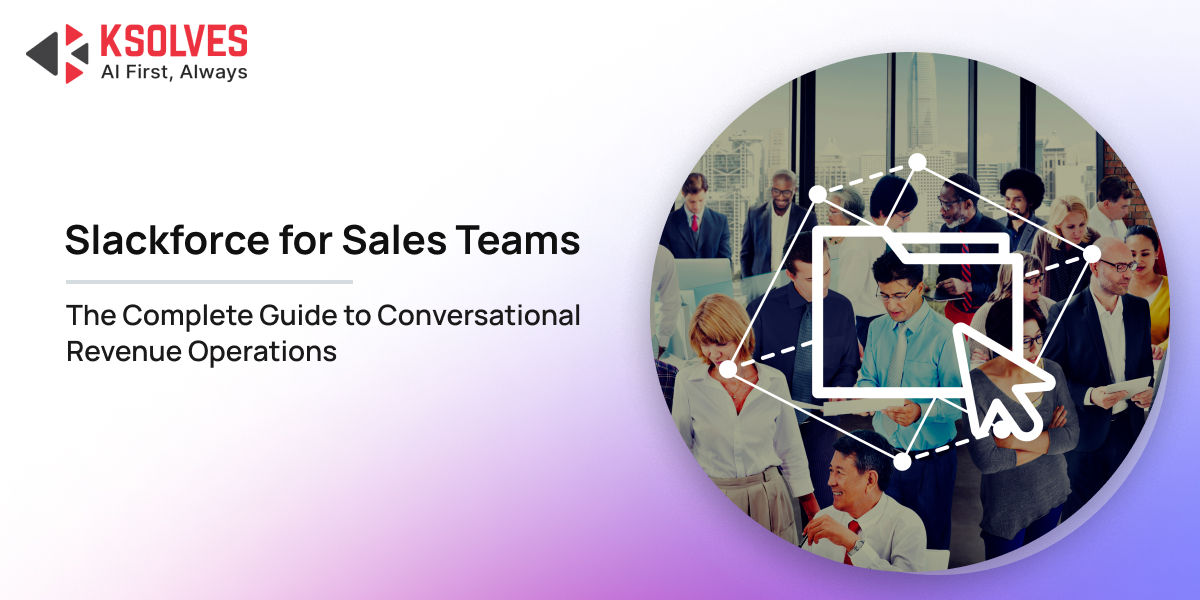
Sales reps are spending less time selling and more time managing the systems around selling. Salesforce’s 2026 State of Sales research found that the average seller spends only 40% of their time actually selling, while 54% of sales organizations have already used AI agents.
The problem is not simply having too many sales tools. Customer conversations happen in Slack, deal information sits in Salesforce, approvals move between teams, and sellers often have to switch between systems to bring everything together.
As Salesforce puts it, “Almost two-thirds of a seller’s week is spent on non-selling tasks.”
In September 2026, Salesforce expanded its Slackforce vision, bringing Salesforce context, CRM actions, AI agents, and conversations closer together inside Slack. Slackforce allows teams to work with Salesforce data, update records, create tasks, and take governed actions directly through Slack.
So, what happens when the conversation around a deal moves faster than the CRM record?
Managers lose visibility, pipeline data becomes harder to trust, and sellers spend valuable time searching for context instead of progressing opportunities.
This is where Slackforce for sales teams fits. With Agentforce Sales in Slack, sellers can prospect, manage pipelines, prepare for meetings, research accounts, and move deals forward from the workspace where they already collaborate. Salesforce says the solution can also synchronize sales activity back to Salesforce, helping keep CRM records and forecasts current.
What Is Slackforce? The Shift From Static CRM to Conversational Revenue Operations
Traditional CRM systems are built around records, fields, objects, reports, and structured workflows. They remain important because they provide the system of record for customer and revenue information.
The challenge is that sales work does not happen only inside those records. A rep may discuss a pricing issue in Slack, receive technical input from an engineer, get approval from a sales leader, and then remember to update Salesforce later. By the time the CRM is updated, some of the context may already be lost.
Slackforce addresses this gap by making Slack a conversational interface for Salesforce. Salesforce channels can connect conversations with CRM records, while Slackbot can retrieve Salesforce information, summarize context, and perform actions.
Instead of following a workflow such as: Lead arrives → open email → log into Salesforce → find record → update fields → contact manager → wait for approval
A conversational workflow can look more like Lead arrives → Slack notification → review CRM context → collaborate in channel → take action → sync changes to Salesforce.
The important change is not simply fewer clicks. It is that conversation and CRM activity can happen in the same operating environment.
5 Practical Slackforce Use Cases for Sales Teams
The real test of Slackforce is not how many features it offers, but where it can remove friction from revenue-critical decisions. The following use cases show how sales teams can apply it to moments where speed, context, and coordination directly affect deal execution.
1. Faster Lead Routing and Follow-Up
Speed matters when a new lead enters the sales pipeline. However, speed is difficult to maintain when lead notifications, CRM records, rep availability, and routing processes exist in separate systems.
With Slackforce and Agentforce Sales in Slack, sales teams can bring lead activity directly into their working environment. Salesforce describes sales agents that can automatically prioritize leads and surface next steps, while Slackbot can coordinate those activities through conversation.
A practical workflow could involve:
- A new lead entering Salesforce.
- The relevant sales channel receiving an actionable notification.
- The rep reviewing account and lead context.
- An agent recommending the next action.
- The rep accepting or modifying that action.
- The activity synchronizing back to Salesforce.
This reduces the gap between lead creation and sales action without requiring representatives to repeatedly check CRM dashboards.
2. Deal Collaboration and Sales Swarming
Enterprise opportunities often involve account executives, solution engineers, legal teams, finance, product specialists, executives, and customer success. The problem is that each participant may hold part of the deal context.
Salesforce channels are designed to bring collaboration around records such as Accounts, Opportunities, Cases, Campaigns, and custom objects into dedicated Slack channels. This keeps discussion closer to the CRM context instead of forcing teams to reconstruct the history across different conversations.
Consider a high-value opportunity approaching contract review. Instead of creating a separate email thread for legal, another conversation for technical questions, and a CRM task for the sales rep, the team can collaborate around the opportunity in Slack.
The CRM record remains the system of record, while Slack becomes the working layer for the people involved.
This model is particularly useful when decisions need input from multiple functions before a deal can progress.
3. Faster Approval Workflows
Pricing, discounts, commercial terms, and other exceptions can create avoidable delays in enterprise sales.
A conversational workflow can bring the relevant deal context into the approval discussion. Rather than asking a manager to search for an opportunity, the workflow can present the information needed to make the decision and provide an action connected to the underlying CRM process.
For example, a sales leader could review the opportunity, account context, deal stage, and relevant approval information within Slack before approving or rejecting the request.
The important point is traceability. An approval should not disappear into a private conversation. The resulting action should update the appropriate Salesforce record and remain connected to the business process.
4. Real-Time Pipeline Management and Forecast Hygiene
Pipeline accuracy depends heavily on how consistently sales teams maintain CRM records.
When reps delay updating close dates, stages, notes, or next steps, sales leaders are forced to make forecasting decisions using incomplete information.
Slackforce can reduce this friction by allowing sellers to work with Salesforce records conversationally. Salesforce says actions taken in Slack can automatically synchronize to Salesforce, helping keep pipeline records and forecasts current.
A rep could complete a customer call and use Slack to update the opportunity instead of waiting until the end of the day. For sales leadership, the benefit is broader than convenience. Better CRM activity can provide a more current view of:
- Opportunity stages
- Close dates
- Next actions
- Deal blockers
- Account activity
- Pipeline movement
The goal is not to create more CRM activity for its own sake. The goal is to make the CRM reflect what is actually happening in active deals.
5. AI-Powered Sales Coaching and Conversational Intelligence
Sales managers traditionally rely on dashboards, pipeline reviews, CRM reports, and individual conversations to understand deal health.
Conversational AI changes how that information can be accessed. With Agentforce Sales in Slack, sellers can work with AI agents for activities such as account research, pipeline management, prospecting, and identifying next steps.
Salesforce also positions Slackbot as an AI assistant that can orchestrate sales activities through conversation. A manager could ask for a summary of an opportunity, identify current blockers, or surface accounts that require attention without manually opening several reports.
For example:
“Summarize the key risks across this quarter’s largest opportunities and identify the next action for each.”
The value comes from connecting the request to governed Salesforce data and business context rather than generating a generic AI response.
Core Slackforce Capabilities for Sales Operations
|
Capability |
How It Works | Sales Impact |
| Salesforce Channels | Connects Slack conversations with Salesforce records |
Keeps deal discussions and CRM context together |
|
Bi-Directional CRM Sync |
Actions taken through Slack can synchronize with Salesforce | Reduces duplicate updates and disconnected records |
| Agentforce Sales in Slack | AI sales agents help with prospecting, pipeline, and next steps |
Reduces repetitive sales administration |
|
Slackbot |
Conversational interface for information retrieval and actions | Lets sellers work with business context through natural language |
| Slack Connect | Supports collaboration with external organizations |
Extends collaboration beyond internal sales teams |
|
MCP-powered actions |
Connects Slackbot with Agentforce capabilities and tools | Allows conversational requests to trigger governed workflows |
Salesforce states that Agentforce Sales in Slack uses Salesforce MCP to connect Slackbot with Agentforce Sales capabilities, allowing actions and sales workflows to operate through Slack.
Why Slackforce Matters for Revenue Operations
The business case for Slackforce is not simply about giving salespeople another AI assistant. It is about reducing the distance between customer conversation, business context, decision-making, and CRM execution.
Salesforce has increasingly positioned Slack as an AI work platform where data, applications, agents, and people can work together.
In April 2026, Salesforce described Slack as a conversational interface for Salesforce, with the aim of reducing the need for teams to move repeatedly between chat, CRM, and other tools.
For revenue leaders, that creates several operational opportunities.
-
Less Context Switching
Salespeople can spend less time moving between Slack, Salesforce, email, documents, and other systems to complete routine work.
-
Better CRM Adoption
If updating a record can happen inside the conversation where the decision was made, CRM maintenance becomes part of the workflow rather than a separate administrative task.
-
Faster Cross-Functional Decisions
Sales, legal, finance, technical teams, and executives can collaborate around the same opportunity context instead of maintaining disconnected discussions.
-
More Accessible Customer Context
AI can help sellers retrieve relevant information without requiring them to know exactly where that information is stored.
Slackforce vs. Traditional Sales Workflows
The difference becomes clearer when comparing the operating models.
| Traditional Sales Workflow | Slackforce Approach |
| Seller searches multiple systems | Seller starts with conversational context |
| CRM updated after the conversation | CRM activity can happen within the conversation |
| Approvals move through separate channels | Approval actions can be connected to workflows |
| Managers rely heavily on scheduled reviews | Managers can query current deal context |
| Sales knowledge is distributed across tools | AI can retrieve governed business context |
| Collaboration and CRM records are separated | Conversations can remain connected to CRM records |
This does not mean Slack replaces Salesforce. Instead, Slack becomes a working interface around Salesforce data and processes.
That distinction matters for enterprise architecture. Salesforce remains responsible for CRM data, permissions, business logic, and governed processes, while Slack provides the conversational environment through which users and agents interact with that information.
How to Deploy Slackforce in a Sales Organization
A successful implementation should begin with workflows, not AI features.
Phase 1: Connect Salesforce and Slack
Start by establishing the Salesforce-Slack connection and mapping users correctly. Salesforce provides configuration options for connecting Salesforce organizations to Slack, including user mapping and approval of the connection. Review permissions carefully before exposing sensitive customer or commercial information.
Phase 2: Define High-Value Sales Workflows
Do not activate every possible notification. Start with processes where collaboration speed and CRM accuracy matter most, such as:
- Lead routing
- Opportunity collaboration
- Approval workflows
- Pipeline updates
- Account research
- Deal-risk identification
The objective is to remove meaningful friction rather than create another stream of notifications.
Phase 3: Introduce Agentforce
Once the core Salesforce and Slack workflows are working, introduce AI agents. Connect agents to the appropriate CRM data, knowledge sources, business rules, and actions. Establish clear boundaries around what an agent can read, recommend, and execute.
This is particularly important for actions that affect pricing, customer records, approvals, or other sensitive business processes.
Phase 4: Measure Business Adoption
Track whether sellers actually use the new workflows. Useful measures include:
- Time from lead creation to first action
- CRM update frequency
- Approval turnaround time
- Pipeline data completeness
- Agent usage
- Sales workflow completion
- Time spent searching for account information
- User adoption across sales roles
The most useful metric is not the number of AI interactions. It is whether the workflow produces a measurable improvement in sales execution.
What Sales Leaders Should Evaluate Before Implementation
Slackforce can change how sales teams work, but the technology alone does not solve poor process design. Before implementation, leadership should evaluate four areas.
- Data readiness: Is Salesforce data accurate enough for agents and sellers to rely on?
- Process readiness: Are lead routing, opportunity stages, approvals, and escalation rules clearly defined?
- Permission readiness: Can sensitive customer and commercial information be exposed safely within conversational workflows?
- Adoption readiness: Will sellers actually benefit from completing work in Slack, or will the organization simply add another interface?
These questions become more important as AI agents move from providing recommendations to taking actions.
The Future of Conversational Sales Operations
The direction Salesforce is taking is broader than a Salesforce-to-Slack integration.
In 2026, Salesforce described Slackforce as a conversational, AI-powered interface to Salesforce. Slackforce Surfaces extends that model by allowing teams to create interactive experiences using Salesforce and other business data directly inside Slack.
Salesforce also says Slackbot can reason across Slack and Salesforce context and take actions such as creating follow-up tasks or reassigning ownership.
For sales organizations, this points toward a different operating model.
- Instead of: CRM → collaboration tool → AI tool → approval system → reporting platform.
- The experience increasingly becomes: Conversation → context → AI reasoning → governed action → CRM update
That is the more important shift behind Slackforce. The CRM does not disappear. The interface around it changes.
Final Thoughts
Slackforce for sales teams represents a shift from treating CRM as a destination to treating CRM intelligence as part of everyday work.
Salesforce data, Slack conversations, AI agents, and sales workflows can operate closer together, giving sellers a more direct way to research accounts, collaborate on opportunities, update records, and execute next steps. Salesforce’s Agentforce Sales in Slack focuses on prospecting, pipeline management, deal execution, and AI-assisted sales work within Slack.
Connecting Slack, Salesforce, AI agents, custom workflows, and governance requires more than enabling an integration.
At Ksolves, we can help you turn Slackforce into a connected sales operation. From Salesforce-Slack integration and custom workflows to Agentforce implementation, data integration, and AI governance, our Salesforce experts can design and implement a setup aligned with your sales processes and business goals.
Ready to make Salesforce work closer to where your sales team actually sells? Partner with us to plan and implement your Slackforce strategy.
FAQs
- What is Slackforce for sales teams?
Slackforce is Salesforce’s vision for using Slack as a conversational interface to Salesforce. It brings CRM context, conversations, AI capabilities, and business actions closer together within Slack. - How does Slackforce help sales teams?
It can help sellers access CRM context, manage pipeline activities, collaborate around opportunities, research accounts, and work with AI sales agents without repeatedly switching between Slack and Salesforce. - Does Slackforce replace Salesforce CRM?
No. Salesforce remains the underlying CRM and system of record. Slack acts as a conversational workspace through which users and agents can interact with Salesforce information and processes. - What is Agentforce Sales in Slack?
Agentforce Sales in Slack brings AI sales agents, Salesforce data, and business context into Slack. Salesforce says these agents can help prioritize leads, progress deals, surface next steps, and support sellers throughout the revenue process. - What should companies consider before implementing Slackforce?
Start with data quality, permissions, workflow design, integration requirements, AI governance, and user adoption. The strongest implementations focus on specific sales processes where reducing context switching or accelerating decisions can create measurable business value.


 Md. Asad Khan