 AI
 5 MIN READ


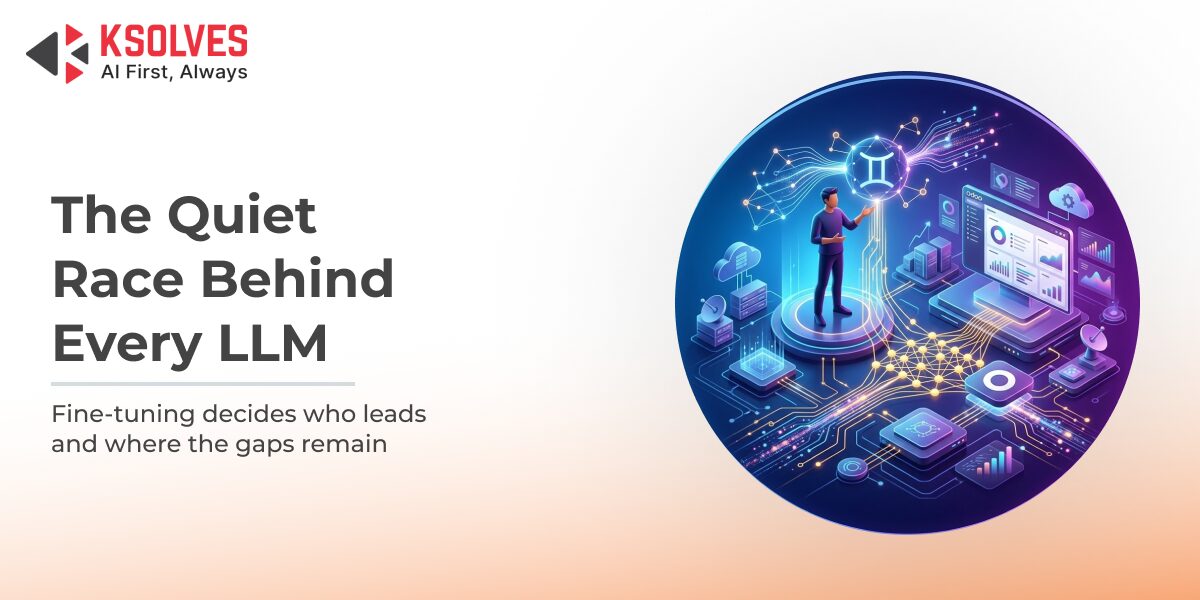
Today, most enterprises adopting AI are focused on making general-purpose language models more effective for their specific domains. The tools and base models, whether LLaMA, Mistral, or GPT-4, are widely available. What truly makes a difference is fine-tuning, teaching the model your domain knowledge, tone, and business needs.
However, fine-tuning is not a one-time step. It is an ongoing process with no clear finish line. Teams must continuously balance data quality, model alignment, evaluation, and governance.
In this blog, we will explore the current state of this process, the key technical challenges, and why many enterprise fine-tuning efforts fall short despite heavy investment.
The Scale of the Race: Why Every LLM Is Being Customized Right Now
The shift from “using AI” to “owning AI behavior” is happening fast, and the driver is competitive necessity. General-purpose LLMs have become table stakes. Every company can call the same API and get similar outputs. The differentiation now lives entirely in fine-tuning: who has better training data, better alignment pipelines, and better feedback loops.
A landmark study from Harvard Business School found that knowledge workers using AI completed 12.2% more tasks and finished them 25.1% faster on average. But critically, for tasks that fell outside the model’s established frontier, those using AI were 19% less likely to produce correct solutions than those working without it. This finding captures the central tension in enterprise LLM deployment: a well-tuned model dramatically amplifies productivity, while a poorly aligned one introduces silent, costly errors.
That 19% failure rate on out-of-frontier tasks is not a limitation of AI itself. It is a limitation of insufficient customization. Enterprises that invest seriously in LLM fine-tuning and domain alignment are actively compressing this failure zone. Those who deploy generic models and hope for the best are widening it.
What Fine-Tuning Actually Means at the Technical Layer
Fine-tuning is often oversimplified as “training on more data,” but in practice, it is a set of specialized techniques designed to shape how a model behaves, responds, and generalizes within a specific context. The choice of method directly influences performance, cost, and scalability.
- Supervised Fine-Tuning (SFT) forms the foundation. It involves training the model on curated prompt-response pairs tailored to a domain. This helps the model learn what high-quality outputs look like in specific contexts, such as clinical documentation, legal contract analysis, or financial reporting. SFT is particularly effective when clear examples of desired outputs are available.
- Reinforcement Learning from Human Feedback (RLHF) builds on this by introducing human judgment into the training loop. Instead of relying solely on predefined correct answers, human evaluators rank or score model outputs. These preferences are used to train a reward model, which then guides the optimization of the base model. This approach improves not just correctness but also response quality, safety, tone, and contextual appropriateness.
- LoRA and QLoRA (Low-Rank Adaptation techniques) address one of the biggest barriers to fine-tuning: computational cost. Rather than updating all parameters of a large model, LoRA introduces lightweight adapter layers that modify behavior efficiently. QLoRA further enhances this approach by quantizing the base model, significantly reducing GPU memory requirements while maintaining strong performance. These methods make fine-tuning feasible even for teams without extensive infrastructure.
- Instruction Tuning focuses on how well the model understands and follows prompts. It ensures the model adheres to specific formats, respects constraints, and performs reliably across varied instructions. This is especially important for enterprise use cases where consistency and structured outputs are critical.
Each of these techniques addresses a different aspect of model adaptation. Selecting the wrong approach can lead to suboptimal performance, increased costs, or failed deployments. That is why a structured evaluation of the use case, data readiness, and infrastructure constraints is essential before choosing a fine-tuning strategy.
At Ksolves, AI-certified engineers assess these factors in depth to recommend the most suitable fine-tuning approach, ensuring that models are not only accurate but also efficient, scalable, and aligned with business objectives.
Where the Gap Still Is: The Three Unsolved Problems
Despite the maturity of fine-tuning methodology, three fundamental gaps remain largely unresolved in enterprise deployments.
- The Data Quality Trap
Fine-tuning amplifies whatever is in your training data, including its biases, inconsistencies, and gaps. Most enterprises discover too late that their “domain data” is not as clean or representative as assumed. Customer support transcripts contain escalation bias. Legal documents over-represent resolved cases. Medical records are structured for compliance, not for model learning. Building a fine-tuning pipeline without a prior investment in data curation is one of the most expensive mistakes an AI program can make. Quality matters more than volume at every stage.
- The Evaluation Problem
How do you know if your fine-tuned model is actually better? General benchmarks like MMLU or HellaSwag are nearly useless for measuring domain-specific performance. Building task-specific evaluation suites requires domain expertise, labeled ground-truth data, and ongoing human review, none of which are included in most fine-tuning project budgets. Without rigorous evaluation, teams often ship models that score well on test prompts but fail unpredictably in production.
- The Alignment Drift
Fine-tuned models can become misaligned with their safety training over time, especially when domain data introduces edge cases that conflict with the base model’s alignment. A model fine-tuned on financial data might become subtly more confident in assertions than the base model intended. A healthcare model might generate plausible but unverified clinical recommendations. Maintaining alignment during and after fine-tuning requires continuous red-teaming and adversarial testing, which most teams treat as optional until an incident forces the issue.
Why Most Enterprise Fine-Tuning Projects Stall Mid-Race
The technical barriers are real, but the organizational gaps are often larger. Here is where enterprise teams typically lose momentum:
- Treating fine-tuning as a one-time event rather than a continuous loop. Models need ongoing retraining as domain data evolves, user feedback accumulates, and business requirements shift.
- Underinvesting in MLOps infrastructure. Fine-tuning without experiment tracking, model versioning, and deployment pipelines creates a fragile system that cannot be improved reliably.
- Separating AI from domain experts. The engineers know the models. The domain experts know what good outputs look like. When these groups do not collaborate closely, fine-tuning yields technically sound models that fail to meet real-world standards.
- Skipping the governance layer. In regulated industries, every fine-tuned model needs auditability: what data it was trained on, its failure modes, and how it will be monitored in production.
These are not edge cases. They are the default trajectory of most enterprise AI programs. Solving them requires experience, not just tooling.
Closing the Gap with AI-Certified Expertise: How Ksolves Approaches LLM Fine-Tuning
The competitive advantage in the LLM fine-tuning race does not belong to organizations with the largest budgets. It belongs to those with the most disciplined & domain-aware AI programs. That distinction requires both technical depth and strategic guidance, which is precisely where AI Development Services from Ksolves come in.
Ksolves is an AI-first company built around certified AI and ML experts who have delivered production-grade LLM solutions across healthcare, finance, manufacturing, legal, and enterprise software. Our approach to fine-tuning starts with data, not models, as we audit your existing data assets, identify gaps in coverage and quality, and build the labeled datasets your fine-tuning pipeline actually needs. From there, we select and implement the right training technique, whether SFT, RLHF, LoRA, or a hybrid approach, based on your specific task requirements and infrastructure constraints.
We do not stop at training. Our services include evaluation framework design, alignment testing, MLOps pipeline setup, and post-deployment monitoring to ensure your fine-tuned model performs reliably as your business scales. Whether you are building your first domain-specific model or overhauling a stalled fine-tuning program, our team of AI-certified engineers brings the hands-on depth to move from prototype to production with confidence.
Conclusion
The arms race behind every fine-tuned LLM is quieter than the headlines suggest, but it is more consequential than most enterprises realize. The organizations pulling ahead are not necessarily using more advanced models. They are using better data, sharper evaluation methods, tighter alignment processes, and continuous improvement loops. The gap between a generic deployment and a genuinely intelligent domain model is a gap in discipline, not just technology. Close it with the right expertise, and the competitive distance you create will be substantial.
Ready to stop running behind? Connect with Ksolves today and turn your LLM investment into a durable, domain-ready advantage. You can also send us your query at [email protected].


 Mayank Shukla