



Mastering Document Chunking for Enterprise RAG: Ingesting into Elasticsearch (ELK)
Big Data
5 MIN READ
July 17, 2026

Building a production-ready Retrieval-Augmented Generation (RAG) chatbot means orchestrating a lot of moving parts. Developers often focus their energy on tweaking Large Language Model (LLM) prompts, but the real secret to a smart, hallucination-free AI assistant lies much earlier in the pipeline: in how you extract, chunk, and index your documents.
If your application already manages a raw document corpus in its own layer, how do you cleanly turn those files into structured, high-relevance vector embeddings? This post breaks down the architectural blueprint for extracting data from an isolated corpus, converting it into semantically rich text chunks, and using Elasticsearch (the ELK Stack) as a high-performance vector database to power an intelligent Q&A chatbot.
In this blog, we’ll cover the architecture, chunking strategy, metadata design, Elasticsearch indexing, and hybrid search retrieval that power a production RAG chatbot.
The Architecture: Corpus to Elasticsearch
Before getting into implementation details, it helps to see how data actually flows through this system. Since your application keeps the raw document corpus in a separate, isolated layer, the pipeline needs a clean, decoupled extraction process so it doesn’t bottleneck your main application database.
| Layer | Role |
|---|---|
| The Corpus Store | Your application’s isolated storage ecosystem, whether that’s a secure file server, a cloud bucket (S3, GCS), or an internal document management system. |
| The Extraction & Chunking Layer | A specialized background service or worker that fetches new or updated documents, parses the raw text, and splits it using a targeted chunking strategy. |
| The Embedding Engine | The mathematical translator that converts text chunks into dense numerical vectors, using an embedding model (OpenAI, a local model, or an open-source alternative). |
| Elasticsearch (ELK Stack) | The destination where both the vector embeddings and structured metadata live, enabling hybrid semantic and keyword search. |
Why Chunking Strategy Dictates Chatbot Intelligence
An LLM can only answer accurately if the context it’s given is precise and relevant. Chunks that are too large make the vector embedding “blurry”: too many unrelated topics get blended, diluting the specific answers the bot needs. Chunks that are too small lose their core context and structural meaning, which produces fragmented answers.
Recursive splitting, which breaks text at sentence, paragraph, and section boundaries before falling back to character-level splits, preserves meaning far better than naive fixed-size windows.
Curious how AI agents fit into this picture? See how AI Agents in RAG Chatbots add reasoning and task execution on top of retrieval, extending what a standard RAG pipeline can do.
The Structured Metadata Matrix
Storing raw text alone when you upload chunks to Elasticsearch is a common and costly mistake. For your chatbot to filter results, respect permissions, and cite sources accurately, every chunk needs to be indexed as a structured object with these fields:
| Field | Purpose |
|---|---|
| Chunk Identifier | A unique key combining the document ID and the chunk sequence number |
| Source Document ID | A reference back to the parent file in your main application corpus |
| Document Attributes | Metadata such as title, author, creation date, department, and permission level |
| Corpus URL | The internal path to the original, full-length document in your corpus |
| Text Content | The actual text the LLM reads when generating an answer |
| Dense Vector | The numerical embedding array (e.g., 1536-dimensional for OpenAI) is mapped to an Elasticsearch vector field |
Need Help Building Your RAG Pipeline?
Step-by-Step Pipeline Implementation
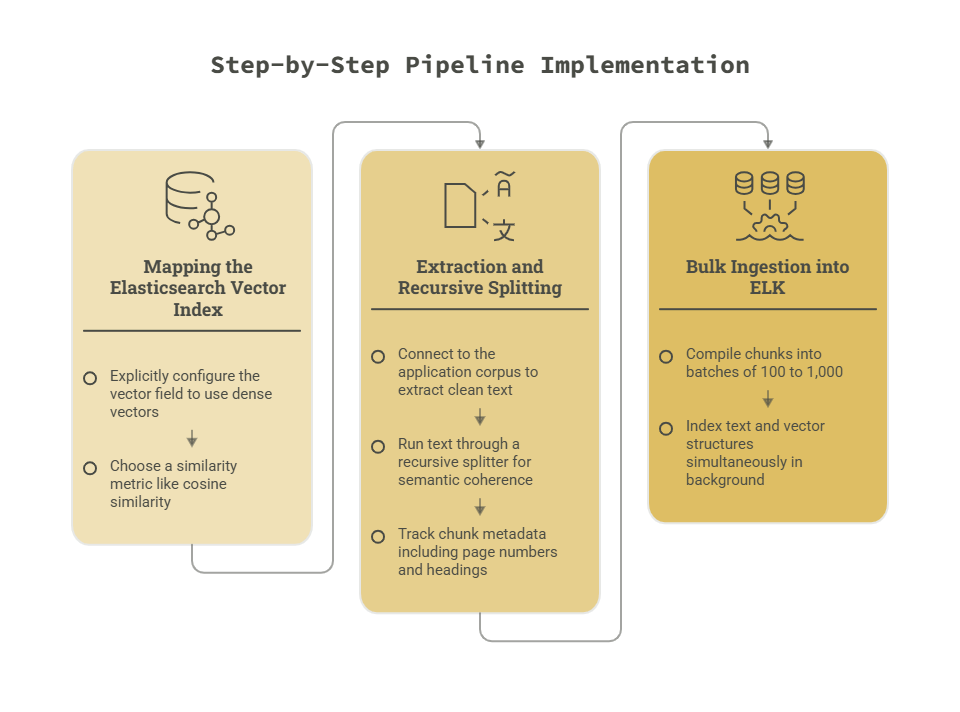
Mapping the Elasticsearch Vector Index
Elasticsearch handles vector search at scale using specialized field types. The first step is defining your index schema. Rather than relying on dynamic mapping, explicitly configure the vector field to use dense vectors, set the exact dimensions to match your embedding model (1536 for OpenAI, 384 for smaller open-source models), and choose a similarity metric. Cosine similarity is the industry standard for semantic search, used to measure how closely a user’s question matches a text chunk.
Extraction and Recursive Splitting
Your extraction service connects to the application corpus, pulls the raw document format (PDF, Markdown, Word, HTML), and extracts clean text. That text then runs through a recursive splitter: instead of chunking naively at fixed 500-character boundaries, the algorithm tries sentence boundaries first, then paragraph boundaries, before falling back to character-level splits. This keeps semantic coherence intact.
For large documents, track chunk metadata, including the original page number, section heading, and sibling chunk indices, so the LLM can reference the document’s original structure when answering.
Bulk Ingestion into ELK
To keep ingestion throughput high and avoid hitting API rate limits, never send chunks to Elasticsearch one at a time. Instead, have the extraction service compile chunks into bulk batches (typically 100 to 1,000 chunks per batch). Elasticsearch processes these batches efficiently, indexing text for keyword search while simultaneously building the vector index structures for semantic search in the background.
Powering the Chatbot with Hybrid Search Retrieval
When a user asks your chatbot a question, the application converts that question into a vector embedding using the same model applied to the document corpus, then sends a search query to Elasticsearch. Rather than relying on vector search alone, the industry best practice for enterprise data is hybrid search: combining vector similarity (finding conceptually related chunks) with keyword matching (finding exact phrases and technical terms).
Elasticsearch can run both search styles at once. Using an algorithm called Reciprocal Rank Fusion (RRF), it merges the best results from vector and keyword search into a single, well-ranked list. Elasticsearch returns the most relevant chunks, and your application hands those text snippets to the LLM as “ground truth” context alongside the user’s question, prompting the model to answer. Because the metadata travels with each chunk, your chatbot can append a citation link straight back to the original document in your corpus.
Key Takeaways for Enterprise RAG Success
- Decouple corpus storage from search. Isolating raw documents lets you scale extraction independently of your main application.
- Prioritize chunking strategy. Recursive splitting and semantic awareness reduce hallucination and improve answer quality significantly.
- Embed rich metadata. Chunk IDs, document attributes, and corpus URLs enable source citation and permission-based filtering.
- Use hybrid search (vector + keyword). RRF merges both retrieval strategies for a level of production robustness that pure vector search can’t match on its own.
- Batch ingestion at scale. Bulk APIs prevent rate limits and maximize throughput when indexing large document collections.
How Ksolves Helps You Take This from Architecture to Production
Designing this pipeline on paper is one thing. Running it reliably at enterprise scale, with chunking tuned to your document types, metadata modeled around your permission structure, and hybrid search weighted for your actual query patterns, is a very different challenge. That’s where Ksolves comes in.
As an AI-first technology company with 12+ years of engineering experience and a 50+ member team of certified AI and ML professionals, Ksolves builds and deploys the full RAG stack for enterprises, including:
| Service | What It Covers |
|---|---|
| RAG Chatbot Development | End-to-end design and deployment of retrieval-augmented chatbots, from document ingestion and chunking through embedding, vector indexing, and LLM orchestration. |
| Elasticsearch & Vector Search Engineering | Index design, hybrid search tuning (RRF, kNN, HNSW), and performance optimization for high-volume, low-latency enterprise search. |
| NLP & Conversational AI | Text classification, entity extraction, summarization, and document intelligence built on state-of-the-art language models. |
| MLOps & Post-Deployment Support | Model versioning, monitoring, retraining, and scaling using tools like Docker, Kubernetes, and MLflow, so your RAG system stays accurate as your corpus grows. |
| AI Strategy & Integration Consulting | Helping you decide where RAG fits in your stack, how it should integrate with existing ERP, CRM, or knowledge systems, and how to keep the whole pipeline secure and compliant. |
Whether you’re starting from a blank corpus or troubleshooting a RAG chatbot that’s already hallucinating in production, Ksolves’ AI engineering team can help you architect a pipeline built to scale.
Wrapping Up
Decoupling your document corpus from your search layer gives your application room to grow, without either side holding the other back. Add a solid text-extraction layer, organize your data into metadata-rich semantic chunks, and tune Elasticsearch as your vector database, and you’ve built the foundation for a fast, citation-aware enterprise RAG chatbot: one that retrieves the right information, answers with confidence, and shows exactly where each answer came from.
Need Help Architecting Your Elasticsearch System?































Author
About the Author Editorial Team The Ksolves Editorial Team includes certified Salesforce experts, Big Data engineers, AI/ML specialists, Zoho consultants, and experienced technology writers focused on delivering clear, actionable insights for modern businesses. With hands-on experience across Salesforce, Big Data platforms, AI/ML solutions, application development, software testing, and Zoho ERP/CRM, the team publishes practical guides, real-world use cases, and industry updates that support smarter decisions and faster growth. Every article is created to solve business challenges, guide technology adoption, and keep organizations aligned with evolving digital ecosystems.
Share with