



SMS vs. WhatsApp vs. Email in Agentforce Marketing: A B2C Retailer’s Guide to Channel Orchestration
Salesforce
5 MIN READ
October 13, 2026

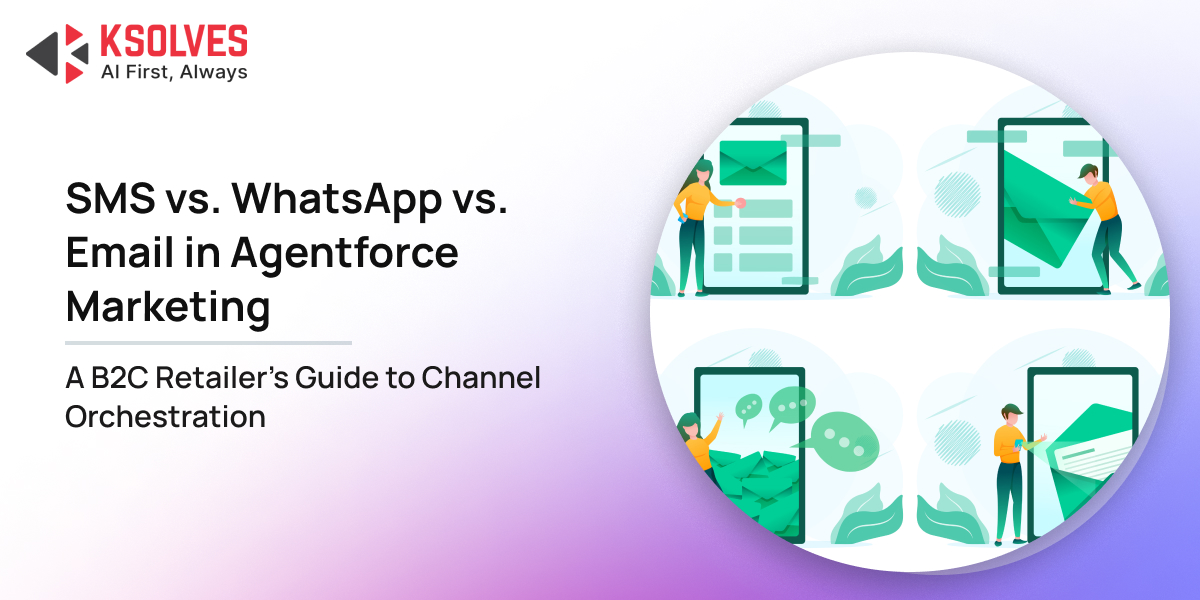
A customer abandons a cart, receives an email, gets a push notification, and then receives an SMS for the same offer. More touchpoints do not always mean more conversions. They can mean message fatigue, wasted spend, and a fragmented customer experience.
Salesforce reports that 73% of customers expect companies to understand their unique needs and expectations. For B2C retailers, that makes intelligent channel selection essential. The goal is not simply to reach customers but to determine which channel, message, and timing are most likely to drive action.
This is where Agentforce Marketing and channel orchestration come into play. By using customer behavior, purchase history, preferences, engagement, and journey context, retailers can coordinate SMS, push notifications, and email instead of treating them as separate campaigns.
For retail decision-makers, the priority is clear: better engagement without overwhelming customers or wasting marketing spend.
So, when should a retailer choose SMS over push or email, and how can Agentforce Marketing orchestrate all three effectively? Read on to find out.
SMS vs. Push Notifications vs. Email: Choosing the Right Marketing Channel for B2C Retail
Each channel has a different role in the customer journey. SMS is suited to urgent, high-intent communication, push notifications are useful for app engagement, and email provides more space for personalized content and product discovery.
With Agentforce Marketing, retailers can bring these channels together and decide how each interaction should fit into the wider customer journey.
1. SMS Marketing: Best for Urgent, High-Intent Messages
SMS provides a direct way to reach customers and does not require a mobile app. This makes it useful when the message is time-sensitive or requires immediate action. Retailers can use SMS for:
- Order and delivery updates
- Cart recovery reminders
- Limited-time offers
- Back-in-stock alerts
- Payment or account reminders
For example, if a customer has abandoned a high-value cart shortly before a promotion ends, an SMS can provide a timely reminder. Similarly, an order-status message can reach the customer without relying on app engagement.
When comparing the best marketing channel for SMS, push, and email, SMS is generally strongest when urgency and direct reach matter. However, frequent promotional SMS messages can increase opt-outs, so retailers should use the channel selectively and respect customer consent.
2. Push Notifications: Best for App Engagement and Retention
Push notifications are particularly effective for retailers with an active mobile app. They provide a direct route back into the app and can connect customers with specific products, offers, or account activity.
For example, a customer who adds a product to a wishlist could receive a push notification when its price changes or when it becomes available again. A loyalty customer could receive a notification when a reward becomes available.
Push notifications can also include deep links, rich media, personalized offers, and time-sensitive messages. Their main limitation is reach: customers generally need the app installed and notifications enabled.
This makes push especially valuable for retention and repeat engagement, rather than as a universal replacement for SMS or email.
3. Email Marketing: Best for Personalization and Product Discovery
Email gives retailers considerably more room to communicate. It can combine product images, recommendations, offers, educational content, and loyalty messaging within one customer interaction. It works particularly well for:
- Product recommendations
- New collection launches
- Seasonal campaigns
- Abandoned-cart journeys
- Loyalty programs
- Newsletters and editorial content
For example, rather than sending a single reminder about an abandoned cart, an email can show the product left behind alongside complementary products, reviews, or relevant offers.
This makes email particularly useful when customers need more information before purchasing or when the objective is to build long-term engagement and customer lifetime value (LTV).
SMS vs. Push vs. Email: Key Differences for Retailers
The key differences between these channels come down to reach, speed, content, cost, engagement, and the type of customer action they are designed to generate.
1. Reach and Accessibility
SMS can reach customers directly on their mobile phones without requiring an app. Push notifications depend on app installation and notification permissions, while email can reach customers across mobile, desktop, and tablet devices.
This means retailers should consider the customer’s available channels before deciding how to communicate. An app-first strategy may favor push, while a broader customer database may make email or SMS more practical.
2. Speed and Message Urgency
When comparing SMS vs. email vs. push for transactional messages, urgency is a major consideration.
SMS and push can be effective for immediate updates such as delivery notifications, order status changes, payment reminders, and limited-time alerts. Email is better suited to communications where customers can take more time to read and explore the content.
For example, a delivery delay may require an immediate SMS or push notification, while a detailed product update can be communicated through email.
3. Content and Creative Flexibility
SMS is designed for short, focused communication. Push notifications provide more flexibility through app-linked experiences, while email offers the most space for rich content.
A retailer could therefore use:
- SMS: “Your order is out for delivery.”
- Push: “Your saved trainers are back in stock. View now.”
- Email: A personalized selection of new trainers based on previous browsing and purchase activity.
The message itself should influence the channel rather than forcing every campaign into the same format.
4. Engagement and Customer Intent
The right channel also depends on how much intent the customer has already demonstrated. A customer who has added an item to their cart may be a strong candidate for an immediate reminder.
A customer who has only browsed a product category may respond better to an email featuring recommendations or a push notification highlighting relevant products.
This is where SMS vs. push notification vs. email marketing becomes less about choosing a single winner and more about matching the channel to customer intent.
5. Cost and Marketing Efficiency
SMS can involve per-message costs, while push notifications can be a cost-efficient way to engage opted-in app users. Email can support large-scale campaigns with relatively low incremental delivery costs.
For decision-makers, the important metric is not simply the cost of sending a message. It is the cost relative to engagement, conversion, revenue, and customer lifetime value.
A low-cost channel is not necessarily the most valuable if it consistently reaches customers who are unlikely to convert.
6. Best Use Cases Across the Customer Journey
Different stages of the customer journey naturally lend themselves to different channels.
- SMS can support urgent transactional messages, cart recovery, delivery updates, and limited-time offers.
- Push notifications can support product alerts, loyalty rewards, app engagement, wishlist updates, and personalized reminders.
- Email can support discovery, product recommendations, new launches, seasonal promotions, loyalty campaigns, and longer-form communication.
This approach helps retailers build a multichannel marketing strategy using SMS, email, and push notifications without sending unnecessary messages through every available channel.
7. Personalization and Channel Orchestration
Personalization is not only about changing the customer’s name in a message. It is also about deciding what to send, when to send it, and which channel to use.
For example, a customer who abandons a cart could first receive a push notification if they are an active app user. If they do not engage, an email could follow with personalized product information. SMS could be reserved for a time-sensitive offer when appropriate.
Agentforce Marketing can help retailers coordinate these interactions using customer data and journey signals rather than managing each channel independently.
SMS vs. Email Marketing Open Rates: What Retailers Should Consider
Open rates can be useful when comparing channels, but they should not be treated as the only measure of campaign success. An SMS may be seen quickly, while an email may generate a purchase several hours or days after it is opened.
Retailers should therefore look beyond SMS vs. email marketing open rates and evaluate metrics such as
|
Channel Parameter |
SMS Messaging | Push Notifications | Email Marketing |
| Average Open Rate | 98% (90% in 3 mins) | 20% – 40% |
18% – 25% |
|
Click-Through Rate (CTR) |
10% – 15% | 3% – 8% | 2% – 5% |
|
Cost Structure |
High (Per-message carrier charges) | Low (Flat platform fee) | Very Low (CPM / volume scaling) |
| Content Capacity | 160 characters (Text/Short Links) | Short text + Small image |
Unlimited Rich HTML/Media |
| Opt-in Friction | High (Strict legal requirements) | Medium (App permission) |
Low (Standard signup) |
The most effective channel is ultimately the one that delivers the desired business outcome while maintaining a positive customer experience.
Push Notification vs. SMS vs. Email for Abandoned Cart Recovery
Abandoned-cart recovery is a strong example of why channel orchestration matters. Consider a customer who adds several products to their cart but leaves without purchasing. A retailer could use a staged journey:
- Step 1: Send a push notification reminding the customer about the cart.
- Step 2: If there is no engagement, send an email with the abandoned products and relevant recommendations.
- Step 3: If the purchase remains incomplete and the offer is time-sensitive, send an SMS reminder.
The exact sequence should depend on customer consent, behavior, channel availability, and journey rules. The objective is not to contact the customer through every channel but to use each channel when it adds value.
What Is the Best Channel for Time-Sensitive Alerts: SMS vs. Push?
For urgent communication, SMS and push notifications are often more suitable than email because they can provide a more immediate mobile touchpoint.
However, the choice depends on the customer. If an active app user has enabled notifications, push may be an effective first option. If the customer is not an app user but has opted into SMS, text messaging may be more appropriate.
For example:
- Delivery update: SMS or push
- Flash-sale reminder: Push or SMS, depending on consent and customer preference
- Detailed product launch: Email
- Wishlist availability: Push
- Payment reminder: SMS or email, depending on urgency
Agentforce Marketing implementation can help retailers build these rules into broader journey orchestration rather than relying on manual channel selection for every campaign.
How Agentforce Marketing Enables Multichannel Orchestration
The value of Agentforce Marketing is not simply having SMS, push, and email available. The real Agentforce implementation comes by coordinating them around a unified understanding of the customer.
Retailers can use customer data and engagement signals to create journeys that respond to actions rather than simply following fixed campaign schedules.
For example, if a customer: Browses → Adds to cart → Abandons cart → Opens email → Returns to product → Purchases the next communication can be influenced by each interaction.
If the customer does not engage with email but regularly responds to push notifications, the journey can prioritize push. If the customer has demonstrated high purchase intent and has opted into SMS, an SMS touchpoint may be appropriate for a time-sensitive incentive.
This creates a more intelligent SMS, email, and push notification marketing cloud strategy, where every channel has a defined role.
Final Thoughts
The strongest B2C retail strategy is rarely about choosing SMS vs. push vs. email as a single winner. Each channel solves a different communication need: SMS delivers urgency, push drives app engagement, and email supports discovery and deeper communication.
With Agentforce Marketing, retailers can bring these channels into a coordinated customer journey, using behavior, preferences, engagement, and purchase signals to determine the next best interaction.
The result is a more relevant customer experience, better marketing efficiency, and a strategy built around customer intent rather than message volume.
At Ksolves, we help businesses make the most of Salesforce Marketing Cloud and Agentforce Marketing by designing connected, data-driven customer journeys across SMS, push, and email.
From channel strategy and journey design to integration and implementation, our Salesforce experts can help create personalized experiences that drive measurable business outcomes. Ready to build a smarter multichannel marketing strategy? Talk to us today.
FAQs
1. Which is better for B2C retail: SMS, push, or email?
There is no single best channel. SMS is suited to urgent messages, push works well for app engagement, and email is effective for detailed and personalized communication.
2. When should retailers use SMS instead of push notifications?
SMS is useful when immediate reach is important, especially for customers who do not actively use the retailer’s mobile app.
3. Is email still effective for retail marketing?
Yes. Email remains valuable for product recommendations, promotions, new launches, loyalty campaigns, and long-term customer engagement.
4. Can Agentforce Marketing coordinate SMS, push, and email?
Yes. Agentforce Marketing can support coordinated customer journeys where behavior, preferences, and engagement signals influence the next communication.
5. How can Ksolves help with Agentforce Marketing?
Ksolves can support Salesforce Marketing Cloud and Agentforce Marketing initiatives, including customer journey design, channel orchestration, integrations, and implementation.
























AUTHOR
Salesforce
Rakesh Kumar is a Salesforce Practice Lead and Application Architect at Ksolves India Limited, with over 11 years of experience in Salesforce development and enterprise solution architecture. He specializes in Salesforce Financial Services Cloud, Consumer Goods Cloud, Sales Cloud, Service Cloud, Commerce Cloud, Revenue Cloud, Data Cloud, and Agentforce. His expertise includes designing multi-cloud CRM solutions, integrating enterprise systems, developing reusable Salesforce accelerators, and implementing AI-driven workflows. A 12-time Salesforce-certified professional, Rakesh focuses on enterprise architecture, secure AI agent deployment, and transforming complex business processes into scalable, production-ready Salesforce solutions.
Share with