

 Salesforce
 5 MIN READ


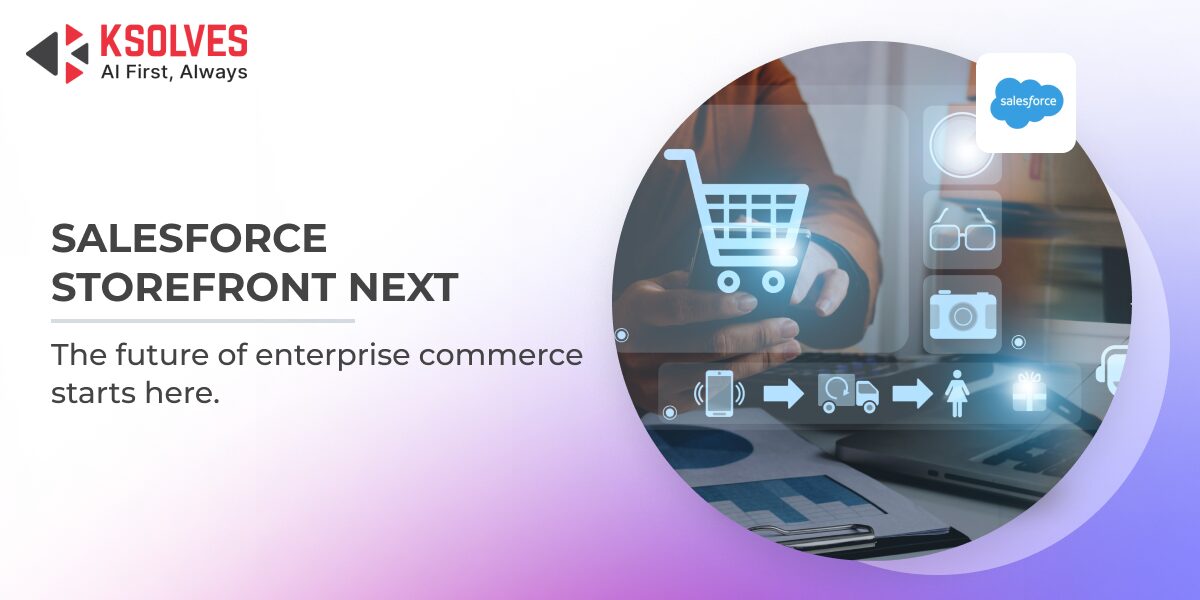
Salesforce has officially introduced Storefront Next, an open-source, headless storefront built on Next.js 14+, and it signals the end of the road for legacy architectures like SFRA and the original PWA Kit. For retail and ecommerce leaders, this is not just another platform update; it is a shift in how enterprise commerce gets built, deployed, and scaled.
Storefront Next (also referred to as Composable Storefront or PWA Kit Next) is Salesforce’s officially supported, open-source headless storefront reference implementation, and it replaces the legacy Storefront Reference Architecture for teams moving toward a composable commerce approach.
This guide breaks down what Storefront Next actually changes, backs it up with data on why the shift to online retail makes this decision urgent, and lays out who should be paying attention right now.
Why the Timing Matters
Retailers are not choosing between architectures in a vacuum but are responding to a structural shift in where sales actually happen. Harvard Business Review’s research on U.S. retail chains found that online retail sales grew from 7.4% of total retail sales in the fourth quarter of 2015 to 16.4% by the third quarter of 2025, more than doubling their share of the market in a decade defined by store closures, supply shocks, and a wave of bankruptcies among major chains.
The same research points to a clear pattern among the retailers that survived and grew: they shifted hard toward online and priced to win digitally once store growth slowed.
That backdrop is exactly why the storefront layer matters so much right now. A platform built on scheduled deployments and tightly coupled front ends cannot keep pace with a market where digital is no longer the secondary channel; it is often the growth engine. Storefront Next is Salesforce’s answer to that pressure, built specifically for the performance, flexibility, and speed that a much larger online audience now expects. For a closer look at how Salesforce supports retail-specific operations beyond the storefront layer, see our guide to Salesforce for the retail industry.
How Storefront Next Stacks Up Against What Came Before
| Feature | SFRA | PWA Kit (Original) | Storefront Next |
|---|---|---|---|
| Rendering | Server-side ISML | Client-side React | React Server Components with hybrid SSR and SSG |
| Framework | B2C Commerce scripts | React and Express | Next.js 14+ |
| Routing | Controller-based | React Router | Next.js App Router |
| API Layer | SFCC internal APIs | Commerce SDK | Commerce SDK Isomorphic |
| Deployment | SFCC platform | Managed Runtime | Managed Runtime or any Node.js hosting environment |
| TypeScript Support | No | Partial | Yes, first-class support |
The leap from SFRA to Storefront Next is not incremental but a full modernization of the experience layer while keeping the robust enterprise backend of Salesforce Commerce Cloud fully intact. Readers who want the foundational rundown of what Commerce Cloud offers beyond the storefront layer can start with our guide to Salesforce Commerce Cloud benefits.
What Storefront Next Brings to the Table
A few capabilities stand out at launch. Merchants can go live with a full storefront, including template, hosting, APIs, and a GitHub repo, in under 30 minutes, and developers can accelerate builds further using the Agentic B2C Developer Toolkit, which integrates with AI coding assistants including Claude Code, GitHub Copilot, and Agentforce Vibes.
Storefront Next templates are benchmarked against Google’s Core Web Vitals, with product display pages loading 66% faster than Google’s recommended 2.5-second threshold, and the platform is built to withstand major traffic spikes like Black Friday and flash sales.
A new Commerce Apps Framework lets merchants install third-party solutions directly from Business Manager without custom development, with launch partners including Adyen, Avalara, Bazaarvoice, Stripe, and Zenkraft. Enterprise multi-site management is built in from day one, and out-of-the-box templates already ship with media galleries, variant selection, ratings and reviews, BNPL, and a streamlined checkout with embedded authentication.
The headless architecture also bridges the gap between low-code Page Designer workflows and pro-code development, bringing both into a single environment, and produces a codebase that AI tools can read, understand, and extend, which matters as agentic commerce becomes standard rather than the exception.
Who Should Be Paying Attention
Storefront Next is most relevant if you fall into one of these situations: you are currently running on SFRA, SiteGenesis, or an aging PWA Kit implementation; you are replatforming away from a competitor like Shopify, Commercetools, or BigCommerce; you manage multiple brands or international storefronts that demand enterprise-level tooling; you are investing in AI-driven commerce and need a clean, unified data foundation to support it; or you are hitting performance and scalability limits on your current platform.
Traditional replatforming has always carried high costs, long timelines, and real risk, and Storefront Next is Salesforce’s answer to that problem, a faster, lower-cost path to enterprise capability backed by an open-source template and an active partner network.
Planning the Move with the Right Partner
A migration like this touches front-end architecture, developer workflows, third-party integrations, and multi-site governance all at once, which is exactly where experienced Salesforce consulting services make the real difference between a clean rollout and a stalled one.
As a Salesforce Summit partner and an AI-first company, Ksolves has worked across Agentforce Commerce Implementation for years and can help you assess whether your current SFRA or PWA Kit setup is ready for Storefront Next, plan a phased migration that protects live traffic, and build a storefront designed to work with AI tools rather than around them.
Conclusion
Storefront Next is not a routine platform refresh; it is Salesforce’s response to a market where online retail keeps taking a bigger share of overall sales and where AI-native tooling is becoming a baseline expectation rather than a bonus. Whether you are migrating away from a brittle monolith or upgrading an aging SFRA stack, the pilot results are strong, and the ecosystem is moving quickly.
If you are thinking about a migration or a new build, Ksolves Salesforce consulting services can help you start that conversation and get the architecture right from day one. Connect with our Salesforce experts today or send us your query at [email protected].


 Rakesh Kumar