Project Name
Patroni PostgreSQL Automated Failover Delivered for a Global Financial Platform


A leading global financial platform processing critical real-time transactions had built its database infrastructure on a traditional primary-replica PostgreSQL setup, an architecture that demanded manual, middle-of-the-night DBA intervention every time a node failed, and exposed the business to split-brain data corruption risks and region-wide outages with no viable disaster recovery path. Operating in the Financial Services and Fintech industry, where every second of downtime translates directly to failed transactions and SLA breaches, the legacy setup had become a structural liability. The organisation engaged Ksolves to modernise its PostgreSQL architecture by transitioning to a Patroni-managed, highly available multi-DC cluster – designed to achieve 99.999% uptime, survive full data centre failures, and shift from reactive database administration to a proactive, self-healing infrastructure with zero manual intervention during outages or maintenance.
- Manual DBA Intervention Breaking SLAs: Legacy primary-replica setups required manual, middle-of-the-night DBA intervention during every node failure. This reactive approach consistently broke stringent SLAs, consumed critical engineering resources, and created unacceptable operational risk for a platform processing real-time financial transactions around the clock.
- Split-Brain Risk From No Distributed Consensus: Network partitions frequently risked data corruption through split-brain scenarios because the legacy setup had no distributed consensus system. Without a mechanism to guarantee a single authoritative primary, any network partition could result in two nodes simultaneously accepting writes, corrupting transaction records.
- No Secondary DC Standby for Disaster Recovery: The absence of a synchronised standby cluster in a secondary data centre meant a region-wide outage could halt operations entirely. There was no promotion-ready replica capable of absorbing production traffic, leaving the business with no viable DR path for a full DC failure.
- High Operational Overhead From Manual Traffic Rerouting: Routing application traffic during outages required complex DNS changes and manual load balancer updates, amplifying the blast radius of every incident, adding significant time to recovery, and locking up engineering capacity on repetitive operational toil.
- Multi-DC Synchronisation Without Performance Impact: Establishing a geographically distinct, highly available standby cluster that maintained regional fault tolerance while not impacting primary DC performance required careful replication topology design across two independent Patroni-managed clusters.
- Zero-Downtime Maintenance Across Live Transactions: The legacy architecture required scheduled maintenance windows and incurred downtime during upgrades and switchovers. The business needed rolling upgrades and database switchovers to be executed safely with zero service interruption to live transaction processing.
Ksolves engineered a complete transition from the client's legacy PostgreSQL primary-replica architecture to a Patroni v2.1.0-managed, highly available multi-DC cluster running PostgreSQL v14.0 across 6 nodes built on dual etcd consensus clusters, cross-DC cascading replication, and intelligent HAProxy traffic routing. The governing principle was self-healing by design: every layer was architected so the cluster detects, responds to, and recovers from failures automatically, without human intervention, at any hour, across any failure scenario.
- Automated Leader Election via Patroni and etcd: Patroni v2.1.0 was deployed with dual etcd clusters (3 nodes each, one per DC) as the distributed consensus backbone - guaranteeing a single authoritative primary at all times and automatically promoting the most eligible replica in under 30 seconds. Inter-DC consensus synchronisation eliminates split-brain under any network partition scenario, entirely removing the need for manual DBA intervention during node failures.
- Multi-DC Standby Cluster With Cascading Replication: A fully synchronised standby cluster was established in DC2 using Patroni's cascading replication, synchronous streaming replication within each DC and asynchronous cross-DC replication for disaster recovery. DC2 maintains a promotion-ready state at all times, delivering an RTO of minutes for a full primary DC failure, a DR capability the legacy architecture could not provide.
- Dynamic Traffic Routing via HAProxy REST API: HAProxy was integrated with Patroni's REST API health checks to automatically route write traffic to the current primary and read-only traffic to replicas across both DCs, with no application-side changes required. Post-failover traffic redirection is fully automatic, eliminating the manual DNS changes and load balancer updates that previously extended every outage.
- Zero-Downtime Rolling Maintenance: Patroni's automated control commands were configured to enable zero-downtime rolling upgrades and database switchovers with no scheduled maintenance windows. Planned operations that previously required downtime are now executed transparently against live transaction traffic with zero service interruption.
- Proactive Observability Across All Nodes: A real-time monitoring stack was deployed covering node health, replication lag, leader election events, and failover logging across all 6 PostgreSQL nodes and both etcd clusters, replacing reactive incident management with continuous, proactive visibility into cluster state across both data centres.
Technology Stack
| Category | Technology |
|---|---|
| HA & Failover | Patroni v2.1.0 |
| Database | PostgreSQL v14.0 |
| Consensus | etcd (3-node per DC) |
| Proxy & Routing | HAProxy + Patroni REST API |
| Observability | Cluster Monitoring Stack |
- 99.999% Uptime Achieved: The Patroni-managed multi-DC cluster sustains five-nines availability, a target that was architecturally impossible on the legacy primary-replica setup and is now met automatically without any dependence on human response speed during incidents.
- Failover Completed in Under 30 Seconds: Node failures that previously demanded manual middle-of-the-night DBA intervention are now handled entirely by Patroni in under 30 seconds. Engineering teams are no longer on-call for database incidents, and SLA commitments are met automatically at any hour.
- Split-Brain Incidents Reduced to Zero: The dual etcd consensus clusters guarantee a single authoritative primary at all times across both DCs. Split-brain data corruption risk has been structurally eliminated - zero split-brain incidents recorded since go-live.
- 100% SLA Adherence Sustained: Sub-30-second automated failover, dynamic HAProxy traffic routing, and zero-downtime rolling maintenance combined to deliver 100% SLA adherence post-deployment, replacing a reactive, breach-prone model with a fully self-healing operational state.
- Enterprise-Grade DR Delivered With Minutes RTO: The synchronised DC2 standby cluster means a complete primary data centre failure no longer halts operations. DC2 promotes automatically with an RTO of minutes, delivering disaster recovery capability that simply did not exist on the legacy architecture.
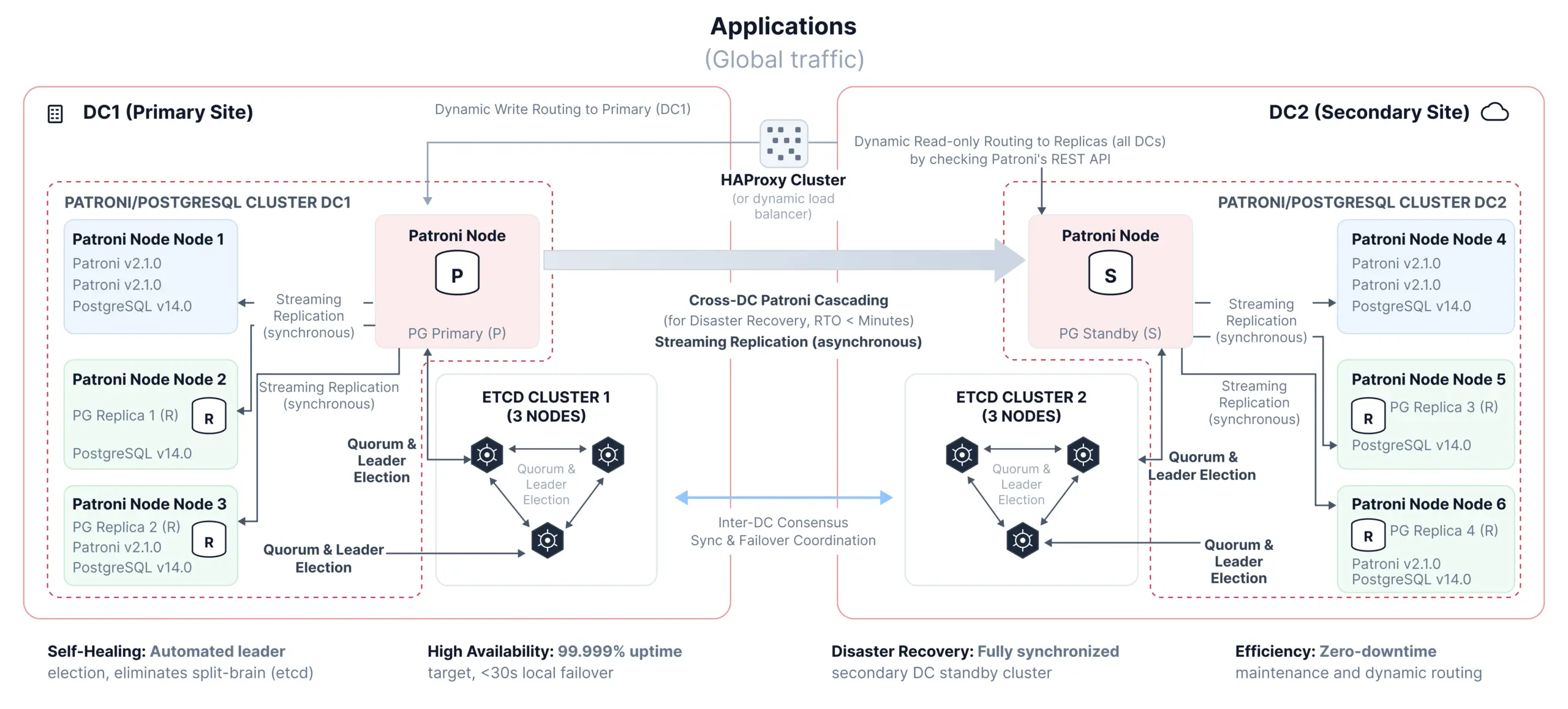
A global financial platform running a legacy PostgreSQL primary-replica setup, plagued by manual DBA intervention, split-brain risk, no disaster recovery path, and chronic SLA breaches, was transformed into a fully self-healing, multi-DC high availability cluster by Ksolves. Deploying Patroni v2.1.0 with dual etcd consensus clusters, synchronous multi-DC replication, and HAProxy dynamic traffic routing, the platform now sustains 99.999% uptime, executes failovers in under 30 seconds, and has recorded zero split-brain incidents and 100% SLA adherence since go-live. With zero-downtime rolling maintenance, replacing scheduled windows, and DC2 providing minutes-RTO disaster recovery, the client’s database infrastructure is now as resilient as the real-time financial transactions it serves.
Running a PostgreSQL Setup That Still Depends on Manual Failover?