Project Name
99.9% Database Uptime for a Data Analytics Firm Using PostgreSQL Streaming Replication


The client is a mid-size data analytics firm based in India, specialising in large-scale data processing and business intelligence for enterprise customers. Operating on bare-metal infrastructure, the organisation manages multiple PostgreSQL databases supporting real-time analytics pipelines and reporting dashboards.
With a growing client base and increasing data volumes, the company needed to ensure uninterrupted database availability without a full cloud migration.
The engagement was driven by a single imperative: eliminate single-point-of-failure risk and establish a reliable high-availability architecture on the hardware already in place.
One database instance, no replication, and no safe path to maintenance, every operational decision carried an availability risk.
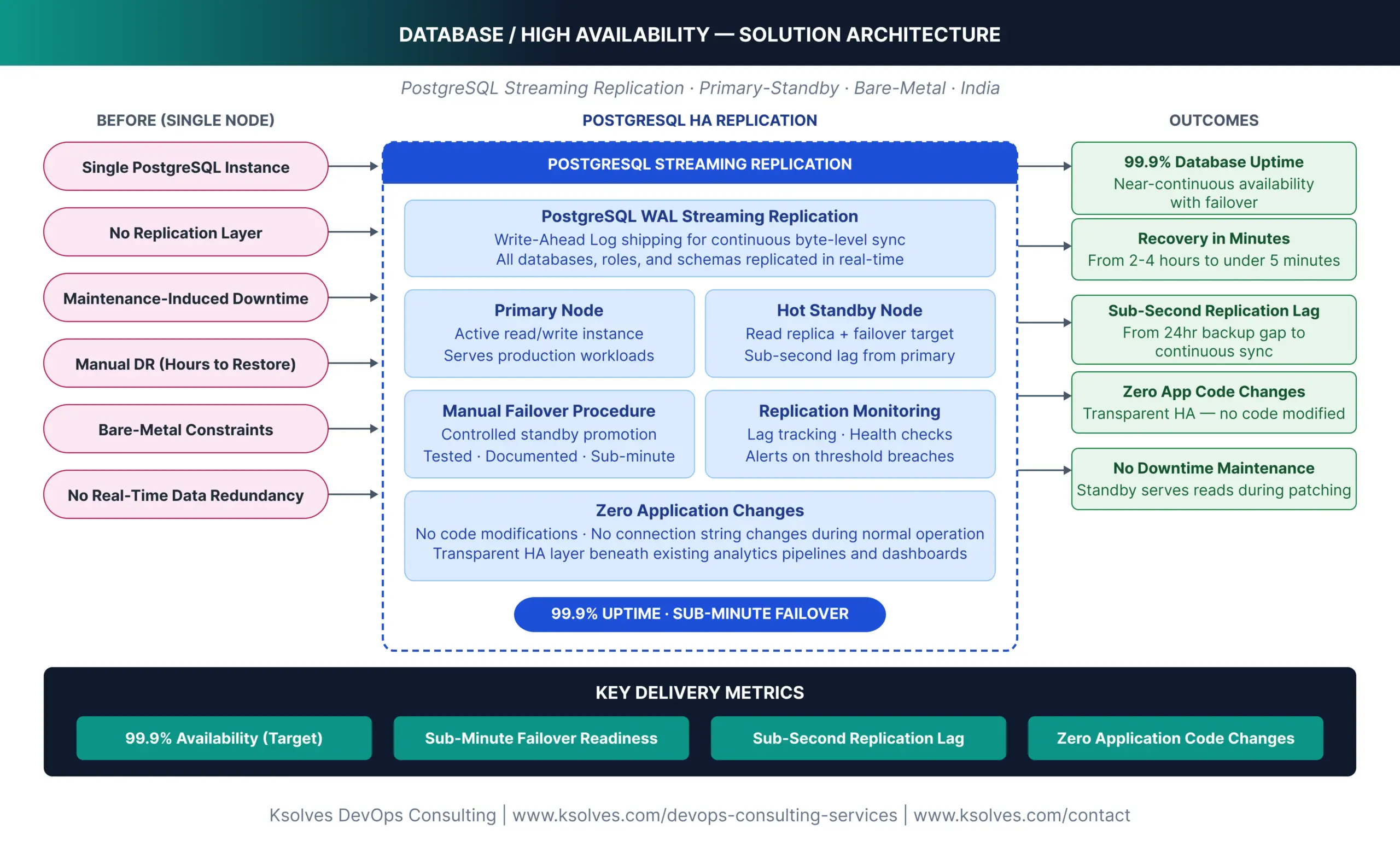
- Single Point of Failure: The entire analytics platform depended on a single PostgreSQL instance. Any hardware or software failure would halt all downstream processing, client-facing dashboards, and active analytics pipelines simultaneously, with no fallback.
- No Replication Layer: Databases, user roles, and table structures had no synchronised copy anywhere. Recovery from any failure required full restoration from backups, adding hours of downtime with no guaranteed recovery point.
- Maintenance-Induced Downtime: Routine PostgreSQL upgrades, patches, and vacuum operations required taking the primary database offline, directly impacting production analytics workloads and client deliverables every time.
- Manual Disaster Recovery: In the event of failure, recovery was entirely manual, requiring DBA intervention to restore from the most recent backup, with no defined RTO and no way to bound the data loss window.
- Bare-Metal Constraints: Cloud-native HA solutions were not viable due to existing bare-metal infrastructure commitments, requiring a replication strategy that delivered enterprise-grade availability entirely within on-premises hardware.
- No Real-Time Data Redundancy: Critical analytics data existed in only one location, creating business continuity and compliance risks for the organisation and the enterprise clients depending on its dashboards.
Ksolves, an AI-first DevOps consulting company, designed and deployed a PostgreSQL high-availability architecture using native streaming replication across two bare-metal nodes. The governing principle was zero disruption to existing application code: by leveraging PostgreSQL's built-in WAL shipping to maintain a synchronised hot standby at all times, the entire replication layer operates transparently beneath existing analytics pipelines.
- PostgreSQL Streaming Replication: Configured WAL-based streaming replication between primary and standby nodes, ensuring continuous real-time synchronisation of all databases, user roles, and table structures, eliminating the single-point-of-failure risk that had exposed the platform to complete outage on any hardware failure.
- Primary-Standby Hot Standby Architecture: Deployed a dedicated standby server on a second bare-metal node, running as a hot standby capable of serving read queries during normal operation while replicating writes from the primary in near-real time.
- Manual Failover Procedure: Implemented a documented, tested failover procedure allowing the operations team to promote the standby to primary within minutes, replacing the previous hours-long backup restoration process with a controlled, repeatable promotion workflow.
- Replication Monitoring and Alerting: Configured replication lag monitoring and health checks to ensure the standby remained continuously synchronised, with alerts triggering when lag exceeded defined thresholds, giving the team real-time visibility into replication health before any incident occurred.
- Zero Application Changes: Designed the replication layer to operate transparently beneath existing analytics pipelines, requiring no code modifications, connection string changes during normal operation, or schema restructuring across any of the platform's workloads.
Technology Stack
| Category | Technology |
|---|---|
| Database | PostgreSQL |
| Architecture | Streaming Replication (WAL) |
| Infrastructure | Bare-Metal Servers (2 Nodes) |
| Methodology | Primary-Standby HA Pattern |
| DevSecOps | Replication Monitoring |
From a single database instance with no fallback to a continuously synchronised hot standby on the same hardware, with zero application changes.
- Database Uptime Improved to 99.9% Availability: A hot standby with streaming replication now provides near-continuous availability with sub-minute failover readiness, replacing a single PostgreSQL instance that offered no recovery path on any hardware or software failure.
- Recovery Time Reduced From Hours to Under 5 Minutes: Manual failover promotes the synchronised standby to primary in under 5 minutes, replacing a full backup restoration process that typically took 2 to 4 hours, depending on dataset size.
- Replication Lag Maintained Under 1 Second: Streaming replication keeps the standby within a sub-second lag of the primary at all times, replacing a nightly backup model where the standby copy could be up to 24 hours stale at the point of failure.
- Zero Application Code Changes Required: The replication layer operates transparently beneath all existing analytics pipelines. Zero lines of application code were modified across the entire platform, with no connection string changes or ORM reconfiguration needed.
- Maintenance Windows Eliminated for Routine Operations: The standby node handles read traffic during primary maintenance, reducing client-visible downtime to zero for routine PostgreSQL patches, upgrades, and vacuum operations that previously required scheduled outages.
A single PostgreSQL instance serving as both the production engine and the sole copy of all analytics data is not an architecture problem; it is a business continuity crisis waiting for a trigger. This organisation had no replication, no tested failover procedure, and no way to perform routine maintenance without taking production offline. Ksolves, an AI-first DevOps consulting company, resolved all three without touching a line of application code. Streaming replication now keeps a hot standby synchronised within sub-second lag on dedicated bare-metal hardware, failover is a controlled procedure that completes in minutes, and routine maintenance no longer means a client-visible outage.
Need to Eliminate Single-Point-of-Failure Risk from Your On-Premises Databases?